What if a single ocean scene could turn children’s excitement about marine life into meaningful #counting, visual-scanning, and science learning? No Such Thing as Boring Math  Buy Now $24.00 helps providers connect intentional play with mathematical concepts, giving you a stronger foundation for extending the Ocean Animal I Spy resource beyond a worksheet.
Why does an ocean-themed search activity matter?
Young children often approach mathematics through playful investigation. When they search for hidden fish, crabs, turtles, or other animals, they are not merely completing a page; they are coordinating attention, comparing visual information, counting objects, and representing what they find. The ocean theme adds a compelling context for these skills because marine animals vary in shape, color, size, body structure, and habitat.
The Ocean Animal I Spy Buy Now $1.49 resource invites children to locate each animal, count how many appear, write the corresponding number, and color the pictures. This sequence integrates observation, fine-motor practice, early numeracy, and science vocabulary in a manageable format for preschool, pre-kindergarten, and kindergarten settings.
It also gives educators useful opportunities to notice individual learning strategies. One child may scan systematically from left to right, while another may jump between interesting details and lose track of previously counted animals. Both responses provide information that can guide supportive teaching rather than comparison or correction.
How does visual scanning support early learning?
Visual scanning is the ability to search a visual field in an organized way. It contributes to tasks such as locating a symbol on a page, finding a familiar object in a busy environment, matching pictures, and later attending to print. An I Spy activity naturally encourages children to look closely and distinguish relevant details from background information.
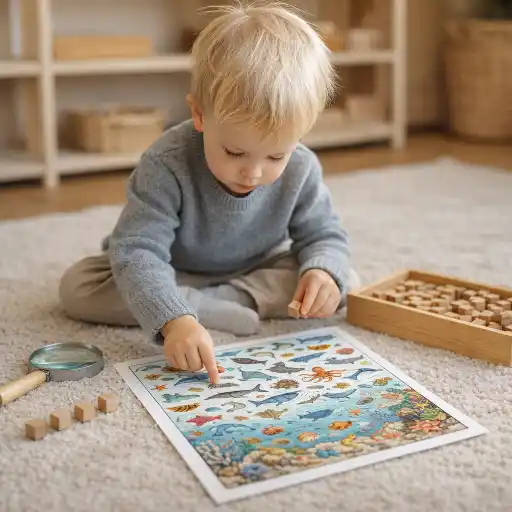
Before beginning, model a calm scanning strategy: “I will start at the top and move across. Then I will look down to the next row.” This think-aloud makes an invisible cognitive process visible. Children do not need to use the same strategy every time, but they benefit from learning that searching can be intentional rather than rushed.
- Invite children to point to an animal before counting it.
- Encourage them to mark or cover each animal after it has been counted.
- Ask, “Where will you look next?” to promote planning.
- Offer enlarged or simplified images when a busy page is overwhelming.
- Allow children to work with a partner who can support visual attention and language.
These adaptations are especially helpful for children who experience visual fatigue, attention differences, motor challenges, or language-related barriers. The goal is participation and meaningful observation—not speed.
How can providers turn counting into mathematical reasoning?
Counting becomes more meaningful when children connect number words to quantities. During Ocean Animal I Spy, encourage one-to-one correspondence by having children touch or point to each animal once as they say a number. After counting, ask, “How many did you find altogether?” This supports cardinality—the understanding that the last number named represents the total set.
Extend the activity with questions that encourage comparison and prediction:
- “Which animal did you find the most?”
- “Which group has fewer?”
- “Are there more fish or more crabs?”
- “How many would there be if we found one more?”
- “Can you show that number with counters or your fingers?”
Concrete objects can make the page more interactive. Children might place one shell or ocean counter beside each pictured animal, build the quantity with linking cubes, or record findings on a simple class chart. These representations help children move between seeing, saying, touching, and writing numbers.
Use the course Early Mathematics Through Play Buy Now $24.00 to deepen staff understanding of number sense, patterns, measurement, and mathematical reasoning through hands-on classroom experiences. The course can help your team design follow-up invitations that move from counting practice toward explanation and problem solving.
How can the activity introduce ocean science without overwhelming children?
Ocean science with young children should begin with observable features and questions. After children locate an animal, invite them to notice what they can see: “Does it have fins, tentacles, a shell, or claws?” “Does it move by swimming, crawling, floating, or waving?” This approach builds classification and descriptive language without requiring children to memorize complex biological terms.
Connect the images to simple ideas about habitats and adaptations. An octopus has arms that help it interact with its environment. A crab has claws and a hard outer covering. A fish uses fins to move through water. Keep explanations accurate but brief, and return repeatedly to children’s observations.
Possible extensions include:
- Sort ocean animals by how they move.
- Compare animals with shells, fins, arms, or claws.
- Use blue fabric, blocks, and loose parts to construct an ocean habitat.
- Read a nonfiction picture book and revisit one animal from the I Spy scene.
- Invite children to draw an animal and dictate one fact or question.
For broader professional preparation, Basic Science in Early Childhood Buy Now $25.00 focuses on helping educators offer opportunities to explore, investigate, question, and experiment. This complements an I Spy activity by emphasizing inquiry rather than isolated factual recall.
How can teachers differentiate and assess learning?
Differentiation can occur through the number of animals presented, the amount of visual complexity, the type of response expected, and the level of adult support. Some children may count three or four animals with physical counters, while others may compare two groups or write numerals independently. Developmentally appropriate teaching begins with observation of what each child can already do.
Consider offering:
- 🦀 A smaller section of the page for children who need reduced visual load.
- Large counters or magnetic animals for tactile representation.
- Picture and word cards for children developing vocabulary or learning English.
- Partner counting, gesture prompts, or a number line.
- An extension challenge: “Can you find a different way to represent this quantity?”
Document specific behaviors rather than general impressions. For example: “Ava located six fish, touched each one once, and stated the total accurately.” Another note might read: “Mateo found the animals but skipped objects when counting; he benefited from covering each animal after touching it.” These observations can guide the next small-group experience.
For deeper observation and documentation strategies, explore Preschool Assessments & Observations Buy Now $24.00. State requirements vary - check your state licensing agency when determining how training or documentation should be used in your program.
What are practical next steps for classroom teams?
Directors and teachers can use Ocean Animal I Spy as the first step in a short, integrated learning sequence. Begin with the printable search activity, then revisit the same animals through manipulatives, books, movement, and discussion. Repetition across contexts helps children transfer concepts rather than treating the activity as a one-time task.
- Plan one objective: for example, one-to-one correspondence, visual scanning, comparison, or animal vocabulary.
- Prepare materials: the I Spy page, counters, writing tools, ocean pictures, and a few books or props.
- Model the process: demonstrate scanning, counting, and recording without taking over.
- Ask reasoning questions: invite children to explain how they know.
- Document one observation: record a strategy, strength, or next step for each child.
For classroom planning that intentionally connects math and literacy while considering individual needs, Letter & Number Planning in Child Care Buy Now $24.00 is another relevant professional-learning option. It can help educators organize playful experiences around developmental goals.
Conclusion: How can Ocean Animal I Spy combine three important learning domains?
Ocean Animal I Spy combines counting, visual scanning, and ocean science by asking children to search carefully, quantify what they see, and talk about the animals represented. Its value increases when adults model organized observation, support one-to-one correspondence, use comparison language, and connect pictures to real scientific ideas.
The resource is intentionally simple, but it can support sophisticated teaching. Use it as a starting point for inquiry, not as an endpoint. Add counters, movement, classification, books, habitat construction, and brief observation notes. With responsive scaffolding, children can experience mathematics and science as connected ways of making sense of a fascinating world.
Frequently asked questions
What ages are appropriate for Ocean Animal I Spy?
It is well suited to preschool, pre-kindergarten, and kindergarten learners, with adjustments to the number of animals, visual complexity, and recording expectations.
Should children write the numbers independently?
Not necessarily. Children may point, use counters, select numeral cards, trace, dictate, or write, depending on their developmental readiness.
How can I avoid turning the activity into a worksheet drill?
Keep the conversation active, use manipulatives, invite movement and sorting, and connect the pictured animals to books and real-world science questions.
What if a child struggles to scan the page?
Reduce the visual field, cover unused sections, use a pointer or transparent window, and model a left-to-right or top-to-bottom search pattern.
How can directors support staff implementation?
Choose one shared math or science goal, provide common materials, and use short team reflections to discuss children’s strategies and possible extensions.
Related ChildCareEd courses:
- Early Mathematics Through Play
- CDA Subject Area 2
- Tomorrow's Einsteins: Infant and Toddler Science
- No Such Thing as Boring Math
- Connections That Count: Building Relationships in Child Care
- Texas Director Credential
- Montessori Cultural Activities: Exploring the World Through Play and Learning
- Enhancing STEM Education for Infants and Toddlers
- Shoo, Germs! Don't Bother Me!
- 💛🧩 ¿Cómo puedo hacer que mi enseñanza sea inclusiva para los niños con autismo?
- 📖 ¿Cómo puedo hacer que la hora del cuento sea la parte más poderosa de mi día?
- 👶 ¿Cuáles son las proporciones y grupos requeridos en Dakota del Norte? 🏫
- 🚌❄️ Ideas de excursiones en Dakota del Norte
- Recursos en Español sobre el Sueño Seguro del Bebé
- Capacitación en Salud y Seguridad Preventiva en Línea para Proveedores de Cuidado Infantil
- Cómo Empezar una Guardería en Casa: Requisitos y Pasos
- Proporciones de Cuidado Infantil y Tamaños de Grupo por Edad en Nueva Jersey (Guía Rápida para Centros y Hogares)
- Proporciones de Cuidado Infantil y Tamaños de Grupo por Edad en Virginia (Guía Rápida para Centros y Hogares)
- Lista para Guardería en Casa en Illinois: Cómo Iniciar una Guardería en el Hogar
- Lista para Guardería en Casa en Texas: Cómo Iniciar una Guardería en el Hogar
- Cómo Trabajar en el Cuidado Infantil en Wisconsin: Requisitos y Pasos
- Las Mejores Ideas de Excursiones para Guarderías en Dakota del Norte
- Las Mejores Ideas de Excursiones para Guarderías en Georgia
- Celebrando la amistad en el cuidado infantil durante el Día de los Mejores Amigos
- Canciones, juegos y preguntas de círculo para niños
- Cómo simplificar la capacitación para sus empleados de daycare
- ¿Demasiado inquietos para sentarse? Actividades de movimiento de otoño que les encantarán a los niños pequeños
- How Do Classification Questions Build Marine Science Vocabulary?
- How Can Ocean Animal I Spy Combine Counting, Visual Scanning, and Ocean Science?
