When children can anticipate a repeated sentence, they have more attention to notice the word, picture, and idea changing on each page. Pairing predictable text with shape exploration gives providers a practical way to build early reading confidence and geometric vocabulary; the Language and Literacy Foundations in Pre-K  Buy Now $16.00 course offers focused professional learning in everyday language and emerging-literacy strategies. For more guided practice with interactive books and stories, consider Reading Aloud and Storytelling Buy Now $16.00 as a complementary next step.
Why does predictable text help children learn shapes?
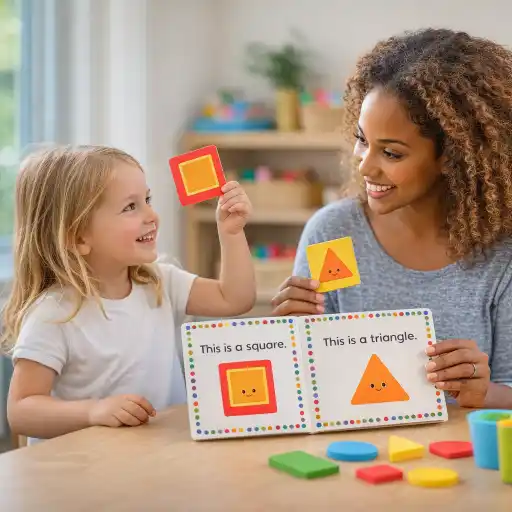
Predictable text uses a repeated pattern, such as “I see a ___,” with one or more words or images changing across pages. Young children quickly recognize the refrain and can join in through speech, gesture, pointing, or AAC. That participation makes a book feel manageable while keeping attention on meaning: the sentence remains familiar, but the shape named or pictured changes.
Repetition is most useful when it connects print to something children can see and discuss. As an educator reads “I see a circle,” the child hears the target word, views its printed form, and matches it to an illustration. The concepts of print guidance explains that shared reading can help children notice that print carries a message and that words and images have related but distinct roles. In this activity, a printed shape word labels the idea; it is not the shape itself.
Shape language also supports reasoning. Children compare, classify, notice features, and explain their thinking. The repeated frame creates room for these conversations without requiring a long lesson. Instead of testing children, use the familiar text to invite a response: “What do you notice?” or “Where have you seen one like this?” The aim is meaningful #language and concept-building in an enjoyable reading routine.
How can providers make a predictable shape reader interactive?
A short emergent reader can anchor a read-aloud, a small-group experience, or a take-home connection. ChildCareEd’s Emergent Readers - Shapes Buy Now $1.75 is a seven-page printable featuring the repeated sentence “I see a…” alongside coloring pages for a circle, square, triangle, star, and heart, plus a review page. Its simple format can be used for shared reading, coloring, and revisiting shape words over several days.
Keep the reading warm and participatory. First, read the book aloud to enjoy the pictures and establish the refrain. On another reading, pause before the shape word so children can supply it, point to the illustration, or choose a matching object. The Victorian guidance on reading with children describes how educators can model and scaffold reading, then invite children to take a more active role as familiarity grows.
- Point to the text as you read, without turning every page into a letter lesson.
- Ask children to find the pictured shape in the room or on their clothing.
- Invite children to color, draw, dictate, sign, or select a matching shape card.
- Reread on later days; familiarity gives more children a chance to participate.
- 📚 Celebrate attempts and observations, not just correct labels.
Adults can model precise vocabulary while honoring children’s contributions: “You noticed something round. This picture shows a circle.”
How can educators move from naming shapes to understanding them?
Shape knowledge develops through repeated encounters, not one-time memorization. After children hear a shape name in the reader, let them handle, build, draw, sort, and locate examples. Start with a small selection of two-dimensional shapes, then extend toward features such as straight or curved sides and corners as appropriate for the group.
Connect the predictable sentence to concrete investigations. After “I see a square,” children might search for a square tile, make one with craft sticks, or compare it with a rectangle. Rotate and turn shapes so children learn that orientation does not change the shape. Encourage explanations rather than relying on appearance alone: “What do you notice about the sides?”
- Offer large foam or paper shapes for tracing, touch, and movement.
- Use blocks or loose parts to create shapes and pictures.
- Invite a classroom shape hunt, then make a shared chart of discoveries.
- Ask open prompts: “How are these alike?” “What could you make with two triangles?”
Picture books and conversation can support both math and language; the DREME discussion of math in storybooks describes how stories can create opportunities to explore mathematical ideas alongside language. Keep the focus playful. A child may show understanding by building or pointing before they can say the formal name. Notice and affirm those signs of developing #thinking.
How can the routine include multilingual learners and different abilities?
A predictable refrain can lower the language demand of joining a group, while pictures, objects, and gestures make meaning easier to access. Invite children to share a shape word in a home language as well as English when they wish; families may help you learn accurate words and pronunciations. Multilingual expression is an asset, not a detour from the learning goal.
Offer more than one way to participate. A child might say the word, point to a picture, choose between two objects, trace an outline, sign, or use an augmentative communication system. Provide tactile shapes, high-contrast images, larger print, fewer choices, or extra wait time when these supports help a child engage. Avoid assuming that limited spoken English means limited understanding of shape concepts.
Keep the book and activity open-ended enough for different starting points. Some children may match a circle to a picture; others may describe its curved edge or find circles in several classroom areas. The NAEYC discussion of collaborative language and literacy learning emphasizes intentionally embedding language goals in meaningful content and play. Use the repeated text as a shared structure, then follow the children’s interests and forms of communication.
- Pair spoken words with real objects, photos, gestures, and clear labels.
- Invite family vocabulary and avoid correcting accents or home-language forms.
- Adapt materials and response methods so every child can take part.
How can teams plan and notice learning without overtesting?
Choose one practical objective before introducing the reader. For example: “Children will communicate the names of two familiar shapes,” or “Children will describe one feature of a shape.” Keep the objective flexible enough to count speech, pointing, matching, building, signing, or drawing as meaningful evidence when appropriate.
Use a simple cycle: read the text, invite children to explore related materials, observe what they do and say, and decide what to offer next. A brief note such as “Mina pointed to circles on the page and found one on a wheel” is more useful for planning than a worksheet score alone. Photos of constructions or dictated descriptions can also document children’s ideas—with program and family privacy practices followed.
Common pitfalls are easy to prevent: avoid rushing through many shape names, treating coloring as the whole lesson, or insisting that every child respond verbally. Keep the refrain short, revisit familiar words, and add hands-on exploration. Directors can support consistency by sharing the same target vocabulary across story time, blocks, art, and classroom labels. State requirements vary - check your state licensing agency when training or documentation requirements apply.
For educators who want a broader grounding in language-rich Pre-K practice, the ChildCareEd course Language and Literacy Foundations in Pre-K Buy Now $16.00 explores oral language, communication, vocabulary, and emerging literacy through everyday learning experiences.
Conclusion: How does predictable text reinforce shape concepts?
Predictable text reinforces shape concepts by giving children a familiar structure in which words, pictures, and ideas can be revisited and connected. A refrain such as “I see a…” supports participation, while a changing shape word invites children to notice, name, compare, and search their environment. The ChildCareEd Emergent Readers - Shapes Buy Now $1.75 resource offers an easy-to-use starting point with five familiar shapes and a review page.
Make the most of the text by pairing it with real objects, open questions, play, and responsive observation. Include home languages and multiple ways of communicating, and treat children’s efforts as evidence of learning. Keep experiences brief, joyful, and repeated across the day. This turns a simple reader into a meaningful bridge between early literacy, mathematical vocabulary, and children’s curiosity about the world around them.
Which ChildCareEd courses can support this work?
- Language and Literacy Foundations in Pre-K Buy Now $16.00 — strengthen practical understanding of language, communication, and emerging literacy.
- Reading Aloud and Storytelling Buy Now $16.00 — explore interactive reading practices that support vocabulary and comprehension.
- Science of Reading Foundations in the Pre-K Classroom Buy Now $16.00 — learn about foundational literacy areas including print knowledge and vocabulary.
- Building Vocabulary Buy Now $16.00 — consider strategies for intentional vocabulary learning across content areas.
- Assessment of Language and Literacy Skills Buy Now $24.00 — develop observation and documentation approaches for language and literacy growth.
- 45 Hour Child Growth and Development
- Roots & Resilience: Understanding What Shapes a Child
- Language and Literacy Foundations in Pre-K
- The ABCs of Behavior: Turning Challenges into Learning Opportunities
- Birth to Five CDA Credential with Portfolio Review
- Positive Attention: Interactions & Supervision for Infants & Toddlers
- Texas Director Credential
- Building Vocabulary
- Every Moment Matters: Schedules and Transitions
- CDA Certification en Español: Recursos y Consejos para Educadores Bilingües
- 👶 ¿Cuáles son las proporciones y grupos requeridos en Dakota del Norte? 🏫
- Cómo Escribir Mi Portafolio Del CDA
- Recursos en Español sobre el Sueño Seguro del Bebé
- Cómo ser director de cuidado infantil en Maryland
- 10 Ejemplos de Cómo la Cultura Influye en el Desarrollo Infantil
- Regulaciones de Licenciamiento de Cuidado Infantil en California para Centros y Hogares de Cuidado Infantil Familiar
- Reglas de Cuidado Infantil en Illinois
- Proporciones de Cuidado Infantil y Tamaños de Grupo por Edad en Maryland (Guía Rápida para Centros y Hogares)
- Proporciones de Cuidado Infantil y Tamaños de Grupo por Edad en Virginia (Guía Rápida para Centros y Hogares)
- Cómo Trabajar en el Cuidado Infantil en Carolina del Norte: Requisitos y Pasos
- Cómo Ser Maestra de Preescolar en Illinois
- Cómo Ser Maestra de Preescolar en Wisconsin
- Cómo Ser Maestra de Preescolar en California
- Cómo Ser Maestra de Preescolar en Maryland
- Celebrando la amistad en el cuidado infantil durante el Día de los Mejores Amigos
- Canciones, juegos y preguntas de círculo para niños
- Cómo simplificar la capacitación para sus empleados de daycare
- How Can Printable Books Help Preschoolers Fall in Love With Reading?
- How Can Predictable Text Reinforce Shape Concepts in Preschool?
