Transportation words invite children to connect print with the vehicles they see, hear, and play with every day. Use a vehicle word search as a playful starting point, then extend the learning with Assessment of Language and Literacy Skills  Buy Now $24.00 to strengthen your observation and planning around children’s emerging literacy. This course offers practical guidance for documenting language and literacy development and turning observations into meaningful learning goals.
Why connect transportation vocabulary with early literacy?
Children often arrive with strong interests in familiar vehicles: a bus rumbling by, a train on a storybook page, or a toy truck in the block area. These everyday points of curiosity provide an authentic context for learning new words. A transportation theme can introduce names such as bus, bicycle, helicopter, submarine, and tractor while inviting children to talk about what each vehicle does and where it travels.
Vocabulary, speaking, listening, print awareness, and early writing are related parts of emerging literacy. Head Start describes language and literacy as connected developmental domains, including vocabulary, phonological awareness, print knowledge, comprehension, and writing. A word search can contribute when it is one piece of a broader experience—not a stand-alone spelling drill.
Keep the emphasis on curiosity and shared meaning. Ask children what they already know, introduce one or two new words, and connect the words to toys, photos, books, or local transportation. Some children may know a vehicle in a home language before learning its English name; that knowledge is an asset and a bridge to new vocabulary.
The goal is not for every preschooler to spell every vehicle independently. Instead, invite children to notice letters, hear word sounds, recognize familiar word shapes, and confidently use new words in conversation.
What literacy skills can a vehicle word search support?
A word search asks children to scan a letter grid and locate a written word. With adult support and suitable expectations, the activity can prompt attention to letters, visual patterns, and left-to-right tracking. Talking about the words adds oral language practice, while copying or attempting to write a chosen word can create an early-writing opportunity.
Transportation puzzles commonly include vehicle names such as bus, train, car, boat, truck, airplane, bicycle, and helicopter. The range makes it easy to compare words: “Bus is short; helicopter has many letters.” Children can match a word to a picture, identify its first letter, or listen for a beginning sound. These are useful entry points even when independent reading is not yet appropriate.
- Build and revisit #vocabulary by naming vehicles and describing their purposes.
- Draw attention to letters, word length, and familiar letter sequences.
- Encourage children to say a target word, listen to its sounds, and connect it to print.
- Support concentration and visual scanning in a calm, brief activity.
These benefits are strongest when educators model language and make the puzzle social. Research-based guidance from NAEYC emphasizes playful, interactive literacy, including conversation, read-alouds, writing, and meaningful print experiences. A word search can complement those practices when children can participate through pointing, speaking, matching, drawing, or writing.
How can providers introduce the activity in a developmentally appropriate way?
Start with real meaning before the grid. Show a toy vehicle or photograph, say its name clearly, and invite children to describe what they notice. Explain unfamiliar words in child-friendly language: “A submarine is a vehicle that travels underwater.” Then point out the written word and briefly model how you will look across the letters.
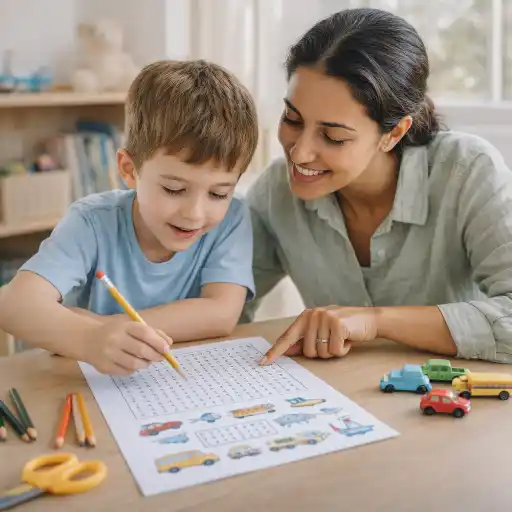
- Introduce two or three vehicles with toys, pictures, or a short book.
- Say each word together and explain its meaning through a simple description or action.
- Show one word in the grid and think aloud as you scan for its first letter.
- Invite children to find, point to, trace, or circle a target word—with help as needed.
- After each find, connect the print back to meaning: “We found train. Where have you seen a train?”
🚌 Let children take turns being the “vehicle expert,” sharing a fact, sound, or story about a word they find. This shifts the activity from quiet searching to meaningful communication and keeps children’s knowledge at the center.
Adapt the materials for access: enlarge the grid, provide a highlighter or pointer, use fewer words, or offer a picture-word matching version. For younger children, adults can locate the words while children identify pictures, letters, or vehicle names orally.
How can educators extend vocabulary and spelling beyond the puzzle?
Children build lasting word knowledge through repeated encounters in different contexts. After the search, add the target words to a classroom word display with a picture and, when appropriate, a child’s drawing. Revisit the words during read-alouds, block play, dramatic play, outdoor observations, or conversations about how families travel.
Extend spelling as exploration, not as a test. Invite children to notice the first letter, clap syllables in longer words, or compare word lengths. Model how you write a vehicle name while saying the word slowly; children can dictate, trace, copy, or make their own marks according to their developmental level. NAEYC highlights the value of modeling writing for real purposes and integrating literacy across classroom areas.
- Vehicle sort: Group picture cards by land, water, and air; encourage children to explain their choices.
- Sound hunt: Find vehicle names that start with the same sound, using objects or pictures as clues.
- Roadway writing: Add signs, labels, tickets, or simple maps to block and dramatic-play areas.
- Story connection: Read a transportation book and invite children to retell a journey using target words.
How can providers observe progress and include every child?
A word search offers a useful moment for observation, but it is not a formal assessment by itself. Notice what each child can do in context: name a vehicle, understand its meaning, recognize a letter, attend to a spoken sound, locate a word with support, or use the word in a sentence. Record brief, objective notes and use them to plan the next experience.
For example, a note might say, “During the vehicle puzzle, Jordan named bus and car from pictures and found the letter B after a verbal cue.” This describes observable behavior without making a broad judgment about ability. Compare observations over time and across activities, since children may show knowledge more readily in conversation or play than on a worksheet.
Make participation flexible and culturally responsive. Offer pictures, objects, gestures, verbal choices, larger print, adapted tools, or a partner. Invite children to share vehicle words in their home languages and work with families to learn accurate pronunciations. Head Start guidance emphasizes that language and literacy develop in any language, and that supporting a child’s home language can help prepare them for learning English.
If concerns about communication or literacy persist, document examples and follow program procedures for partnering with families and seeking appropriate support. Assessment should help educators individualize instruction—not label children. State requirements vary - check your state licensing agency.
What common pitfalls should educators avoid?
A word search may look simple, but the activity can become frustrating if the print task is out of step with a child’s developmental level. The aim is to create a welcoming invitation to notice words, not to measure worth or readiness through speed and accuracy.
- Expecting independent reading: Read words aloud, use picture cues, and accept pointing or matching as valid participation.
- Introducing too many unfamiliar terms: Teach a few words in context and revisit them across the day.
- Correcting every spelling attempt: Model conventional spelling warmly while valuing children’s ideas and early writing.
- Using the puzzle in isolation: Pair it with conversation, books, objects, and play so children connect print to meaning.
- Comparing children’s speed: Allow varied time and support; focus on individual engagement and growth.
Directors can help by ensuring staff have adaptable materials and a shared understanding of what to observe. A short planning conversation can identify target words, participation options, and a simple documentation focus before the activity begins.
Conclusion: How can a vehicle word search make literacy meaningful?
Transportation word searches can support vocabulary and early spelling when educators connect the printed words to children’s real experiences, model letter noticing, and invite discussion. Keep the activity short and flexible, choose a few useful vehicle names, and extend those words into books, dramatic play, sorting, drawing, and everyday conversation.
Most importantly, treat the puzzle as one opportunity to observe children’s strengths and interests—not as a test of independent reading. Offer multiple ways to participate, honor home languages, and use objective observations to guide what comes next. To deepen your practice, explore ChildCareEd’s Assessment of Language and Literacy Skills Buy Now $24.00 course, which focuses on observation, documentation, and developmentally appropriate learning goals.
- Understanding Print Knowledge in Preschool
- Appropriate Precautions in Transportation of Children
- Easy Steps to Resume and Interview Success
- The Subtle Teacher: Nonverbal Communication in the Classroom
- Money Matters in Medicine
- Pediatric RSV First Aid & CPR/AED
- Transportation and Field Trip Safety in the Early Childhood Environment
- Texas Director Credential
- Transportation Safety
- CDA Certification en Español: Recursos y Consejos para Educadores Bilingües
- 🔍 ¿Qué ves cuando observas a un niño aprender?
- 👶 ¿Cuáles son las proporciones y grupos requeridos en Dakota del Norte? 🏫
- Celebra El Cumpleaños de Dr. Seuss En Tu Guardería Con Actividades Fáciles y Divertidas!
- Cómo Trabajar en una Guardería Sin Experiencia en Cuidado Infantil
- Proporciones de Cuidado Infantil y Tamaños de Grupo por Edad en Nueva Jersey (Guía Rápida para Centros y Hogares)
- Proporciones de Cuidado Infantil y Tamaños de Grupo por Edad en Virginia (Guía Rápida para Centros y Hogares)
- Cómo Trabajar en el Cuidado Infantil en Wisconsin: Requisitos y Pasos
- Las Mejores Ideas de Excursiones para Guarderías en Dakota del Norte
- Las Mejores Ideas de Excursiones para Guarderías en Georgia
- Celebrando la amistad en el cuidado infantil durante el Día de los Mejores Amigos
- Canciones, juegos y preguntas de círculo para niños
- Cómo simplificar la capacitación para sus empleados de daycare
- Why Is Beginning-Sound Bingo a Smart Step Toward Reading?
- How Can You Teach Sight Words Through Games, Movement, and Play?
- How Does Word Sorting Build Phonics and Vocabulary Skills?
- How Can Holiday Word Games Strengthen Visual Scanning and Spelling?
- How Can Transportation Word Searches Build Vocabulary and Spelling Skills?
- Are Holiday Word Searches Suitable for Children Learning English?
