Small, thoughtful changes can turn everyday routines into real opportunities for every child to participate, connect, and learn. The ChildCareEd course Inclusive Lessons for Preschoolers  Buy Now $16.00 offers practical guidance for adapting materials and lesson plans; for a deeper look at individualized planning, explore Planning for Every Child: Responsive Strategies in Action Buy Now $55.00. Read on for strategies you can put into practice during play, meals, transitions, and group activities.
Why does inclusion in everyday activities matter?
Inclusion is not a separate event or a special activity reserved for certain children. It is the intentional work of making sure each child can access the classroom community, participate meaningfully, communicate, and build relationships. When children are welcomed as they are, they have more chances to explore, contribute, and experience themselves as capable members of the group.
For providers and directors, this work can feel challenging when children have different communication, sensory, mobility, attention, or learning needs. You do not need a separate lesson for every child. Often, modest changes to the room, materials, timing, or way a child responds are enough to make a shared activity more accessible.
Inclusive practice benefits the whole classroom. Visual cues, flexible seating, meaningful choices, and predictable routines may support children who need specific accommodations while also helping peers understand what to expect. These approaches nurture #belonging, peer connection, confidence, and participation. They also help educators notice children’s strengths instead of focusing only on barriers.
How can you adapt the space and daily routines?
Start by viewing the room and schedule from each child’s perspective. Can everyone reach the materials, move through the room, understand what happens next, and take a break when needed?
- Keep pathways clear, materials within children’s reach, and activity areas easy to identify.
- Use picture schedules, first-then cards, gestures, and brief verbal directions to make routines more predictable.
- Offer flexible seating and a calm area where a child can regulate without being excluded from the group.
- Give transition warnings and allow extra time when a child needs it to shift activities or complete a task.
- Make materials easier to handle with larger tools, non-slip mats, adapted grips, or pre-cut pieces when appropriate.
Keep supports practical and purposeful. Too many new visuals or tools at once can make a room harder to navigate, so introduce a small number consistently and observe how children respond. For more ideas, see ChildCareEd’s strategies for creating inclusive classrooms.
How do you make play and learning activities accessible to everyone?
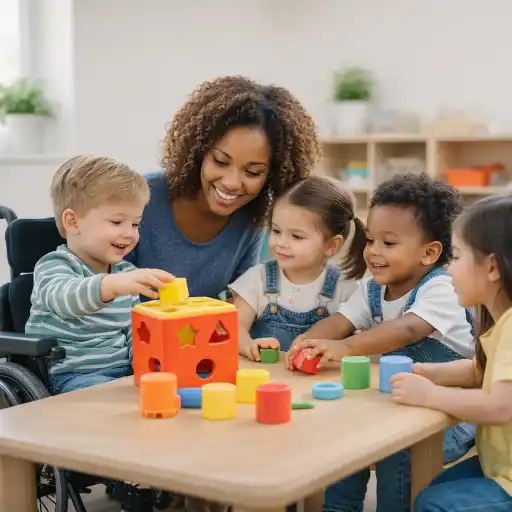
Begin with a shared learning goal, then offer different ways to take part. During a story, one child might answer aloud, another may point to a picture, and another may use a gesture or communication device. In an art project, children can select materials, use adapted tools, or work with pre-cut shapes while still making meaningful choices and creating their own work.
Consider whether the activity’s main purpose is getting lost in an unnecessary barrier. If children are exploring color, the goal need not depend on each child holding a thin brush. If the group is building together, children can take different roles: choosing pieces, directing where they go, stacking, or describing the structure.
- Offer choices: “Would you like to build with blocks or make a plan with pictures?”
- Break multi-step activities into manageable parts and model the first step.
- Use real objects, pictures, demonstrations, songs, or short phrases alongside spoken directions.
- Allow children to show what they know by talking, pointing, moving, drawing, building, or using assistive communication.
- Pair peers for shared play, while making sure the child receiving support still has agency and choice.
🌟 A child who participates differently is still participating fully when their actions and decisions matter. Keep the central idea shared, and adjust the route into it.
How can you support communication, sensory needs, and independence?
Children communicate in many ways: speech, facial expressions, movement, signs, pictures, and assistive devices. Notice how each child expresses interest, refusal, discomfort, or a request for help. Make sure communication supports are available throughout the day—not only during a planned lesson—and respond to a child’s communication as meaningful.
Sensory needs also vary. A child may benefit from reduced noise, a movement break, a familiar object, or a quiet place to reset. Other children may learn best through movement and hands-on exploration. Offer options without treating a child’s support as a reward or punishment. The aim is access, comfort, and participation, not compliance for its own sake.
Scaffold without taking over. Pause, observe, and offer the least intrusive support that helps a child continue: a visual cue, a choice, a model, a simplified step, or brief assistance with a tool. Then allow time for the child to act. The routine adaptation examples from Brookes Publishing describe ways to embed meaningful choices, communication, and peer interaction into block play, books, art, and circle time.
Keep brief notes on what supports engagement and what creates difficulty. Describe what you observe rather than assigning labels: “Pointed to the picture choice after I showed the card” is more useful than “would not participate.” These observations help your team choose next steps and celebrate growing #independence.
How can families, specialists, and staff work together?
Families know their children’s interests, routines, communication, and successful supports. Begin with strengths-focused questions: “What does your child enjoy?” “How do they let you know they need a break?” and “What helps them join a new activity?” Share specific positive observations and invite families to shape goals and strategies. Clear, respectful communication builds trust and can help keep supports consistent between home and child care.
When a child has an IFSP or IEP, collaborate with the family and relevant professionals, follow applicable plans, and seek guidance when classroom implementation is unclear. Specialists may demonstrate positioning, communication tools, or ways to adapt an activity. Protect confidential information and share details only with staff who need them to support the child.
Directors can make inclusion a team practice by allowing time for brief planning conversations, helping staff access focused professional development, and reviewing whether classroom routines offer meaningful participation.
- Agree on a few consistent strategies across the day, such as a visual transition cue or a communication board.
- Document what was tried, how the child responded, and what adjustment the team will consider next.
- Check that peer support remains respectful: encourage children to ask before helping and to honor one another’s choices.
What common pitfalls should providers avoid?
Well-intentioned educators can accidentally create barriers when they assume every child must participate in the same way or at the same pace. One common pitfall is expecting a child to adapt to a rigid activity rather than adapting the activity. Another is focusing on a diagnosis instead of observing the child’s interests, strengths, and current access needs.
Avoid singling children out unnecessarily. If a visual schedule, flexible seating, or choice of response can be offered to the whole group, it may feel like a normal classroom option rather than a special exception. At the same time, universal strategies do not eliminate the need for individualized accommodations. Follow relevant plans and collaborate when a child needs a particular support.
Other pitfalls include giving help too quickly, using only spoken directions, introducing too many tools at once, or describing a child only in terms of what is difficult. Instead, start with one manageable change, give the child time to respond, and notice what enables participation. Avoid assuming that a child is uninterested when the activity may be inaccessible, confusing, uncomfortable, or too demanding. A strengths-based approach keeps attention on the interaction between the child and the environment—and on what educators can change.
Use reflection as a practical tool: Who had a meaningful role today? Who spent most of the activity watching? What did a child communicate through actions or choices? One adjustment at a time helps the team learn without adding unnecessary complexity.
Conclusion: What is the first step toward everyday inclusion?
To include children with different abilities in everyday classroom activities, plan for variation, make routines and spaces accessible, offer several ways to participate, and treat communication in all its forms as important. Observe children’s strengths, adapt materials and expectations when a barrier appears, and scaffold without taking away their agency. Partner with families, specialists, and coworkers so supports are consistent and responsive.
Start with one routine this week—perhaps circle time, snack, or cleanup. Identify one barrier, try one practical adjustment, and note whether the child can participate more comfortably or independently. Inclusion grows through these small, thoughtful actions: children experience belonging, peers learn to collaborate, and educators develop a clearer picture of how to make shared classroom life work for #everyone.
For further professional learning, explore these English-language ChildCareEd courses:
- Tailoring Instruction to Children’s Needs Buy Now $24.00 — differentiation and scaffolding strategies.
- Special Needs: From Referral to Inclusion Buy Now $24.00 — understanding referrals, plans, and inclusion.
- Effective Approaches for Autism and Inclusion Buy Now $55.00 — classroom strategies for communication, materials, and sensory needs.
- Building Equity: Inclusionary Practices in Preschool
- The ABCs of Behavior: Turning Challenges into Learning Opportunities
- Moving About the Classroom: Effective Transitions for Everyday
- Pediatric RSV First Aid & CPR/AED
- Inclusive Lessons for Preschoolers
- CDA Bridge Bundle: Family Child Care without Portfolio Review
- CDA Bridge Bundle: Infant/Toddler without Portfolio Review
- CDA Bridge Bundle: Preschool without Portfolio Review
- Texas Director Credential
- Moving About the Classroom: Effective Transitions for Everyday
- Celebrate the Joy of Reading on National Book Lovers Day
- Mathematical Skill Development
- CDA Certification en Español: Recursos y Consejos para Educadores Bilingües
- 💛🧩 ¿Cómo puedo hacer que mi enseñanza sea inclusiva para los niños con autismo?
- Capacitación en Salud y Seguridad Preventiva en Línea para Proveedores de Cuidado Infantil
- Actividades de Fiesta para Niños de Preescolar y Primaria
- Proporciones de Cuidado Infantil y Tamaños de Grupo por Edad en Nueva Jersey (Guía Rápida para Centros y Hogares)
- Lista para Guardería en Casa en Illinois: Cómo Iniciar una Guardería en el Hogar
- Lista para Guardería en Casa en California: Cómo Iniciar una Guardería en el Hogar
- Lista para Guardería en Casa en Texas: Cómo Iniciar una Guardería en el Hogar
- Retraso del Habla en la Guardería: Cómo Pueden Ayudar los Proveedores
- Capacitación Previa al Servicio para Proveedores de Cuidado Infantil en Dakota del Norte
- How can we celebrate diversity and inclusion in California early childhood classrooms?
- How can childcare providers support fine motor development with simple activities?
- Diversity and Inclusion in Childcare: What Does It Look Like in Everyday Practice?
- How Can We Celebrate Every Family and Create a Classroom Where Everyone Is Represented?
- How Can Child Care Providers Build a Developmentally Appropriate Curriculum for Infants?
- How Can Child Care Providers Plan a Balanced Summer Learning Routine for Young Children?
- How Do You Include Children With Different Abilities in Everyday Classroom Activities?
