When a child becomes ill in group care, staff must protect the whole community while responding compassionately to one child and family. A clear, consistently applied process can reduce conflict, support sound decisions, and strengthen daily health practices; ChildCareEd’s Illness, Medication, and Allergies in Child Care  Buy Now $32.00 course offers focused training on recognizing illness, managing health concerns, and responding appropriately.
Why does a thoughtful exclusion policy matter?
Sick-child exclusion is not simply an administrative rule. It is a balance among the child’s comfort, the group’s health, staffing capacity, family circumstances, and applicable regulations. A policy that is too vague invites inconsistent judgments; one that is unnecessarily restrictive can burden families and encourage them to conceal symptoms.
Strong policies also protect professional relationships. Families are more likely to accept an exclusion decision when the program communicates expectations before illness occurs, applies the same criteria to every child, and provides clear return-to-care information. Remember that state requirements vary - check your state licensing agency.
Which symptoms generally require exclusion?
Programs should identify objective triggers in both the family handbook and staff procedures. The exact thresholds must align with state and local requirements, but common criteria include:
- Fever accompanied by behavior change or other concerning symptoms. CFOC identifies 100.4°F (38°C) or higher with behavior change as an exclusion concern; infants younger than two months with that temperature require immediate medical attention.
- Vomiting or diarrhea that is persistent, uncontrolled, bloody, or substantially above the child’s usual pattern.
- Difficulty breathing, unusual lethargy, or an inability to participate comfortably.
- A new rash with fever or behavioral change, draining sores that cannot be covered, or symptoms associated with a reportable disease.
- Any condition for which the child’s health professional or public health authority recommends exclusion.
Staff should not attempt to diagnose children. Instead, document what was observed and follow the written #policy. The American Academy of Pediatrics’ disease-specific reference sheets can help programs consult return-to-care information for conditions such as influenza, norovirus, conjunctivitis, and pertussis.
Not every runny nose or mild cough requires exclusion. A child who can participate comfortably and does not require care beyond the program’s capacity may remain, subject to current public-health guidance and program policy.
How should staff respond when a child becomes ill?
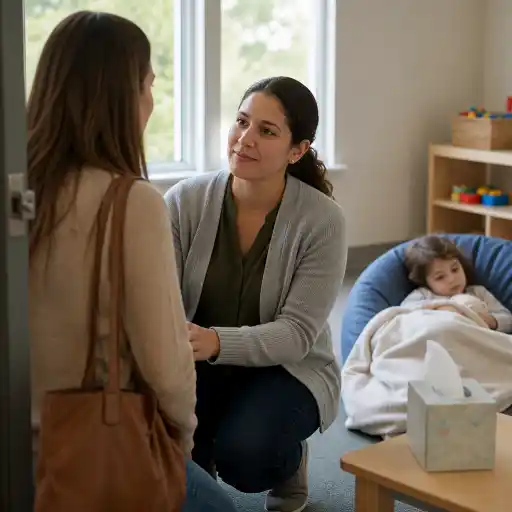
A predictable response protects dignity and reduces exposure. When exclusion-level symptoms appear, staff should:
- Move the child to a comfortable, designated area away from the group while maintaining continuous adult supervision.
- Assess immediate safety. Call emergency services for severe breathing difficulty, unresponsiveness, seizure, or another emergency.
- Contact the parent, guardian, or authorized pickup person promptly and explain the observable symptoms without speculation.
- Provide the expected pickup timeline and written return criteria.
- Record the date, time, symptoms, temperature if taken, contacts attempted, and time of pickup.
Use a calm script: “I’m sorry that Maya is not feeling well. We observed two episodes of vomiting, so she needs to rest at home. Our policy allows return after vomiting has stopped for the required period and she can drink and participate comfortably.”
The CDC recommends planning a supervised area for ill children, separating personal belongings, practicing hand hygiene, and disinfecting when someone is sick. These steps support both immediate care and broader infection control.
How can programs establish fair return-to-care criteria?
Return rules should correspond directly to exclusion triggers. Avoid relying on a parent’s statement that a child “seems fine” when the written policy requires a symptom-free interval. Common examples include:
- Fever: return after the program’s required fever-free period without fever-reducing medication.
- Vomiting: return after the required symptom-free period and when the child can tolerate fluids and normal activities.
- Diarrhea: return when symptoms have improved, accidents are manageable, and the child meets state or local criteria.
- Confirmed or reportable infection: follow the health department’s disease-specific instructions.
There is no universal return rule for every condition. Minnesota’s specific disease exclusion guidance, for example, distinguishes among infections and may require different time periods or laboratory clearance. Programs should maintain an up-to-date chart rather than copying a single blanket rule.
Doctor’s notes should not automatically be required for every common illness unless state rules or the condition warrant one. Unnecessary documentation can create financial and access barriers. Conversely, staff should not waive required criteria because a family is experiencing a difficult workday. Consistency is a form of #care for every child and family.
How can directors communicate and document decisions?
Communication works best when it is proactive, private, and specific. Give families the illness policy at enrollment, review it during orientation, post key expectations near sign-in, and provide translations when feasible. Staff should use the same language and avoid discussing a child’s illness in front of other families.
A concise illness log might include:
- Child’s name, classroom, date, and time
- Objective observations and temperature method, if applicable
- Action taken and location of supervised care
- Parent or emergency-contact calls, including times and outcomes
- Pickup time and return instructions provided
- Any public-health notification or follow-up required
Documentation should be factual: “10:15 a.m.—three watery stools, child unable to participate; parent called at 10:20; pickup at 10:48.” Avoid labels such as “dramatic,” “contagious,” or “neglectful” unless a qualified authority has made that determination.
Directors can strengthen staff confidence through role-play, quick-reference charts, and brief refreshers. ChildCareEd’s Prevention and Control of Infectious Diseases Buy Now $16.00 course provides a focused way to reinforce infection-prevention practices and may help staff connect policy language with daily routines.
How should programs manage outbreaks and common mistakes?
An outbreak response should be prompt but not alarmist. When several children or staff develop similar symptoms:
- 📞 Contact the local health department and licensing agency when required or when guidance is needed.
- Increase cleaning and disinfection of high-touch surfaces, bathrooms, mouthed toys, and areas contaminated by body fluids.
- Review attendance and symptom records to identify patterns.
- Communicate facts, protective actions, symptoms to monitor, and where families can obtain guidance.
- Protect confidentiality; do not identify the affected child without authorization.
Common mistakes include vague language such as “too sick,” inconsistent enforcement between classrooms, requiring medical notes for routine symptoms, and failing to train substitutes. Correct these by defining observable criteria, using one decision tree, auditing documentation periodically, and reviewing the policy whenever public-health guidance changes.
The CDC’s infection-protection guidance for early care programs also emphasizes vaccination, ventilation, handwashing for at least 20 seconds, separated belongings, and a supervised isolation area. These prevention layers reduce the frequency and disruption of exclusion decisions.
Additional professional development options include How To Keep A Healthy Class: Six Tips for Germ Control Buy Now $35.00, which addresses communicable diseases, hygiene-focused procedures, and healthier classroom practices.
Conclusion
Managing sick-child exclusion policies effectively means answering the central question consistently: Is the child able to participate comfortably and safely without creating an unreasonable risk to others? A strong system combines objective criteria, supervised separation, respectful family communication, clear return rules, concise documentation, and timely public-health collaboration.
Review your policy against current state requirements, train every staff member to use it, and update it when disease guidance changes. With preparation and empathy, exclusion becomes less punitive and more protective—supporting children, families, staff, and the continuity of care.
Five practical takeaways:
- Use observable symptoms and participation ability rather than diagnosis or fear.
- Supervise and comfort an ill child while arranging prompt pickup.
- Give families clear, written return-to-care expectations.
- Document facts, times, actions, and contacts consistently.
- Partner with public health during clusters or reportable illnesses.
- 45 Hour Child Growth and Development
- How To Keep A Healthy Class: Six Tips for Germ Control
- Safe and Sound: Creating Healthy Environments for Every Child
- CDA Family Child Care Credential
- CDA Family Child Care Credential with Portfolio Review
- 45 Hour Infant and Toddler Methods and Materials
- Texas Director Credential
- History, Policy, and Practice in ECE
- Everyday Safety: Creating Healthy Environments
- CDA Certification en Español: Recursos y Consejos para Educadores Bilingües
- 🩺 Cumplimiento de Salud e Inmunización en Cuidado Infantil de Nevada ✔️
- 🍼📋 ¿Qué necesitas para trabajar en el cuidado infantil en Texas?
- Recursos en Español sobre el Sueño Seguro del Bebé
- Regulaciones de Licenciamiento de Cuidado Infantil en California para Centros y Hogares de Cuidado Infantil Familiar
- Normas de Licenciamiento de Cuidado Infantil en Virginia para Centros Diurnos Infantiles y Hogares Diurnos Familiares
- Proporciones de Cuidado Infantil y Tamaños de Grupo por Edad en Maryland (Guía Rápida para Centros y Hogares)
- Proporciones de Cuidado Infantil y Tamaños de Grupo por Edad en Nueva Jersey (Guía Rápida para Centros y Hogares)
- Proporciones de Cuidado Infantil y Tamaños de Grupo por Edad en Virginia (Guía Rápida para Centros y Hogares)
- Lista para Abrir una Guardería en Casa en Virginia: Cómo Empezar
- How can childcare centers use simple health and safety best practices every day?
- Cómo simplificar la capacitación para sus empleados de daycare
- How can childcare settings prevent the spread of illness?
- How can group child care programs effectively prevent the spread of illness?
- How Can Childcare Programs Create Clear Policies That Families Understand and Trust?
- How Can Child Care Programs Manage Sick-Child Exclusion Policies Fairly and Effectively?
- How Can Classrooms Prevent the Spread of Illness During Cold and Flu Season?
- Can a Child Attend Daycare With a Cough or Runny Nose?
- How Long Should a Child Stay Home After Vomiting?
- What Should Parents and Providers Ask Before a Child Returns to Child Care After Illness?
