Cold and flu season can disrupt attendance, staffing, and children’s comfort, but a layered classroom plan can significantly reduce opportunities for germs to spread. For deeper professional learning, explore Prevention and Control of Infectious Diseases  Buy Now $16.00, a two-hour online course that strengthens infection-prevention knowledge and may help you document relevant training hours; also consider How To Keep A Healthy Class: Six Tips for Germ Control Buy Now $35.00 for practical classroom policies and routines.
Why does a layered prevention plan matter?
Young children learn, play, eat, and rest in close proximity. They also touch shared materials frequently and may need adult support with nose wiping, toileting, and handwashing. These realities make complete prevention impossible, but they also show why relying on a single strategy—such as disinfecting tables—is not enough.
The CDC identifies shared objects, close contact, inadequate cleaning routines, and poor ventilation as factors that can contribute to transmission in group settings. A strong response combines environmental controls, hygiene instruction, cleaning, health policies, communication, and vaccination promotion. Each layer reduces risk in a different way.
- Improve indoor air and airflow.
- Build predictable hand hygiene and respiratory-etiquette routines.
- Clean, sanitize, and disinfect according to the task.
- Use clear illness, exclusion, and return-to-care procedures.
- Communicate respectfully with families and coordinate with public health when needed.
How can classrooms improve ventilation and indoor air?
Respiratory viruses can spread more readily in crowded, poorly ventilated indoor spaces. Cleaner air is therefore an important part of #prevention, especially during periods of increased respiratory illness.
Directors should consult facilities personnel or a qualified HVAC professional before making major system changes. Practical measures may include:
- Open windows when weather, security, allergies, and building conditions permit.
- Confirm that HVAC systems operate as designed and receive routine maintenance.
- Use portable air cleaners in spaces with limited ventilation, following manufacturer guidance.
- Run bathroom and kitchen exhaust fans appropriately.
- Move selected activities outdoors when safe and developmentally appropriate.
- Keep a simple log of ventilation actions so staff responsibilities remain clear.
Do not place fans or air cleaners where cords, noise, or airflow create hazards. Ventilation complements—not replaces—hand hygiene, staying home when ill, vaccination, and cleaning. If a room feels stuffy, crowded, or unusually warm, treat that observation as a prompt to review airflow and occupancy patterns.
Which daily hygiene routines should staff teach and supervise?
Children need repeated modeling and supportive coaching rather than reminders delivered only after a problem occurs. Build #handwashing into the schedule at arrival, before meals and food preparation, after toileting or diapering, after outdoor or sensory play, after coughing or sneezing, and whenever hands are visibly dirty.
Teach the five-step process: wet hands, apply soap, scrub for at least 20 seconds, rinse, and dry thoroughly. Use songs, picture cards, or a short story to make the timing concrete. Adults should model the routine and provide specific feedback, such as, “You scrubbed between your fingers.”
Soap and water are preferred. If they are unavailable, use hand sanitizer containing at least 60% alcohol. Store sanitizer out of children’s reach and supervise its use for children under six. Sanitizer is not a substitute for washing visibly dirty hands.
Teach respiratory etiquette in a calm, non-shaming manner:
- Cover coughs and sneezes with a tissue and discard it immediately.
- If no tissue is available, cough or sneeze into the elbow rather than the hands.
- Wash hands after blowing the nose, coughing, or sneezing.
- Keep tissues and no-touch waste baskets accessible near learning areas.
How should programs clean, sanitize, and disinfect?
These terms describe different actions. Cleaning uses soap, water, and scrubbing to remove dirt and many germs. Sanitizing reduces germs on objects and surfaces to safer levels, particularly those that contact food or children’s mouths. Disinfecting uses an appropriate chemical product to destroy remaining germs after cleaning and is especially relevant when someone is sick or after contact with body fluids.
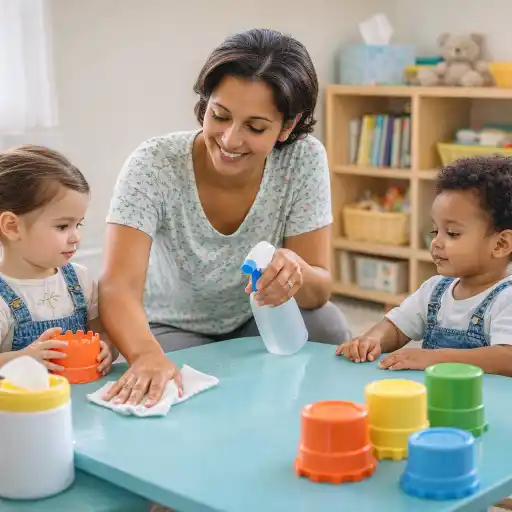
Use a written schedule that identifies high-touch surfaces, toys, eating areas, diapering spaces, bathrooms, and electronics. Toys placed in mouths should be removed immediately and placed in a labeled container until they can be cleaned and sanitized. Items that cannot be cleaned safely should not be shared.
- 🧼 Clean visibly dirty surfaces and high-touch areas regularly.
- Sanitize feeding items, eating surfaces, and mouthed toys as required.
- Disinfect diaper-changing surfaces, bathrooms, and areas contaminated by body fluids according to applicable guidance.
- Follow product labels for dilution, ventilation, protective equipment, and contact time.
- Never mix bleach with ammonia or other incompatible products.
- Store all chemicals locked, labeled, and out of children’s sight and reach.
The CDC recommends cleaning surfaces before sanitizing or disinfecting them. State requirements vary - check your state licensing agency, local health department, and facility policies for specific procedures.
How should classrooms respond when a child or staff member becomes ill?
A clear response protects the ill person’s dignity while reducing exposure for others. Before cold and flu season, review the program’s illness policy with staff and families. Explain symptoms that require exclusion, how families will be contacted, pickup expectations, and criteria for returning.
When a child becomes ill, assess whether the child can participate comfortably, whether the required care exceeds what staff can provide without compromising other children, or whether the symptoms create a meaningful risk of transmission. Follow your written policy and applicable public-health guidance rather than making inconsistent decisions from one classroom to another. Because respiratory infections can sometimes affect breathing, staff should know the early signs of respiratory distress in children and follow emergency procedures promptly if they appear.
- Move the child to a designated area away from close contact with peers while maintaining active adult supervision.
- Notify the parent, guardian, or authorized pickup person promptly.
- Use gloves or other appropriate PPE when contact with body fluids is possible.
- Clean and disinfect contaminated surfaces after the child leaves the area.
- Document symptoms, communication, actions taken, and follow-up according to program policy.
Staff should also stay home when ill and avoid pressure to work while contagious. Directors can support this practice through cross-training, backup staffing plans, and respectful communication. If several people develop similar symptoms or a reportable illness is suspected, contact the local health department and follow its instructions.
How can directors partner with families and strengthen prevention?
Families are more likely to follow health procedures when expectations are concise, consistent, and communicated before an illness occurs. Provide a one-page seasonal handout that explains handwashing, respiratory etiquette, vaccination recommendations, exclusion criteria, return-to-care procedures, and whom to contact with questions.
Programs can encourage families and staff to remain current with recommended vaccinations, including seasonal influenza vaccination when appropriate. Share evidence-based information without pressuring families or making medical decisions for them. Direct individual medical questions to a qualified healthcare professional.
Review records and routines periodically rather than waiting for an outbreak. Ask:
- Are soap, paper towels, tissues, gloves, and cleaning products consistently available?
- Do staff follow the same handwashing and toy-handling procedures?
- Can every classroom explain its supervised illness-response plan?
- Are ventilation concerns reported and addressed promptly?
- Are families receiving the same information from all staff members?
Professional development can make these expectations easier to implement. Shoo, Germs! Don’t Bother Me! Buy Now $24.00 focuses on communicable diseases, hygiene, and classroom policies, while Health and Safety Orientation Buy Now $55.00 addresses infectious-disease prevention within broader child care health and safety responsibilities. For directors seeking a wider wellness focus, Healthy Starts: Safety, Nutrition, and Wellness in Child Care Buy Now $55.00 includes illness prevention alongside other health topics. Review course details and verify whether a course meets your specific state or program requirements.
What common mistakes should programs avoid?
- Relying only on surface cleaning: Add ventilation, hand hygiene, respiratory etiquette, and clear illness policies.
- Disinfecting before cleaning: Remove dirt first so the disinfectant can work as directed.
- Using inconsistent exclusion decisions: Apply the written policy and consult public health when circumstances are unclear.
- Leaving supplies inaccessible: Keep soap, tissues, and paper towels within reach, while securing chemicals and sanitizer.
- Shaming children for symptoms: Use neutral language and teach health routines as skills, not punishments.
- Changing HVAC settings without expertise: Consult qualified personnel and confirm that changes do not create safety or equipment problems.
Conclusion: What is the most effective cold and flu season strategy?
Classrooms prevent illness most effectively through a sustainable, layered approach rather than one dramatic cleaning effort. Improve air quality, schedule and supervise handwashing, teach respiratory etiquette, clean and disinfect correctly, respond promptly to illness, promote recommended vaccination, and communicate clearly with families.
Begin with two or three changes your team can maintain every day, then monitor supplies, attendance patterns, staff feedback, and illness events. These practical steps protect children and adults while preserving the warm, play-based environment that young children need. State requirements vary - check your state licensing agency for current rules and reporting expectations.
Sources and further reading
- CDA Home Visitor Subject Area 3 Part 3 Birth to 5
- How To Keep A Healthy Class: Six Tips for Germ Control
- Birth to Five CDA Credential with Portfolio Review
- How To Keep A Healthy Class: Six Tips for Germ Control
- 24 Hour Texas Pre-Service
- Emergent Learning & Development
- 45-Hour Infant and Toddler Curriculum
- Texas Director Credential
- Keeping Them Safe: Infants & Toddlers
- CDA Certification en Español: Recursos y Consejos para Educadores Bilingües
- ⏰ Cómo puedo facilitar las transiciones y las rutinas diarias en mi aula?
- ❄️ ¿Qué actividades al aire libre funcionan bien para los niños de Illinois en cada estación? 🌷🍂
- Recursos en Español sobre el Sueño Seguro del Bebé
- ¿Cómo pueden los equipos de cuidado infantil practicar habilidades rápidas de primeros auxilios en situaciones reales?
- 10 Ejemplos de Cómo la Cultura Influye en el Desarrollo Infantil
- Capacitación en Salud y Seguridad Preventiva en Línea para Proveedores de Cuidado Infantil
- Proporciones de Cuidado Infantil y Tamaños de Grupo por Edad en Nueva Jersey (Guía Rápida para Centros y Hogares)
- Proporciones de Cuidado Infantil y Tamaños de Grupo por Edad en Virginia (Guía Rápida para Centros y Hogares)
- Lista para Guardería en Casa en Illinois: Cómo Iniciar una Guardería en el Hogar
- Cómo Trabajar en el Cuidado Infantil en California: Requisitos y Pasos
- Capacitación Previa al Servicio para Proveedores de Cuidado Infantil en Nevada
- Canciones, juegos y preguntas de círculo para niños
- Cómo simplificar la capacitación para sus empleados de daycare
- How should I prepare my classroom for cold and flu season beyond cleaning?
- How Can Classrooms Prevent the Spread of Illness During Cold and Flu Season?
- When Should a Sick Child Be Sent Home From Daycare?
