A cough or runny nose does not automatically mean a child must stay home, but the decision should consider the child’s comfort, participation, other symptoms, and your program’s policy. For providers who want deeper preparation, Illness, Medication, and Allergies in Child Care  Buy Now $32.00 offers focused training on recognizing illness and responding appropriately while supporting professional-development goals.
Why is a mild cough or runny nose not always a reason for exclusion?
Respiratory symptoms are common in group care. Young children encounter many viruses, and a lingering cough or nasal discharge may remain after a child is otherwise recovering. The American Academy of Pediatrics states that children with coughs or colds without fever or other signs of illness, as well as runny noses regardless of discharge color or consistency, do not necessarily need exclusion if they feel well enough to participate.
The central question is not simply whether a symptom exists. Instead, assess whether the child can participate comfortably and whether staff can provide care without compromising the health and safety of the group. This approach recognizes children’s normal exposure to minor illnesses while still protecting infants, children with medical vulnerabilities, staff, and families.
Use a strengths-based, objective lens:
- Can the child play, eat, rest, and engage as usual?
- Is the cough manageable without continuous one-to-one attention?
- Can the child breathe comfortably?
- Are symptoms stable or improving rather than worsening?
- Does the child have fever, vomiting, diarrhea, rash, unusual fatigue, or behavior changes?
A mild symptom alone may not require exclusion, but a child who is miserable, unable to participate, or needing more care than the program can safely provide should remain home. State requirements vary - check your state licensing agency.
When should a child with respiratory symptoms stay home?
Children with respiratory symptoms and a fever should generally stay home. The AAP recommends return after the fever associated with those symptoms has been gone for at least 24 hours without fever-reducing medication. Programs should also follow current state and local public-health guidance, particularly during outbreaks.
Exclusion is also appropriate when respiratory illness is accompanied by signs of significant illness or when the child cannot participate comfortably. Warning signs include:
- Difficulty breathing, wheezing, rapid breathing, chest retractions, or bluish or gray lips.
- Unusual sleepiness, unresponsiveness, confusion, or inconsolable irritability.
- A cough that is persistent, worsening, or prevents eating, sleeping, playing, or resting.
- Fever with a new rash or significant behavior change.
- Repeated vomiting, dehydration concerns, or diarrhea.
- A suspected or confirmed disease requiring exclusion, such as pertussis, influenza under applicable guidance, or another reportable condition.
Do not attempt to diagnose the child. Document observable symptoms, notify the director or health lead, and communicate with the family. Emergency medical services are appropriate for severe breathing difficulty, unresponsiveness, seizure activity, or another urgent threat to life. For more guidance on recognizing breathing changes that may need urgent attention, see early signs of respiratory distress in children.
For infants younger than two months, a temperature of 100.4°F (38°C) or higher requires immediate medical attention and exclusion. Always consider the child’s age, health history, and individualized care plan.
How should providers assess a child at arrival and during the day?
A brief, welcoming health check helps staff identify changes from a child’s usual baseline. Observation should continue throughout the day because symptoms can emerge after arrival. Ask families when the cough or runny nose began, whether the child has had a fever, whether medication was given, and whether there has been a known exposure.
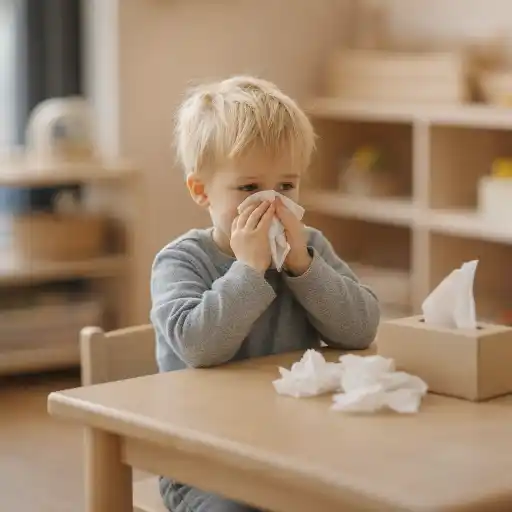
Observe:
- Breathing effort, rate, and comfort.
- Energy, mood, responsiveness, and ability to join activities.
- Appetite, fluid intake, sleepiness, and urination.
- Temperature when indicated by policy or observed symptoms.
- Whether nasal secretions or coughing require frequent individual assistance.
🩺 Record facts rather than conclusions. For example: “At 10:15 a.m., child coughed repeatedly during snack, drank water, had no measured fever, and returned to play,” is more useful than “child seems sick.” Documentation supports consistent decisions and helps families share accurate information with a health professional.
If exclusion-level symptoms appear, move the child to a comfortable, supervised area away from close group activity. Maintain connection and dignity; separation should never feel punitive. Follow the program’s notification procedure and provide clear return-to-care expectations.
Providers should also review their procedures regularly. The CDC recommends hand hygiene, cleaning and disinfection, improved ventilation, separated personal belongings, and a supervised area for children who become ill.
How can programs reduce the spread of coughs and colds?
Even when a child remains in care, layered prevention practices can reduce transmission. Respiratory viruses may spread through droplets, close contact, contaminated surfaces, and hands touching the eyes, nose, or mouth. Prevention should be routine rather than activated only when someone appears ill.
- Teach children to cough or sneeze into their elbow or a tissue.
- Wash hands with soap and water for at least 20 seconds, especially after wiping noses and before eating.
- Use hand sanitizer containing at least 60% alcohol when soap and water are unavailable and use is appropriate.
- Dispose of tissues promptly and clean hands after contact with nasal secretions.
- Clean frequently touched surfaces, mouthed toys, tables, door handles, and shared materials.
- Improve airflow and ventilation when feasible.
- Keep personal belongings, cups, bottles, and comfort items separate.
- Encourage families and staff to remain home when illness prevents comfortable participation.
Vaccination according to recommendations can reduce the risk of serious illness from vaccine-preventable diseases. Programs should communicate health expectations before enrollment, provide policies in accessible language, and avoid shaming families when symptoms occur.
Directors can strengthen staff confidence through refresher training. Prevention and Control of Infectious Diseases Buy Now $16.00 focuses on infection prevention and maintaining a healthier child care environment, while How To Keep A Healthy Class: Six Tips for Germ Control Buy Now $35.00 emphasizes practical hygiene policies and responses to communicable disease.
How should providers communicate with families and manage return to care?
Families benefit from clear, respectful communication that describes what staff observed without implying a diagnosis. Share the onset and pattern of symptoms, temperature information if taken, the child’s participation level, care provided, and any change that prompted contact.
A helpful message might be: “We noticed that Maya’s cough has become frequent, and she is resting instead of participating. She has no measured fever, but she needs more individual care than we can provide safely today. Please arrange pickup and contact her health professional if you are concerned.”
Return decisions should be based on the written policy and applicable guidance. Common considerations include:
- Fever has resolved for the program’s required period without fever-reducing medicine.
- Respiratory symptoms are improving overall.
- The child can manage remaining cough or congestion and participate comfortably.
- No new exclusion-level symptoms have developed.
- Any disease-specific public-health requirements have been met.
Do not require a medical diagnosis for every mild cold unless policy or law requires it. Conversely, do not waive a required exclusion period because a family faces work or transportation difficulties. Consistent criteria are fairer to every family. When several children or staff develop similar symptoms, review attendance and illness records and contact the local health department or licensing agency when required.
For broader health-and-safety preparation, Health and Safety Orientation Buy Now $55.00 includes infectious-disease prevention among its core topics, and Creating Safe & Healthy Child Care Environments Buy Now $55.00 addresses exclusion criteria, healthy practices, supervision, and environmental safety.
Conclusion: Can a child attend daycare with a cough or runny nose?
Usually, a child with a mild cough or runny nose may attend child care when there is no fever or concerning symptom, the child can participate comfortably, and staff can meet the child’s needs without compromising the group. The symptom’s presence, color, or duration alone should not determine exclusion.
Keep the decision grounded in four questions:
- Can the child participate comfortably?
- Are symptoms improving or becoming more severe?
- Does the child require more care than the program can safely provide?
- Could the illness meet a state, local, or disease-specific exclusion requirement?
When in doubt, consult the family, follow the written policy, and seek guidance from the child’s health professional or local health department. Calm observation, accurate documentation, respectful communication, and consistent prevention practices help providers protect children without treating every sniffle as an emergency.
Important: This article is educational and does not replace medical advice. State requirements vary - check your state licensing agency.
- 45 Hour Child Growth and Development
- Bienvenido! Welcoming All Families
- CDA Family Child Care Credential with Portfolio Review
- Pediatric RSV First Aid & CPR/AED
- 45 Hour School Age Methods and Materials
- CDA Bridge Bundle: Family Child Care
- CDA Bridge Bundle: Family Child Care without Portfolio Review
- Texas Director Credential
- CDA Certification en Español: Recursos y Consejos para Educadores Bilingües
- Cómo Abrir Una Quardería En Casa Sin Dinero?
- Cómo Empezar una Guardería en Casa: Requisitos y Pasos
- Proporciones de Cuidado Infantil y Tamaños de Grupo por Edad en Maryland (Guía Rápida para Centros y Hogares)
- Proporciones de Cuidado Infantil y Tamaños de Grupo por Edad en Nueva Jersey (Guía Rápida para Centros y Hogares)
- Proporciones de Cuidado Infantil y Tamaños de Grupo por Edad en Virginia (Guía Rápida para Centros y Hogares)
- Cómo Trabajar en el Cuidado Infantil en Wisconsin: Requisitos y Pasos
- How can North Dakota child care providers protect children now that measles is back in 2026?
- How Can New York Child Care Providers Protect Children Now That Measles Is Back in 2026?
- How should your Minnesota childcare program respond if a child was exposed to measles?
- Cómo simplificar la capacitación para sus empleados de daycare
- How should Michigan child care providers watch for measles this summer?
- How should New York child care providers respond to a measles exposure?
- What Should Providers Know About the New Measles Guidance for Classrooms?
- What Should Providers Know About Measles and Immunization Records This Fall?
- How Can Child Care Providers Recognize Signs of Illness and Respond Safely?
- Can a Child Attend Daycare With a Cough or Runny Nose?
- What Should Daycare Illness Policies Include to Protect Children, Staff, and Families?
- When Should a Sick Child Be Sent Home From Daycare?
- When Should a Sick Child Be Sent Home From Daycare?
