Every day in a child care program offers repeated opportunities to help children and #staff build lifelong #handwashing and #hygiene habits. Consistent routines—such as washing hands at arrival, before and after meals, after toileting or diapering, after outdoor play, and after contact with bodily fluids—can reduce the spread of germs and help children become more independent in caring for their health. This article provides practical, numbered steps programs can use immediately, including engaging teaching strategies, visual reminders, cleaning and sanitizing schedules, safe diapering procedures, staff expectations, family partnership ideas, and common mistakes to avoid. State requirements vary, so always check with your state licensing agency.
To strengthen your program’s hygiene and infection-prevention practices, explore ChildCareEd’s self-paced online course Prevention and Control of Infectious Diseases  Buy Now $16.00. This two-hour training helps providers identify strategies for preventing infectious disease and develop policies and procedures that promote good hygiene in child care environments.
Why it matters
Healthy hygiene reduces illness-related absences, protects staff, and keeps classrooms stable and calm. Short, consistent routines increase child independence and lower the day-to-day burden on teachers — so wellness becomes part of learning, not a constant firefight. For practical classroom tools and printable posters, see ChildCareEd: Handwashing and hygiene routines and the CDC Clean Hands materials (CDC: About Hand Hygiene).
How do we build a simple daily hygiene routine everyone will follow?
Programs that win at hygiene keep it short, visible, and predictable. Use a numbered plan, so staff and children remember what comes next.
- Pick 5–7 key times (enumerate):
- 🧾 Arrival
- 🍽️ Before food
- 🚽 After toileting/diapering
- 🌳 After outdoor or sensory play
- 🤧 After coughing/sneezing
- Teach one five-step script: 1) wet, 2) soap, 3) scrub 20 seconds, 4) rinse, 5) dry. (See Handwashing for Kids and CDC guidance.)
- Design the sink area:
- 🪜 Step stools, reachable soap pumps, paper towels, visual steps by each sink.
- 🧴 Provide 60%+ alcohol hand sanitizer for supervised use when sinks aren’t available (CDC).
- Post the routine in plain language and pictures; add a 20-second song or timer to cue scrubbing length (see ChildCareEd routines).
- Supply checklist: liquid soap, paper towels, safe sanitizer, step stools, sink posters — keep spares and assign daily supply checks to staff.
How can we teach and coach children and staff so habits stick?
Learning happens through repetition, friendly prompts, and positive feedback. Make hygiene part of learning time rather than only a rule to enforce.
- 📚 Train staff with short, practice-based sessions: model the five-step script, practice diapering order, and run sink-side role plays. Use ChildCareEd orientation and infection-control resources (ChildCareEd: Protect health and hygiene).
- 🎵 Use consistent cues for kids: a handwashing song, a “Soap Captain” role, or step cards that children order before moving to the sink (Handwashing for Kids).
- 🤝 Partner families quickly: send one-line notes with the class song and the 5 key times to wash. Encourage the home team to use the same words so children get consistent messages (see CDC: Hand Hygiene as a Family Activity).
- 📝 Coach with data: observe and record 1–2 handwashing challenges per week and use micro-feedback (praise, remind, re-model) — small wins build momentum.
- 🔁 Reinforce by routine: include handwashing in daily schedules and staff checklists so it becomes automatic, not optional.
How should diapering, cleaning, and toileting fit into infection control?
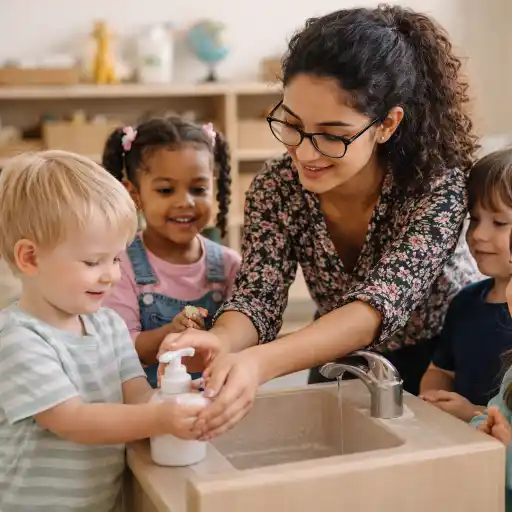
Hygiene works best when handwashing connects to safe diapering, cleaning, and toy procedures. Follow clear sequences and product directions.
- Diapering steps (numbered):
- 1) Prepare supplies and lay a disposable liner, 2) clean the child front-to-back, 3) bag soiled clothing, 4) remove trash and gloves, 5) disinfect the changing surface, 6) wash child’s hands, 7) staff wash hands last. See CDC’s diapering steps (CDC Diaper Hygiene).
- Cleaning hierarchy: 1) clean (soap + water), 2) sanitize (weaker bleach or EPA product), 3) disinfect (stronger product) — always follow label contact times; see CDC cleaning guidance.
- 🧸 Mouthed toys: keep a sealed “mouthed toy” bin, clean and sanitize those items before reuse; use dishwasher-safe toys when possible (ChildCareEd).
- 👩⚕️ Illness plan: use daily health checks, clear exclusion rules, and a communication plan. For many infections,s follow local health department rules and national resources like Caring for Our Children.
What common mistakes do programs make—and how do we avoid them?
Learning from typical missteps saves time and keeps families confident.
- 🔸 Rushed scrubbing: fix by using a 20-second song or sand timer and praise effort each time.
- 🔸 Over-relying on sanitizer: fix by prioritizing soap and water after toileting or when hands are soiled; reserve sanitizer for supervised moments (CDC).
- 🔸 Missing mouthed-toy procedures: fix by assigning a staff person to the mouthed-toy bin and a cleaning schedule (daily or between uses) — see ChildCareEd.
- 🔸 Inconsistent staff practice: fix by making hygiene part of orientation and by keeping a visible checklist on the classroom clipboard.
- 🔸 Mixing cleaning chemicals: fix by training staff to read labels and never mix products — follow CDC cleaning safety steps (CDC).
How can we partner with families and measure success?
Families are essential partners. Keep outreach short, practical, and focused on one thing they can try at home.
- Family engagement (three simple actions):
- 📩 Send one-line texts/emails with the week’s hygiene focus and the class song or steps.
- 📸 Invite a photo-share challenge: families send one photo of handwashing at home.
- 🤲 Share a one-page handout (posters and printable materials available from ChildCareEd and CDC: ChildCareEd, CDC).
- Measure success with three simple metrics (weekly or monthly):
- 1) Number of staff who completed a brief hygiene practice session.
- 2) Number of classrooms using the handwashing song/timer routinely.
- 3) Family reach: percent of families who opened the message or participated in a photo challenge.
- Use quick feedback loops: celebrate wins in staff huddles; adjust messages that don’t land; repeat what works. For creative project ideas to involve students and families, es see the Minnesota Dept. of Health handwashing project ideas (MN Dept. of Health).
Quick FAQ (brief)
- Q: Can sanitizer replace soap? A: No — only when sinks aren’t available; soap and water remain best (CDC).
- Q: How long to scrub? A: About 20 seconds (two rounds of "Happy Birthday" or a short song).
- Q: Who enforces rules? A: Licensing agencies — state requirements vary - check your state licensing agency.
Actionable 5-step checklist to try this week
- 🧼 Post the five-step handwashing poster at each sink (use ChildCareEd/CDC posters).
- 📋 Add handwashing times to the daily schedule and staff checklist.
- 🪣 Start a mouthed-toy bin and assign cleaning responsibility.
- 👩🏫 Run a 10-minute staff drill on diapering order and sink routines.
- 📣 Send one short family message with the class handwashing song.
You're already doing the most important work: creating predictable, caring routines that keep kids healthy. Start small, measure one thing, and celebrate progress. For downloadable resources and training, prioritize ChildCareEd resources (Health & Nutrition resources, Germ control tips) and federal guidance from the CDC. State requirements vary - check your state licensing agency.
- CDA Preschool Credential with Portfolio Review
- Professional Presence in Early Childhood
- Birth to Five CDA Credential with Portfolio Review
- CDA Family Child Care Credential with Portfolio Review
- CDA Bridge Bundle: Family Child Care
- Positive Attention: Interactions & Supervision for Infants & Toddlers
- Texas Director Credential
- Healthy Cooking for Picky Kids
- CDA Certification en Español: Recursos y Consejos para Educadores Bilingües
- 👶 ¿Cuáles son las proporciones y grupos requeridos en Dakota del Norte? 🏫
- Menos Estrés a la Hora de Comer: Rutinas Simples Que Sí Funcionan
- Recursos en Español sobre el Sueño Seguro del Bebé
- Proporciones de Cuidado Infantil y Tamaños de Grupo por Edad en Virginia (Guía Rápida para Centros y Hogares)
- How Can We Create a Healthy Childcare Environment?
- How Can Early Childhood Programs Encourage Healthy Habits?
- Cómo simplificar la capacitación para sus empleados de daycare
- How Can Minnesota Child Care Programs Build A Strong Handwashing And Hygiene Routine?
- Which Handwashing Activities Best Help Young Children Build Healthy Habits?
- How can child care programs build healthy hygiene habits?
- How can child care programs build healthy eating habits that last?
- How Can Child Care Programs Build Healthy Teeth Habits for Young Children?
- Health and Safety Training: 7 Everyday Habits That Protect Children in Care
- How Can Child Care Providers Build Healthy Habits for Young Children?
- Why Doesn’t a Handwashing Reminder Alone Close Germ-Control Gaps in Child Care?
- How Can Child Care Programs Reduce Germ Spread in Shared Bathrooms?
- How Can Child Care Providers Make Dental Health Lessons Fun for Preschoolers Who Resist Brushing?
