Ocean animals can turn a lively group game into a meaningful language-learning experience. Explore practical ways to help children listen, name, describe, and talk together—and consider Language and Literacy Foundations in Pre-K  Buy Now $16.00 for deeper strategies that strengthen vocabulary, communication, and everyday classroom practice.
Why does ocean vocabulary matter in group play?
When children play together, new words have a purpose: they help players identify a picture, follow a direction, explain a choice, or share a discovery. A sea-animal theme offers a compelling context for words such as “octopus,” “tentacle,” “shell,” “fin,” and “ocean.” Children can connect these words to images, gestures, movement, and conversation instead of meeting them only as isolated labels.
Language includes both understanding what others say and expressing ideas. In a group game, children listen for an animal’s name, scan the board, make a match, and may then name or describe what they see. Those receptive and expressive opportunities can support vocabulary as well as attention, turn-taking, and social connection. Head Start’s Language and Literacy guidance describes vocabulary as part of children’s broader language and communication development.
How can providers prepare a sea-animal bingo activity?
Begin with a small, focused set of familiar sea-animal images. The Bingo Cards - Sea Animals Edition Buy Now $1.99 resource is designed as a cut, color, paste, and play activity: children prepare their own grid and then match pictures as the teacher calls out names. Its hands-on format can fit circle time, a learning center, or a small group.
Before play, preview the images and decide on a few target words. Use clear pictures, and if children are unfamiliar with a creature, show a photograph or a simple book illustration. Keep the vocabulary manageable; a few words used repeatedly are more useful than a long list delivered all at once.
- Say each target name slowly and naturally, then invite children to repeat, point, or show the matching card.
- Introduce one useful feature or action: “A crab has claws,” or “A fish swims with its fins.”
- Prepare counters or other safe markers, check that each child can see the board, and plan how turns will move around the group.
- 🦀 Offer a movement cue, such as gently waving arms like an octopus, as an optional way to respond.
What language can educators model during each turn?
The call itself is only the beginning of a language-rich turn. Name the animal clearly, pause, and give children time to look and respond. Expand what a child says without requiring them to repeat a longer sentence. If a child says “whale,” you might respond, “Yes, a whale. The whale is very large.” This models additional vocabulary and sentence structure while affirming the child’s contribution.
Vary the prompts to give children multiple ways into the conversation. Ask questions that invite observation or reasoning rather than relying only on “What is it?” For example, “Which animal has a shell?” or “How is the turtle different from the fish?” The aim is not to make every turn a test; a short prompt followed by attentive listening is often enough.
- For naming: “What animal do you see?”
- For attributes: “What do you notice about its body?”
- For action words: “How does it move?”
- For comparison: “What is alike or different about these two animals?”
- For a fuller sentence: “Tell us what your animal is doing.”
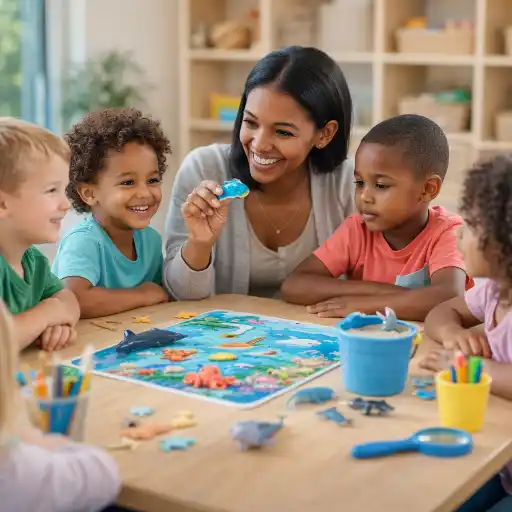
How can the game include different communication styles and abilities?
Group play works best when children can participate in more than one way. Some preschoolers may readily name every picture; others may need extra time, a repeated cue, a pointing option, or a peer model. Adapt the pace and response expectations so the game remains shared rather than becoming a race in which only the quickest speakers succeed.
For children who are learning English alongside another language, their home language is a resource for understanding and communicating. Invite family members to share the names of familiar sea animals in languages used at home, and use those words respectfully alongside English.
- Accept pointing, gestures, signs, a communication device, or a spoken word as ways to take a turn.
- Use picture cues and demonstrate a sample round before beginning.
- Pair children thoughtfully and make sure each child has a clear view and a real opportunity to respond.
- Allow extra wait time; avoid completing a child’s answer too quickly.
- Offer a smaller set of images or fewer choices if that helps a child stay engaged.
Check that the materials and small markers are appropriate for the ages and abilities in your group, and supervise closely. If a child does not want to speak in front of the group, allow them to match quietly or participate with a partner. Inclusive participation is not an extra feature of language teaching: it is how every child gets a genuine chance to communicate.
How can educators extend vocabulary beyond bingo?
Revisit the target words later in the day so children encounter them in more than one context. Repetition is most meaningful when it adds a fresh opportunity to notice, use, or connect a word. After bingo, children might sort animal pictures by how they move, build an imaginary ocean habitat, or draw a favorite creature and dictate a sentence about it.
Connect the game to books, songs, and hands-on exploration. A read-aloud can introduce new animal names and descriptive language; a movement game can invite children to “glide,” “crawl,” or “wiggle.” At a discovery table, shells or safe models can prompt words about shape, texture, size, and pattern.
- Repeat two or three target words during another routine, such as cleanup or outdoor play.
- Invite children to retell a simple story with animal pictures or toys.
- Make a class word display with animal images and children’s descriptions.
- Send families one optional conversation prompt, such as “Which sea animal did your child enjoy talking about?”
Observe which words children recognize, use independently, or attempt with support. Brief notes can guide what to revisit in the next small group; they need not turn a playful activity into a formal test. For more comprehensive classroom approaches to language, listening, and emerging literacy, explore Language and Literacy Foundations in Pre-K Buy Now $16.00.
What common pitfalls should providers avoid?
A vocabulary game can lose its playful character if adults focus only on correct answers or move too quickly. Keep the language goal clear, but let children’s comments and curiosity shape the conversation. Bingo is a useful shared activity—not a measure of a child’s overall language ability.
- Too many new terms at once: Select a few meaningful words and revisit them across the day.
- Only accepting spoken answers: Recognize pointing, gestures, home-language responses, and other communication methods.
- Turning each turn into a quiz: Balance questions with descriptions, modeling, and child-led observations.
- Rushing to correct: Acknowledge the child’s idea, then offer a natural, accurate model.
- Making winning the main goal: Emphasize shared discovery and participation, and adjust rules to reduce pressure.
Directors can support consistent practice by helping staff select purposeful target words, plan inclusive adaptations, and reflect on children’s engagement after the activity. The teaching team can ask: Which words prompted conversation? Who participated comfortably? What might make the next round more accessible? State requirements vary - check your state licensing agency.
Conclusion: How can group play make ocean words stick?
Interactive group play can help children build ocean vocabulary when it combines meaningful words, repeated exposure, responsive adult modeling, and genuine peer interaction. Sea-animal bingo offers a simple structure for listening, matching, naming, and taking turns, while the educator’s prompts can extend those skills into describing, comparing, and storytelling.
Keep the activity welcoming: prepare a manageable set of images, allow multiple ways to respond, honor home languages, and notice what children communicate during and after the game. Then carry a few target words into books, movement, art, and everyday routines. To develop a broader foundation for supporting children’s listening, speaking, vocabulary, and emerging literacy, consider the relevant ChildCareEd Pre-K language and literacy course Buy Now $16.00.
- CDA Home Visitor Subject Area 3 Part 3 Birth to 5
- Language and Literacy Foundations in Pre-K
- Bienvenido! Welcoming All Families
- From Play to Planning: Building Culturally Competent, Child-Centered Curriculum
- TEAM: Together Everyone Achieves More
- Working Together: Teachers & Preschoolers
- Art from the Heart for Preschoolers: Open Ended Art Projects that Build Self-Esteem
- Creating Environments that Nurture Growth and Community
- Building Vocabulary
- Supporting Families and Caregivers in Language and Literacy
- CDA Certification en Español: Recursos y Consejos para Educadores Bilingües
- 👶 ¿Cuáles son las proporciones y grupos requeridos en Dakota del Norte? 🏫
- Curso Gratis De Cuidado Infantil Con Certificado
- Celebra El Cumpleaños de Dr. Seuss En Tu Guardería Con Actividades Fáciles y Divertidas!
- Apoyo en Español para Capacitaciones Grupales Presenciales y por Zoom en Cursos Selectos
- 10 Ejemplos de Cómo la Cultura Influye en el Desarrollo Infantil
- How can I use beach and ocean-themed summer activities in my California early childhood classroom?
- Celebrando la amistad en el cuidado infantil durante el Día de los Mejores Amigos
- Canciones, juegos y preguntas de círculo para niños
- La mejor manera de hacer seguimiento a la capacitación de su equipo de daycare How to Organize Staff Training for Your Child Care Center Cómo organizar la capacitación del personal para su centro de cuidado infantil
- Cómo simplificar la capacitación para sus empleados de daycare
- How can ocean-themed sensory bins and water play boost learning while staying safe in preschool programs?
- Why Is Animal Bingo a Great Way to Introduce Habitats and Classification?
- How Do Classification Questions Build Marine Science Vocabulary?
- How Can Ocean Animal I Spy Combine Counting, Visual Scanning, and Ocean Science?
- How Can Ocean Art Build Marine Vocabulary and Curiosity in Young Children?
- How Can Predictable Ocean-Themed Text Build Reading Confidence?
- How Can Interactive Group Play Build Ocean Vocabulary in Preschool?
- A Child Has Memorized the Book: What Can You Teach Next?
- Following Children's Counting Questions into an Investigation: How Can Educators Turn Curiosity into Meaningful Math?
