A pretend toy library can turn children’s enthusiasm for books into authentic practice with names, lists, stories, and written messages. Explore Classroom Tools for Emergent Literacy  Buy Now $16.00 for practical ways to build literacy into everyday classroom materials, and consider Reading Aloud and Storytelling Buy Now $16.00 to strengthen the language and story experiences that can launch library play. These courses offer a deeper professional-learning path as you make a simple play area a purposeful part of your curriculum.
Why does a pretend library offer more than a fun theme?
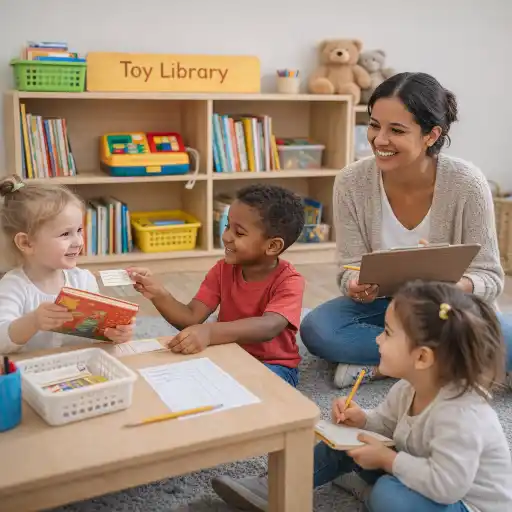
A pretend library gives children a familiar social world to explore: choosing books, helping a visitor, checking out a toy, and returning it later. As they take on roles, children use language for real purposes and encounter print as something people rely on to organize and communicate. A library card identifies a borrower, a borrowing slip records a choice, and a receipt can show what is going home. These objects make reading and writing purposeful rather than isolated tasks.
Research on play and early literacy connects dramatic play with opportunities to develop vocabulary, oral narrative, print awareness, and functional reading and writing behaviors. Adult guidance can help make these opportunities more meaningful without taking control of the play. NAEYC likewise describes dramatic play as a context for language-rich interaction, encounters with print, storytelling, and authentic writing.
For educators, the goal is not to make every child complete a form correctly. A child’s drawing, scribble, dictated words, letter-like marks, or independent name-writing can all communicate meaning. When children see that their marks help a library operate, they begin to understand the #purpose of written language—and are more likely to return to it.
How can you set up a welcoming toy library?
Choose a manageable, visible space with a low shelf or baskets, a small checkout surface, and room for children to browse or share a book. Use sturdy, age-appropriate books and toys connected to stories, such as puppets, story figures, or soft animals. The setup need not be elaborate; a few thoughtfully selected materials and clear routines are more valuable than a crowded display.
Introduce the center by showing how a visitor can select an item, use a card or borrowing slip, and return the item to a labeled basket. Model the process briefly, then invite children to adjust the roles and invent their own library routines. Dramatic-play resources often include cards, signs, badges, and checkout logs; for this activity, the key is to use materials as invitations rather than scripts.
- Place materials within children’s reach and keep pathways and supervision sight lines clear.
- Pair simple words with pictures: “borrow,” “return,” “books,” and “toys.”
- Offer roles such as librarian, visitor, storyteller, sorter, or repair helper.
- Include books and familiar words that reflect children’s cultures, home languages, interests, and family experiences.
- 🧸 Add a toy or puppet that children can borrow alongside a related book.
Keep the system flexible. If children treat the library as a storytelling circle or a place to repair books, follow that play and add materials that extend it. A print-rich environment works best when print is accessible, connected to children’s lives, and used in interaction—not simply displayed as decoration.
How do library cards and borrowing slips invite early writing?
Cards and slips create natural reasons to notice names, symbols, and written information. Start with a child’s name and photograph on an individual card, or offer blank cards for children to decorate and mark. Some children may copy a name, identify its first letter, draw a self-portrait, or make a mark that stands for their identity. Educators can write a child’s dictated words while explaining, “I’m writing your choice so the librarian can remember it.”
A borrowing slip might include a picture or title of the item, the borrower’s name, and a return day represented with a symbol, number, or calendar mark. Adapt the amount of information to children’s developmental readiness. The aim is purposeful participation—not accurate spelling, handwriting, or date calculation.
- Provide chunky pencils, crayons, clipboards, and different sizes of paper.
- Allow drawing, invented spelling, scribbles, letter-like forms, copying, and dictation.
- Use picture cues or communication supports so children can select and record a choice in different ways.
- Invite children to explain what their marks mean; record their words when helpful.
These materials support fine-motor practice, but their deeper value is communicative: children discover that marks can carry a message from one person to another. Follow each child’s interests and provide a little help when requested, then return authorship to the child. This approach respects varied paths into #writing and helps children feel that their ideas belong in the classroom.
How can receipts and checkout routines build literacy and math together?
A pretend receipt can record what a visitor borrowed, how many items they chose, or when the items should come back. Children can match pictures to objects, count a small collection, make marks beside each choice, or dictate a list to the librarian. As they talk through the process—“You borrowed the bear and one book”—they practice vocabulary, sequencing, and the language of everyday transactions.
Keep the routine playful and authentic. A child might “scan” a toy with a pretend device, stamp a paper receipt, or place a book in a return basket. Another child may announce that a toy is overdue and negotiate an extension. These exchanges invite children to create problems, explain their reasoning, and build a shared story. Research reviews of play and early literacy note that guided play can support both oral language and functional literacy behaviors.
Try asking open-ended questions without turning the activity into a quiz:
- “What should we write so the librarian remembers this toy?”
- “How can we show that two books went home?”
- “What might happen if the library is closed when the visitor returns?”
- “Can you tell me the story of the book you chose?”
Model useful words such as “borrow,” “due,” “receipt,” “title,” and “return,” and connect them to children’s actions. These exchanges bring together #language, #books, and early #literacy while protecting the imaginative flow of play. Keep numbers and written details optional and appropriate to the children participating.
How can educators scaffold without taking over children’s play?
Begin by observing. Notice which materials children use, what roles they choose, and where their play naturally leads. If children are not yet engaging with the cards, model one quick checkout and then step back. If they already have a rich storyline, join as a responsive participant: ask for help finding a book, offer a new prop, or wonder aloud how the librarian can remember a visitor’s selection.
Short, responsive interactions are often more effective than repeated corrections. Expand children’s language by restating and adding a word: when a child says, “I take bear,” respond, “You’re borrowing the bear today.” Invite storytelling by asking what happens next or why a character might choose a particular book. NAEYC recommends modeling literacy materials, offering guidance, and then giving children opportunities to use them independently.
Document learning with brief notes or samples, following program policies for photos and records. You might record a new word, a child’s explanation of a symbol, or how peers negotiated turns. Use these observations to plan a next step—perhaps adding a “book repair” form, a recommendation card, or a storytime sign—rather than adding materials simply to make the center look more complete.
Make participation accessible. Offer large cards, visual supports, tools that are comfortable to hold, and ways to respond through speech, home language, pointing, drawing, or assistive communication. Avoid requiring every child to read or write conventionally. A supportive adult can help children engage in #play while honoring the ideas and abilities they bring.
What common pitfalls should providers avoid?
One common pitfall is making the library materials too complicated. Multiple forms, tiny print, elaborate rules, or a rigid checkout sequence can make play feel like paperwork. Begin with a card and one simple slip or receipt. Add a new feature only when children’s questions or play suggest it would be useful.
Another pitfall is treating conventional writing as the only evidence of literacy. Preschoolers may tell a story from pictures, recognize a familiar symbol, dictate a message, or use scribbles to stand for a title. These behaviors show developing understanding of communication. Respond with curiosity and describe what the child is doing instead of correcting their work into an adult version.
Also avoid letting props replace interaction. Cards and signs can invite print exploration, but children benefit from conversations, shared reading, and adults who notice and extend their ideas. Keep items in good condition, choose materials appropriate for the children in your group, and maintain active supervision. State requirements vary - check your state licensing agency, particularly when adjusting classroom layouts, equipment, or supervision arrangements.
Finally, consider whose experiences the library reflects. Include books, names, images, and stories that make children feel recognized, while also offering windows into lives and experiences beyond their own. A small, responsive toy library can be inclusive, meaningful, and easy to refresh.
Conclusion: How can a toy library make literacy purposeful?
A pretend toy library makes reading and writing meaningful by giving children a reason to use print: cards identify visitors, borrowing slips help remember choices, and receipts record what has gone home. Its greatest value is not a perfect form or a polished dramatic-play setup, but the conversations, decisions, stories, and marks children create together.
Start with a few accessible materials, model how they might work, and then follow children’s ideas. Welcome drawing, scribbling, dictation, home-language storytelling, and emerging conventional writing as valid ways to communicate. Observe play, offer responsive prompts, and add materials only when they deepen children’s interests. With thoughtful support, a pretend library can become a lively space where children explore the #stories and messages that connect reading and writing to everyday life.
Further professional learning: Explore Classroom Tools for Emergent Literacy Buy Now $16.00 for classroom strategies such as interactive read-alouds, labeling, and reading buddies; Reading Aloud and Storytelling Buy Now $16.00 for language-rich story experiences; Understanding Print Knowledge in Preschool Buy Now $16.00 for print-awareness approaches; Science of Reading Foundations in the Pre-K Classroom Buy Now $16.00 for a broader view of early reading and writing foundations; and Play Safe, Think Big: Literacy Through Play Buy Now $10.00 for strategies that connect literacy and safe supervision.
- CDA Home Visitor Subject Area 3 Part 3 Birth to 5
- Reading Aloud and Storytelling
- Building Equity: Inclusionary Practices in Preschool
- The ABCs of Behavior: Turning Challenges into Learning Opportunities
- Birth to Five CDA Credential with Portfolio Review
- Using Toys to Support Learning
- Setting the Stage: Story Time
- Emergent Learning & Development
- Classroom Tools for Emergent Literacy
- Classroom Tools for Emergent Literacy
- CDA Certification en Español: Recursos y Consejos para Educadores Bilingües
- 📖 ¿Cómo puedo hacer que la hora del cuento sea la parte más poderosa de mi día?
- 10 Ejemplos de Cómo la Cultura Influye en el Desarrollo Infantil
- Proporciones de Cuidado Infantil y Tamaños de Grupo por Edad en Virginia (Guía Rápida para Centros y Hogares)
- Celebrando la amistad en el cuidado infantil durante el Día de los Mejores Amigos
- Canciones, juegos y preguntas de círculo para niños
- Cómo simplificar la capacitación para sus empleados de daycare
- How can child care providers build early literacy skills through play?
- What Toddler Activities Encourage Language and Communication?
- How Can Child Care Providers Help Children Recognize Letters Through Play?
- How Can Child Care Providers Create Print-Rich Early Childhood Environments?
- How Can Teachers Build Early Literacy Without Screens or Worksheets?
- How Can Printable Books Help Preschoolers Fall in Love With Reading?
- How Can Camping Themes Expand Preschool Vocabulary?
- How Can Child Care Providers Teach Less-Frequent Letters Without Relying on Worksheets Alone?
- How Can Food and Kitchen Words Build Early Reading Skills?
- ¿Todos los niños deben participar en el tiempo de círculo?
- How Can a Pretend Toy Library Turn Play Into Meaningful Reading and Writing Practice?
- How Can Pretend Voicemail Help Children Leave a Complete Message?
- How Can Restaurant Order Tickets Give Preschool Writing a Real Audience?
