A pretend voicemail station turns everyday communication into playful practice, helping children organize their thoughts, listen closely, and share details others can understand. Add Language Development in Early Childhood  Buy Now $16.00 to deepen your strategies for building children’s verbal and nonverbal communication; for an additional focus on interactive literacy, explore Reading Aloud and Storytelling Buy Now $16.00. These courses can help you connect a fun phone-center activity to intentional language support throughout the classroom day.
Why does pretend voicemail matter for young children?
Leaving a message asks children to do more than talk. They must decide what matters, put ideas in order, use understandable words, and consider what the listener needs to know. In a playful setting, children can practice these skills without the pressure of a real call or the expectation of adult-level writing.
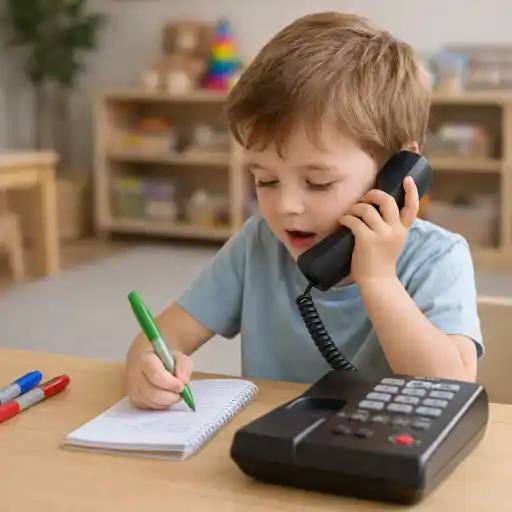
Voicemail role play also makes spoken language purposeful. A child might explain that a stuffed-animal visitor is late, report that the pretend bakery needs more flour, or invite a classmate to a block-building meeting. Such scenarios encourage #language, listening, turn-taking, and early writing as children dictate or mark information on a message card. Dramatic play can bring communication and print together in an authentic way, as noted in guidance on emergent literacy in everyday play.
The goal is not a perfect script. It is a supportive opportunity to practice how messages work: a speaker communicates information, a listener attends, and written marks can help preserve what was said. Keep the experience light, responsive, and open to children’s ideas.
What information makes a message complete?
A simple message structure gives children a helpful memory aid. Keep a card nearby with picture cues or large-print prompts. For preschoolers, four parts are usually enough to begin:
- Who is calling? The caller says their name or chooses a character name.
- Who is the message for? The caller identifies the person or role they want to reach.
- What is the message? The caller shares the main information in one or two connected ideas.
- Is there a next step? The caller may add a time, plan, or request, such as “Please call me after lunch.”
Adults can model a brief example: “Hi, this is Maya. I’m calling for the library helper. The book delivery is here. Please come to the front desk.” Ask children what details helped them understand the message. A conventional phone-message form can support dramatic play and early writing, as illustrated by this telephone message form for role play.
Accept developmentally appropriate approximations. A child may draw a picture, make a mark, dictate to an adult, or use a few words. The communication goal is meaningful participation, not spelling accuracy.
How can providers set up a welcoming phone center?
Create a small, defined area with a toy phone, a few message cards, chunky crayons or pencils, and props that spark scenarios. The Pretend Voicemail Message Cards and Phone Center Kit can provide a ready-to-use starting point: place cards where children can reach them, and keep the center uncluttered so the phone, writing materials, and pretend roles are easy to understand.
Rotate themes to sustain interest. A classroom “office” might receive calls about a field trip, a lost teddy bear, or a party invitation; a veterinary clinic could take messages about an animal needing care. Add familiar materials such as a notepad, a small basket for completed cards, and simple role labels. Use a disconnected toy phone or a pretend device, and avoid using children’s or families’ real phone numbers and private information.
Introduce the center with a short, playful demonstration rather than a long explanation. Show how to answer, pause to listen, and jot or draw a few key details. Then let children explore. Effective play support combines engaging materials with attentive, light-touch scaffolding, as described in guidance on supporting children’s play.
- 📞 Keep the pretend phone and message cards together in a consistent, accessible spot.
- Offer picture prompts, home-language words, and alternatives such as pointing or dictating.
- Make room for children to choose whether to call, record, listen, or simply watch at first.
How can adults scaffold without taking over?
Join the play as a curious partner. Follow the child’s scenario, listen for the message’s purpose, and offer a prompt only when it helps the child continue. Useful questions include, “Who needs to hear this?” “What should they know first?” and “Is there anything they need to do?” Then wait. A pause gives children time to plan and respond, and a genuine back-and-forth interaction is more supportive than rapid-fire questioning.
Model language naturally. If a child says, “Tell Sam we going park,” you might respond, “You want Sam to know we’re going to the park. Let’s tell Sam when.” This expansion respects the child’s contribution while offering a fuller sentence. You can also repeat the child’s exact words as you write or draw on the card, making the connection between spoken language and written marks visible.
For children who are learning more than one language, welcome communication in their strongest language and use visual supports, familiar names, or family-shared vocabulary. Children’s language and literacy skills can develop in any language, and supporting the home language can help build a strong foundation, as explained by Head Start’s language and literacy guidance.
Avoid correcting every pronunciation or insisting on a fixed script. The adult’s role is to keep the exchange meaningful, safe, and inviting—not to turn dramatic play into a test.
How can providers adapt the activity and notice learning?
Adjust the task to children’s ages, interests, communication styles, and access needs. Younger children may enjoy pressing a pretend button, making a sound, or delivering a one-word message. Preschoolers might identify the caller, dictate a short sentence, or add a time and next step. Children who communicate through gestures, pictures, or augmentative communication can participate by selecting symbols or having a partner record their message.
Notice process rather than judging children against a single standard. Brief observation notes can capture whether a child:
- Names a caller or intended recipient.
- Includes a main idea or relevant detail.
- Waits, listens, and takes a conversational turn.
- Uses drawing, marks, symbols, speech, or a communication device to convey meaning.
- Retells or adds to a peer’s message during play.
Use these observations to plan the next small step. If children leave out key information, model one additional detail; if they already offer complete ideas, invite them to create a new scenario or record a peer’s message. Share strengths and examples with families when appropriate, while protecting children’s privacy. State requirements vary - check your state licensing agency if you are aligning classroom documentation or staff training with local rules.
What common pitfalls should providers avoid?
One common pitfall is turning the station into a handwriting assignment. Children may be at very different stages of drawing, mark-making, and conventional writing; the activity remains valuable when an adult scribes or a child uses a picture. Keep writing meaningful and let spoken communication lead.
Another pitfall is over-directing the play. A lengthy lesson or repeated corrections can interrupt a child’s story. Demonstrate the basic idea, then step back and offer brief prompts as needed. Also avoid expecting every message to include every field; use a few clear cues first and add complexity only when children show interest and readiness.
Finally, keep the pretend scenario safe and inclusive. Use fictional names and details, supervise small materials, and make sure children can participate without having to speak aloud. Provide a choice to observe, gesture, draw, dictate, or use communication supports. These adjustments preserve the playful purpose while giving every child an entry point.
For further professional learning, these English-language ChildCareEd courses connect closely to the strategies in this article:
- Language Development in Early Childhood Buy Now $16.00 — practical foundations for supporting young children’s communication.
- Reading Aloud and Storytelling Buy Now $16.00 — interactive approaches to language, narrative, and literacy.
- Building Vocabulary Buy Now $16.00 — strategies for expanding children’s word knowledge through meaningful experiences.
- Language and Literacy Foundations in Pre-K Buy Now $16.00 — a focus on communication and emergent literacy in preschool.
- Play Safe, Think Big: Literacy Through Play Buy Now $10.00 — ways to nurture early literacy while maintaining active supervision.
Conclusion: How can pretend voicemail build complete messages?
Pretend voicemail gives children a purposeful, low-pressure way to practice listening, organizing ideas, sharing details, and connecting speech with early writing. A simple message framework—caller, recipient, main idea, and optional next step—helps children understand what makes a message useful, while picture cues and adult modeling make the activity accessible.
Set up an inviting phone center, follow children’s play, and scaffold with brief prompts, patient pauses, and language expansions. Adapt the task for different ages, languages, and communication needs, and observe growth without demanding one “correct” format. With thoughtful support, a pretend call can become a small but rich opportunity for communication, literacy, and connection.
- Language and Literacy Foundations in Pre-K
- Pediatric RSV First Aid & CPR/AED
- CDA Bridge Bundle: Family Child Care without Portfolio Review
- CDA Bridge Bundle: Infant/Toddler without Portfolio Review
- CDA Bridge Bundle: Preschool without Portfolio Review
- Creating Environments that Nurture Growth and Community
- Texas Director Credential
- Bridging Cultures: Family Communication & Collaboration
- Supporting Families and Caregivers in Language and Literacy
- Frequently Asked Questions
- CDA Certification en Español: Recursos y Consejos para Educadores Bilingües
- 🔍 ¿Qué ves cuando observas a un niño aprender?
- 💛🧩 ¿Cómo puedo hacer que mi enseñanza sea inclusiva para los niños con autismo?
- 👶 ¿Cuáles son las proporciones y grupos requeridos en Dakota del Norte? 🏫
- ¿Cómo empiezo mi certificación CDA en Florida en línea?
- 10 Ejemplos de Cómo la Cultura Influye en el Desarrollo Infantil
- Regulaciones de Licenciamiento de Cuidado Infantil en California para Centros y Hogares de Cuidado Infantil Familiar
- Reglas de Cuidado Infantil en Illinois
- Proporciones de Cuidado Infantil y Tamaños de Grupo por Edad en Maryland (Guía Rápida para Centros y Hogares)
- Proporciones de Cuidado Infantil y Tamaños de Grupo por Edad en Nueva Jersey (Guía Rápida para Centros y Hogares)
- Proporciones de Cuidado Infantil y Tamaños de Grupo por Edad en Virginia (Guía Rápida para Centros y Hogares)
- Actividades de Otoño Fáciles para Preescolares esta Temporada
- Lista para Guardería en Casa en Illinois: Cómo Iniciar una Guardería en el Hogar
- Lista para Guardería en Casa en California: Cómo Iniciar una Guardería en el Hogar
- Cómo Trabajar en el Cuidado Infantil en Carolina del Norte: Requisitos y Pasos
- Celebrando la amistad en el cuidado infantil durante el Día de los Mejores Amigos
- Canciones, juegos y preguntas de círculo para niños
- Cómo simplificar la capacitación para sus empleados de daycare
- How Can Pretend Voicemail Help Children Leave a Complete Message?
