A jungle maze can be more than a quiet-time worksheet: it can invite children to plan, persist, talk through choices, and celebrate discovery. Pair the Curriculum Planning course  Buy Now $24.00 with the The Best Promotion is Play course Buy Now $24.00 to strengthen your ability to turn children’s interests into purposeful, developmentally appropriate learning experiences. These trainings offer practical foundations for planning engaging classroom experiences while this guide shows how to bring a jungle maze to life.
Why does a jungle maze offer more than a puzzle?
When a child studies a maze, chooses a route, reaches a dead end, and tries again, they are practicing a genuine problem-solving cycle: notice, plan, test, and revise. A jungle story gives that cycle a meaningful purpose—perhaps helping a monkey find bananas or guiding a tiger cub back to its family. The imaginative context can help children stay engaged without taking away the thinking work.
Maze play can draw on several areas of development at once. Children may use visual tracking and spatial reasoning to follow paths, fine-motor control to trace with a finger or crayon, and language to describe turns or explain a new strategy. When children solve together, they also practice listening, turn-taking, and considering a peer’s idea. The Head Start framework describes early learning through interconnected domains, including approaches to learning, cognition, language, social-emotional development, and physical development.
That range makes a jungle maze a useful teaching opportunity—not a test of speed or correctness. The aim is to notice how each child approaches a challenge and to offer just enough support for the next step. Small successes, including changing direction after a wrong turn, are meaningful evidence of learning.
How can educators plan a purposeful jungle-maze experience?
Begin with one or two clear goals, rather than expecting a single maze to teach everything. A goal might be for children to trace a route with growing control, use directional words, or explain what they will try after encountering a dead end. Then connect the goal to children’s interests and the group’s current curriculum theme.
- Prepare the maze, crayons or tokens, and a small set of jungle animals or pictures.
- Introduce a simple story problem: “How can the elephant reach the watering hole?”
- Decide what you will observe, such as route planning, persistence, hand control, or cooperation.
- Plan an extension, such as drawing a new path or building a larger route with blocks or floor tape.
A plan provides direction, not a script. If children become curious about animal habitats or invent their own maze, follow that interest while keeping the learning goal in view.
How should maze challenges be adjusted for different learners?
The best maze is challenging enough to invite thought, but not so difficult that a child loses access to the activity. Consider age, experience, motor control, vision, language, attention, and the child’s comfort with puzzles. Start with a broad, simple path for beginners; offer more intersections or alternate routes when a child is ready for additional complexity.
Change the way children participate, too. A child may trace with a finger before using a pencil, move a toy animal through a printed route, point to the next turn, or describe directions aloud. For young children still developing pencil control, finger tracing is a supportive first step; the jungle-animal maze resource also recommends tracing with a finger before moving to a pencil or crayon.
- Widen paths or enlarge the print for easier visual and motor access.
- Use a high-contrast route, a raised line, or a tactile cue when helpful.
- Offer a starting point, a picture clue, or one decision at a time.
- Invite a peer partner when shared planning is useful, while ensuring each child has a meaningful role.
- Let children stop, take a break, or return later; completion is not the only evidence of learning.
These adjustments preserve the central challenge—figuring out a route—while making participation more inclusive. Avoid assuming that one age label predicts what an individual child can do.
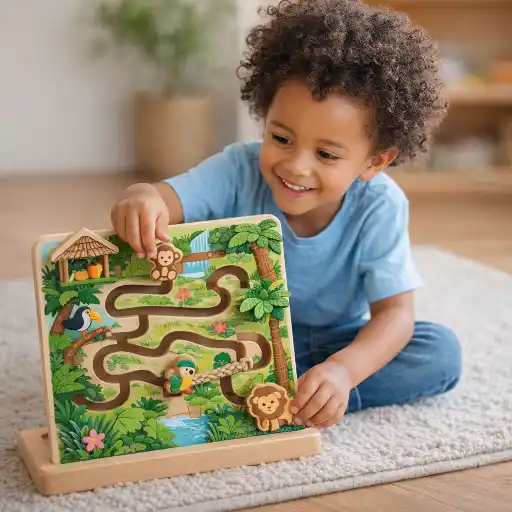
What can educators say and observe while children solve?
- “Where might this path take you?”
- “What did you notice when you reached that turn?”
- “What could you try next?”
- “How is your partner’s idea different from yours?”
- “What helped you find a way through?”
Give children time to look, point, draw, gesture, or explain verbally. If frustration rises, acknowledge it without taking over: “That path didn’t work the way you hoped. Let’s pause and see what you noticed.” This frames a dead end as useful information rather than failure.
Observe a few specific behaviors rather than trying to record everything. Note whether a child starts independently, anticipates a turn, changes strategy, controls a tracing tool, or collaborates with a peer. A short, objective note can guide your next plan: “Maya traced with her finger, tried a second route after a dead end, and explained why she changed direction.” These observations help educators adjust the next challenge and share concrete progress with families.
How can the maze connect with a wider jungle curriculum?
A maze can be the starting point for an integrated learning sequence, not an isolated worksheet. Follow the puzzle with a jungle story, a conversation about habitats, or a collaborative map children design themselves. Ask children to invent a problem for an animal and create paths that offer more than one possible route. Such extensions connect spatial reasoning with literacy, science, art, early mathematics, and social learning.
For example, children might count turns, compare short and long routes, sort animal pictures by habitat, or dictate a story about the journey. A floor maze made with safe tape can add movement and directional vocabulary; blocks can become walls and tunnels. The practical guidance in ChildCareEd’s creativity and logic activities describes ways maze experiences can support sequencing, planning, motor practice, language, and observation when educators set a goal and scaffold thoughtfully.
Keep animal and habitat content accurate and respectful. “Jungle” can be a playful theme, but educators can explain that real tropical forests are diverse environments with many kinds of plants, animals, and communities. Invite children’s questions and family knowledge, and use reliable materials when adding facts. A connected, flexible sequence makes the maze more relevant while allowing children to revisit ideas through different modes of play.
What common pitfalls can educators avoid?
A maze activity can lose its learning value when the adult’s goal becomes finishing quickly or getting the “right” path with no room for children’s reasoning. Keep the focus on process: what children notice, try, change, and communicate. A wrong turn is a normal part of exploration, not a reason for correction or embarrassment.
- Too much difficulty: simplify the route, widen paths, or break the challenge into smaller decisions.
- Too little challenge: invite the child to design a maze or compare two possible paths.
- Overdirecting: pause before giving a solution and ask what the child is considering.
- One-size-fits-all materials: offer alternatives such as finger tracing, a toy, larger print, or verbal directions.
- 🎉 Rewarding only completion: recognize persistence, curiosity, strategy changes, and collaboration as well.
- Planning without observation: use what children show you to choose the next step, rather than repeating an activity unchanged.
It is also easy to treat a themed worksheet as a complete curriculum. Instead, connect it to an intentional learning goal and follow children’s thinking. State requirements vary - check your state licensing agency when determining any training or curriculum obligations for your program.
Conclusion: What makes jungle-maze problem-solving effective?
A jungle maze becomes a rich learning experience when educators make its purpose clear, match the challenge to each child, and value the process as much as the finished path. Children can practice planning, spatial reasoning, fine-motor coordination, communication, and persistence—especially when an adult provides thoughtful prompts without taking control.
Plan with a small number of goals, adapt the materials and response options, observe children’s strategies, and extend their curiosity into stories, movement, science, art, or collaborative design. Keep the atmosphere playful and welcoming: a dead end is simply a clue to reconsider the route.
For a deeper foundation in designing meaningful learning experiences, explore ChildCareEd’s Curriculum Planning course Buy Now $24.00 and The Best Promotion is Play course Buy Now $24.00. Together with reflective practice, these resources can help your team turn a simple jungle maze into purposeful, responsive learning for young children.
- 45 Hour Preschool Methods and Materials
- From Play to Planning: Building Culturally Competent, Child-Centered Curriculum
- Birth to Five CDA Credential with Portfolio Review
- Children at the Wheel: Emergent Curriculum
- Emergent Learning & Development
- 45-Hour Infant and Toddler Curriculum
- Creating Engaging and Meaningful Learning Experiences
- Texas Director Credential
- Spaces that Support Discovery
- Creativity & Logic Activities
- CDA Certification en Español: Recursos y Consejos para Educadores Bilingües
- 🔍 ¿Qué ves cuando observas a un niño aprender?
- 🪁¿Cómo puede el juego apoyar de manera poderosa a los niños con autismo?🧩
- 💛🧩 ¿Cómo puedo hacer que mi enseñanza sea inclusiva para los niños con autismo?
- 🤯 ¿Por qué este niño está teniendo un comportamiento difícil de repente?
- 10 Ejemplos de Cómo la Cultura Influye en el Desarrollo Infantil
- Proporciones de Cuidado Infantil y Tamaños de Grupo por Edad en Virginia (Guía Rápida para Centros y Hogares)
- Celebrando la amistad en el cuidado infantil durante el Día de los Mejores Amigos
- Canciones, juegos y preguntas de círculo para niños
- Cómo Planificar Actividades al Aire Libre Seguras Durante el Calor y la Mala Calidad del Aire
- Common After School Activities Kids Get Bored With—and What to Try Instead
- How Do Mazes Strengthen Pencil Control and Problem-Solving in Preschool?
- How Can You Increase Maze Difficulty Without Frustrating Young Learners?
- How Can Low-Prep Christmas Activities Build Preschoolers’ Visual Planning?
- How Can Spring-Themed Pencil-Control Activities Support Preschoolers’ Pre-Writing Skills?
- How Can Farm-Themed Mazes Build Spatial Reasoning and Pencil Control?
- How Can Valentine’s Day Problem-Solving Activities Help Preschoolers Learn?
- How Can a Jungle Maze Turn Play into Problem-Solving for Young Learners?
