What looks like a simple path on paper can become a powerful opportunity for preschoolers to practice controlled movement, planning, and persistence. Pair maze activities with DAP for Preschool  Buy Now $24.00 to strengthen your understanding of developmentally appropriate practice and translate playful pencil work into intentional classroom learning.
Why do mazes matter for preschool development?
Mazes are valuable because they combine physical and cognitive demands in one accessible activity. A child must look carefully, decide where to move, guide a tool, notice errors, and continue toward a goal. This integration supports #pencil control, visual-motor coordination, attention, spatial reasoning, and problem-solving without requiring expensive equipment.
Research and practitioner guidance consistently describe fine motor skills and executive function as important contributors to kindergarten readiness. Fine motor control and executive function each contribute to children’s early achievement, while visual-motor integration is associated with early mathematical development (Cameron et al., 2012; Li et al., 2025). These findings do not mean that completing worksheets guarantees later success. Rather, they support providing varied, meaningful experiences in which children can practice related skills.
Mazes also offer an emotionally manageable form of challenge. A wrong turn is information, not failure. Children can pause, retrace, and try again. This makes maze work a natural setting for developing persistence and frustration tolerance.
- Fine motor practice: controlled starts, stops, curves, and turns.
- Visual tracking: following a route while anticipating what comes next.
- Executive function: planning, working memory, flexibility, and inhibition.
- Language growth: using words such as beside, around, under, left, and right.
How do mazes build pencil control?
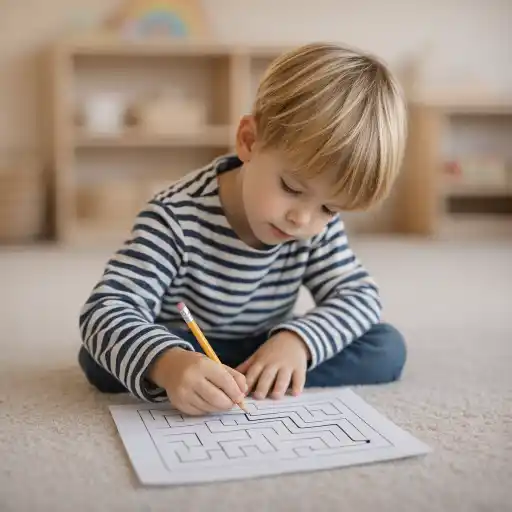
Pencil control develops gradually through repeated opportunities to make purposeful, increasingly precise movements. In a maze, children practice staying within boundaries, adjusting pressure, changing direction, and stopping before crossing a wall. These actions resemble the controlled strokes needed for drawing, copying shapes, and eventually forming letters.
Start by matching the maze to the child’s current ability rather than assuming that every preschooler should use the same page. Wide pathways, high-contrast lines, short routes, and clearly marked start and finish points reduce visual and motor demands. As control improves, introduce longer paths, tighter turns, gentle curves, and additional decision points.
A helpful progression is to move from large movements to smaller ones:
- Trace a route with the index finger.
- Guide a toy car or marker through a large floor maze.
- Trace a wide paper maze with a crayon.
- Use a short pencil or colored pencil for more precise control.
- Repeat a familiar maze with fewer verbal prompts.
Children do not need a perfect grip to benefit. Avoid forcing a particular grasp; instead, offer short crayons, triangular crayons, clipboards, or an angled writing surface. Observe whether the child can control the tool, remain comfortable, and sustain participation. If fatigue or pain is persistent, share observations with the family and follow appropriate referral procedures.
How can maze play strengthen problem-solving?
Every maze presents a small, authentic problem: how can I reach the destination? Children plan routes, test choices, monitor progress, and revise strategies when a path ends. This cycle—plan, act, evaluate, adjust—is a concrete introduction to flexible thinking.
Adult language determines whether the child owns the problem. Instead of pointing out the correct route, try prompts that invite reasoning:
- “What do you notice about these two paths?”
- “Where might this route lead?”
- “What could you try if the path is blocked?”
- “How do you know this is a dead end?”
- “Can you show me another way?”
Allow productive struggle, while remaining emotionally available. A child may need encouragement, a brief model, or a simpler maze—not an adult solution. Normalize revision by saying, “That route gave us useful information. Let’s look again.” This approach supports #problem-solving and helps children view mistakes as part of learning.
Problem-solving can also be social. Invite two children to plan a floor route together, with one child describing directions and the other moving a toy. Then switch roles. This adds turn-taking, listening, negotiation, and perspective-taking to the activity.
How should providers plan age-appropriate maze experiences?
Intentional planning begins with a clear objective. Decide whether the primary goal is pencil control, visual tracking, directional language, persistence, sequencing, or cooperation. One maze can address several domains, but a focused objective helps educators choose materials and observe progress.
- For younger preschoolers: use finger paths, large floor routes, wide paper corridors, and one or two turns.
- For older preschoolers: add multiple routes, themed destinations, simple maps, or paths that require remembering two steps.
- For children developing language: pair the maze with picture symbols, gestures, home-language vocabulary, and repeated directional phrases.
- For children who prefer movement: tape a path to the floor or wall and invite them to walk, crawl, or guide a vehicle through it.
Integrate mazes into centers rather than treating them only as table work. A “rescue the animal” maze can support storytelling and vocabulary. A number maze can connect movement with counting. A shape maze can invite classification. After children finish, ask them to explain the route, draw a map, or create a maze for a peer.
Keep practice brief and voluntary when possible. Two to ten focused minutes may be more productive than a long session after fatigue has begun. Rotate paper activities with playdough, construction, cutting, threading, drawing on vertical surfaces, and outdoor movement. As discussed in Creativity & Logic Activities, maze experiences are most powerful when connected to language, math, observation, and hands-on exploration.
How can educators adapt and document maze learning?
Inclusive maze design preserves the learning goal while changing the pathway, tool, sensory input, or level of support. Widen the corridors, simplify the route, add tactile boundaries, use a contrasting background, or permit the child to move a token instead of drawing. A child can demonstrate planning verbally, through gestures, by placing arrows, or by guiding a toy.
Consider these adaptations:
- 🧩 Use raised glue lines, textured tape, or a shallow tray for tactile feedback.
- Provide larger paper, an easel, or a clipboard for improved posture and stability.
- Offer a short crayon, adapted grip, or marker when a thin pencil is tiring.
- Reduce visual clutter and present one section of a maze at a time.
- Pair children strategically, ensuring that peer support does not replace the child’s own decision-making.
Documentation should capture the process, not merely whether the maze was completed. During a three- to five-minute observation, note:
- How the child approached the starting point.
- Whether the child planned or described a route.
- How steadily the child controlled the tool or object.
- How the child responded to a dead end.
- How much prompting or physical assistance was needed.
- Whether the child used directional or sequencing language.
A useful note might read: “Maya traced a two-turn maze with a short crayon, paused at a dead end, backtracked independently, and completed the route with one verbal prompt.” Repeated notes help providers plan next steps and communicate strengths to families. State requirements vary - check your state licensing agency.
What common mistakes should providers avoid?
Mazes are simple to offer, but thoughtful implementation matters. The most common mistake is selecting a page that is too difficult. Narrow paths, crowded graphics, and numerous dead ends can turn a promising activity into an exercise in discouragement. Begin with success, then increase challenge gradually.
Another mistake is correcting every movement. Frequent reminders such as “stay in the lines” can shift attention from reasoning to performance anxiety. Use descriptive feedback instead: “You slowed down at the curve,” or “You noticed the wall and changed direction.”
- Mistake: Using paper mazes as the only fine motor experience.
Better approach: Balance them with manipulatives, sensory play, art, construction, and self-help routines. - Mistake: Measuring only speed or perfect completion.
Better approach: Observe planning, persistence, control, communication, and independence. - Mistake: Solving the maze for a frustrated child.
Better approach: simplify the task, model one small strategy, and return responsibility to the child. - Mistake: Expecting identical pencil grasps or outcomes.
Better approach: respect developmental variation and provide accessible tools.
Safety and supervision remain essential, especially with floor materials, small objects, clips, or manipulatives used in maze construction. Choose materials appropriate for the children’s ages and follow program policies. If concerns about fine motor development persist across settings and activities, collaborate with families and relevant professionals rather than making a diagnosis from maze performance.
How can directors support consistent classroom practice?
Directors can make maze activities part of a coherent curriculum by giving staff a shared planning and observation structure. A simple team template might include the learning objective, materials, adaptations, teacher prompts, and evidence to collect. This helps educators move beyond “busy work” and connect playful tasks to children’s development.
Invite teachers to review one observation during weekly planning meetings. Ask: Which supports helped? Was the challenge appropriate? Did the child transfer the strategy to another activity? What should change next time? These conversations turn small moments of play into actionable curriculum decisions.
For broader professional learning, From Play to Planning: Building Culturally Competent, Child-Centered Curriculum Buy Now $55.00 explores play, scaffolding, problem-solving, emergent learning, and inclusive curriculum design. Providers seeking a more comprehensive preschool focus may also explore the CDA Preschool Credential Buy Now $400.00, a 120-hour self-paced training that covers all eight CDA Subject Areas; completing training does not itself award the CDA Credential, which is issued by the Council for Professional Recognition after all requirements are met.
Additional relevant options include:
- Lesson Planning for Preschoolers Buy Now $24.00 for connecting activities to developmentally appropriate objectives.
- Preschool Assessments & Observations Buy Now $24.00 for strengthening objective documentation and individualized planning.
- Classroom Tools for Emergent Literacy Buy Now $16.00 for extending maze work into language and early literacy experiences.
Conclusion: How do mazes strengthen pencil control and problem-solving?
Mazes strengthen preschoolers’ pencil control by requiring precise, purposeful movements within visible boundaries. They strengthen problem-solving by inviting children to plan, test, notice consequences, revise strategies, and persist toward a goal. Their greatest value comes from intentional use: select a just-right challenge, provide supportive language, adapt materials, and document the child’s process.
Start with one short maze experience this week. Let children trace with fingers, move through a floor route, or guide a crayon across a wide path. Then observe what each child notices, attempts, and explains. When educators treat mazes as playful investigations rather than worksheets to finish, a small path on paper becomes a meaningful route toward #fine motor growth, confidence, and flexible thinking.
- CDA Preschool Credential
- Lesson Planning for Preschoolers
- 45 Hour Preschool Methods and Materials
- DAP for Preschool
- Birth to Five CDA Credential with Portfolio Review
- CDA Bridge Bundle: Preschool
- Art from the Heart for Preschoolers: Open Ended Art Projects that Build Self-Esteem
- CDA Bridge Bundle: Preschool without Portfolio Review
- Texas Director Credential
- Creativity & Logic Activities
- Qué capacitación se requiere para ser director de cuidado infantil en Texas?
- Recursos en Español sobre el Sueño Seguro del Bebé
- Cómo ser director de cuidado infantil en Maryland
- Que es Título 22 en California?
- 10 Ejemplos de Cómo la Cultura Influye en el Desarrollo Infantil
- Capacitación en Salud y Seguridad Preventiva en Línea para Proveedores de Cuidado Infantil
- Lista para Guardería en Casa en Illinois: Cómo Iniciar una Guardería en el Hogar
- Lista para Guardería en Casa en Texas: Cómo Iniciar una Guardería en el Hogar
- Apoyo en Preescolar para Retrasos del Habla: Estrategias Simples que Ayudan
- Cómo Trabajar en el Cuidado Infantil en California: Requisitos y Pasos
- Cómo Ser Maestra de Preescolar en Dakota del Norte
- Cómo Ser Maestra de Preescolar en Maryland
- Capacitación Previa al Servicio para Proveedores de Cuidado Infantil en Dakota del Norte
- Cómo simplificar la capacitación para sus empleados de daycare
- How Do Mazes Strengthen Pencil Control and Problem-Solving in Preschool?
- How Can You Increase Maze Difficulty Without Frustrating Young Learners?
- How Can Low-Prep Christmas Activities Build Preschoolers’ Visual Planning?
- How Can Farm-Themed Mazes Build Spatial Reasoning and Pencil Control?
- How Can Valentine’s Day Problem-Solving Activities Help Preschoolers Learn?
