A child’s route through a maze can reveal more than whether they reach the finish: it can show how they anticipate, test ideas, and respond to a dead end. The CDA: Approaches to Learning course  Buy Now $24.00 can help providers connect those observations with children’s individual learning styles and development. Pair that professional learning with the Advanced Kids Maze Activity Buy Now $0.99, which offers five mazes that gradually increase in difficulty, for a practical way to invite and observe children’s strategies.
Why is a maze a useful window into planning?
A maze gives a child a clear goal and a set of possible routes. To make progress, the child must notice the layout, choose a direction, monitor what happens, and decide whether to continue or change course. That sequence offers educators a small, observable glimpse of planning in action—not a complete measure of a child’s ability, but useful information about how they approach a challenge.
Planning draws on related capacities such as working memory, attention, inhibition, and cognitive flexibility. A child may look ahead before moving, remember a route, pause rather than cross a boundary, or revise a choice after discovering a dead end. The Harvard Center on the Developing Child’s activities guide for executive function describes age-appropriate activities as opportunities to practice executive function and self-regulation skills. A maze can be one playful opportunity among many.
The child’s process matters more than a perfect finish. One learner may plan silently; another may narrate every turn, point, or move a toy along the path. All can demonstrate purposeful thinking. As educators, we can value the strategy, persistence, and reflection we see rather than treating maze completion as a pass-or-fail test.
Which planning behaviors can educators observe?
Notice how a child begins and what they do at each decision point. Some children scan the whole route; others begin immediately and learn through trying. Neither behavior alone establishes a fixed skill level. Look for patterns over time and across different play experiences.
- Anticipation: Does the child look ahead or point to a possible next turn before moving?
- Sequencing: Can the child describe or remember one or more steps in a route?
- Inhibition: Does the child pause at an intersection or boundary instead of moving impulsively?
- Flexibility: After reaching a dead end, does the child backtrack, reconsider, or try another route?
- Monitoring: Does the child check whether a chosen path is still leading toward the goal?
- Communication: Does the child use words, gestures, or home-language phrases to express a plan?
These behaviors align with broader descriptions of children’s problem-solving, including forming a mental model of a task and selecting steps that move toward a goal. The chapter on observing children’s problem solving offers a useful framework for noticing the parts of a problem-solving process.
Keep observations descriptive. For example: “Jordan scanned the maze, tried the upper path, then retraced independently after reaching a dead end.” This is more helpful for planning than a label such as “good at mazes.”
How can providers support planning without taking over?
Children need enough time and emotional safety to make their own choices. Rather than pointing to the correct route, pause and invite the child to think aloud or show their idea. Open-ended prompts make reasoning visible while keeping ownership with the learner.
- “What do you notice about the paths from here?”
- “Where might this route take you?”
- “What could you try if you reach a dead end?”
- “Would you like to look ahead before choosing?”
- “How did you decide to try a different way?”
When a child gets stuck, acknowledge the challenge without rushing to solve it: “This part is tricky. Let’s take a moment and see what you notice.” A calm adult presence can help a child stay engaged, but productive struggle should remain manageable. Offer a clue, demonstrate one small strategy, simplify the route, or take a break when needed.
NAEYC’s discussion of observing, planning, and guiding through play emphasizes the educator’s role in observing children and extending learning through thoughtful questions and support. In a maze activity, that means guiding the process without supplying the solution. Celebrate the useful thinking: “You noticed that path ended and went back to choose another.”
How should maze challenges be matched to individual learners?
Planning becomes visible when the challenge is accessible enough for the child to engage. Consider pathway width, visual complexity, number of turns, and the child’s familiarity with the activity. The Advanced Kids Maze Activity includes five mazes that gradually increase in difficulty, allowing providers to offer different levels without assuming every child should complete the same page.
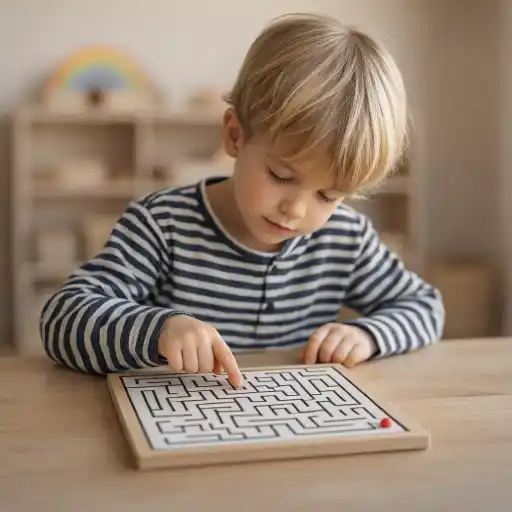
Adjust one feature at a time. A child may be ready for more intersections but still benefit from wide paths; another may understand the route but prefer a token to pencil tracing. Remember that maze performance combines several demands: reasoning, visual tracking, attention, and sometimes fine-motor control. If the goal is planning, do not let pencil precision become an unnecessary barrier.
- Begin with a simple route or invite finger-tracing before using a writing tool.
- Use a toy, counter, or picture token to move through the path.
- Enlarge the maze, reduce visual clutter, or cover part of the page.
- Let children point, gesture, describe the route, or use their home language.
- 🌟 Offer a choice to repeat a familiar maze, try a new level, or pause and return later.
Spatial language can enrich the experience: “beside,” “around,” “between,” and “toward” help children describe relationships and routes. The Early Childhood Mathematics Group’s spatial reasoning toolkit highlights the value of spatial language, movement, maps, and hands-on exploration. Combine paper mazes with floor routes, blocks, or small-world play so children can explore similar ideas in different ways.
How can observations guide next steps and avoid common pitfalls?
Use brief notes to inform what you offer next. During or after an activity, record a few observable details: whether the child looked ahead, how they responded to a dead end, what tools they used, and how much support helped. A short note might say: “After tracing with a finger, Sam planned a two-turn route and independently changed direction at a dead end.” Over time, these notes can help educators notice changes in strategies and share specific examples of learning with families.
Avoid making the finished worksheet the only evidence of success. A child might stop before the end but show thoughtful route planning, or finish quickly by moving impulsively without looking ahead. Consider the whole process, including communication, comfort, persistence, and independence. The NAEYC topic page on executive function includes resources on play-based strategies and persistence with challenging tasks.
- Common pitfall: Choosing a maze that is too difficult. Try instead: shorten the route, widen pathways, or reduce decision points.
- Common pitfall: Correcting every wrong turn. Try instead: ask what the child noticed and allow time to reconsider.
- Common pitfall: Measuring only speed or perfect tracing. Try instead: document planning, backtracking, and the child’s chosen strategies.
- Common pitfall: Treating one maze as an assessment or diagnosis. Try instead: consider observations across activities and follow program procedures if concerns persist.
State requirements vary - check your state licensing agency when determining training or program obligations.
Conclusion: What does a child’s maze approach tell us?
A child’s approach to a maze can offer a meaningful snapshot of how they plan, monitor choices, and adjust when a route does not work. Looking ahead, pausing at a turn, trying an alternative, or explaining a choice are all useful observations—but none should be interpreted in isolation or used to rank children.
Match the maze to the learner, invite thinking with open-ended prompts, and observe the process rather than focusing only on completion. Offer varied ways to participate and use what you notice to plan a responsive next experience. The central question is not simply whether a child reaches the finish, but how they make decisions along the way—and how our support can help them keep exploring.
For a deeper foundation in how children learn differently and develop at their own pace, explore the CDA: Approaches to Learning course Buy Now $24.00. To bring graduated maze challenges into your classroom, see the Advanced Kids Maze Activity Buy Now $0.99.
Further professional learning
- CDA: Approaches to Learning Buy Now $24.00 — understand individual learning styles and factors that influence learning.
- Early Mathematics Through Play Buy Now $24.00 — explore practical, play-based ways to support reasoning and early math.
- The Best Promotion is Play Buy Now $35.00 — consider how meaningful play supports cognitive, language, physical, and social development.
- Lesson Planning for Preschoolers Buy Now $24.00 — strengthen developmentally appropriate planning and classroom practice.
- From Play to Planning: Building Culturally Competent, Child-Centered Curriculum Buy Now $55.00 — connect observation, scaffolding, and child-centered curriculum.
- CDA Home Visitor Subject Area 2 Part 3 Birth to 5
- Birth to Five CDA Credential with Portfolio Review
- Children at the Wheel: Emergent Curriculum
- CDA Bridge Bundle: Preschool
- Classroom Arrangement: The Second Teacher
- CDA Bridge Bundle: Family Child Care
- CDA Bridge Bundle: Family Child Care without Portfolio Review
- CDA Bridge Bundle: Infant/Toddler without Portfolio Review
- CDA Bridge Bundle: Preschool without Portfolio Review
- CDA Bridge Bundle: Infant/Toddler
- Pencil and Paper Activiites
- Creativity & Logic Activities
- CDA Certification en Español: Recursos y Consejos para Educadores Bilingües
- 10 Ejemplos de Cómo la Cultura Influye en el Desarrollo Infantil
- Proporciones de Cuidado Infantil y Tamaños de Grupo por Edad en Maryland (Guía Rápida para Centros y Hogares)
- Actividades de Otoño Fáciles para Preescolares esta Temporada
- Celebrando la amistad en el cuidado infantil durante el Día de los Mejores Amigos
- How do I select developmentally appropriate digital resources for young children?
- After School Activities for Elementary Kids Who Finish Homework Early
- How Do Mazes Strengthen Pencil Control and Problem-Solving in Preschool?
- How Can You Increase Maze Difficulty Without Frustrating Young Learners?
- How Can Low-Prep Christmas Activities Build Preschoolers’ Visual Planning?
- How Can Spring-Themed Pencil-Control Activities Support Preschoolers’ Pre-Writing Skills?
- How Can Farm-Themed Mazes Build Spatial Reasoning and Pencil Control?
- How Can Easter Mazes Build Fine-Motor Skills Without Losing Sight of Learning?
- How Can Valentine’s Day Problem-Solving Activities Help Preschoolers Learn?
- How Can a Jungle Maze Turn Play into Problem-Solving for Young Learners?
- How Can You Plan October Classroom Activities for Children Who Do Not Celebrate Halloween?
- What Screen-Free After-School Choices Engage Children Who Prefer Devices?
- What Can a Child’s Approach to a Maze Reveal About Planning Skills?
