When a preschooler cannot yet explain “I’m overwhelmed,” a picture can provide a powerful bridge to communication and calm. A feelings chart gives educators a concrete way to build emotional vocabulary, practice co-regulation, and guide safer choices; for deeper professional learning, explore From Tantrums to Triumphs: Equipping Preschoolers with Self-Regulation Skills Buy Now $25.00, which focuses on practical strategies for teaching self-control and responding to challenging behavior. Educators can also use the Feelings Faces Chart: 16 Simple Emotions Buy Now $0.99 to help children identify, name, and communicate their emotions while building the language and self-awareness needed for stronger self-regulation.Why does a feelings chart matter for self-regulation?
Self-regulation develops gradually. Preschoolers experience intense emotions while their language, impulse control, and problem-solving abilities are still emerging. A feelings chart does not make children calm automatically, but it gives them a visible vocabulary for communicating internal experiences before those experiences become unsafe actions.
Research on early emotional development connects regulation with warm relationships, classroom participation, peer interactions, and later learning. A systematic review of preschool research emphasizes that relational teacher support is central to children’s emotional development, while CASEL summarizes evidence that social-emotional learning benefits well-being and academic achievement. In practice, this means a chart is most effective when it is embedded in responsive relationships rather than treated as a behavior-management device.
For providers, the chart can help children:
- Recognize and label common #emotions.
- Ask for help, space, or comfort.
- Connect a feeling with a calming strategy.
- Notice that feelings are acceptable even when unsafe actions are not.
- Return to play and learning after co-regulation.
ChildCareEd’s guide on using feelings charts at home and in the classroom similarly emphasizes brief check-ins, child-height placement, and consistent adult follow-up. The chart is a starting point for conversation, not a test with one “correct” answer.
How should providers choose and arrange a feelings chart?
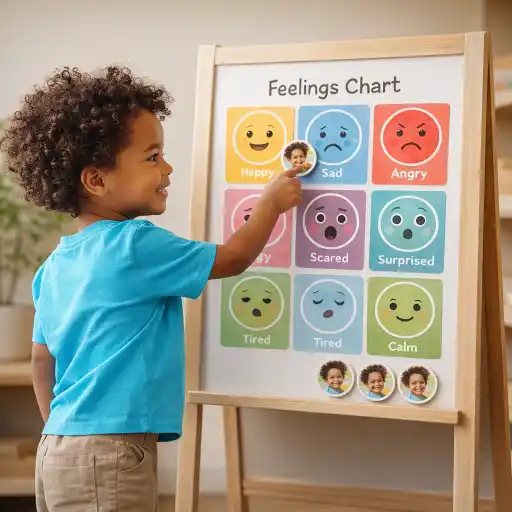
Begin with accessibility. A useful chart should be visible, durable, culturally responsive, and understandable to children who are not yet reading. Use photographs, illustrations, simple faces, symbols, or color choices according to the needs and preferences of the group. Include diverse skin tones, facial features, abilities, and ways of expressing emotion.
Start with four to six familiar feelings, such as happy, sad, mad, scared, tired, and calm. Add words such as frustrated, proud, worried, or disappointed after children have experience with the initial vocabulary. Too many choices can make the chart cognitively demanding, particularly during distress.
- Place it at children’s eye level near arrival, the meeting area, or a calm space.
- Laminate it or display it in a protective frame for repeated use.
- Offer several response modes: point, clip a name, use a gesture, draw, speak, or select a communication symbol.
- Keep privacy in mind, especially when using photographs or individual mood tracking.
- Pair the chart with two or three calming tools rather than an overflowing collection.
😊 A particularly effective setup is a small feelings station with a chart, a breathing visual, and a “What can help?” card. Children can identify a feeling and then choose a next step, such as breathing, asking for an adult, squeezing a soft object, or taking quiet space.
State requirements vary - check your state licensing agency regarding posted materials, photographs, documentation, supervision, and privacy practices.
How can teachers teach children to use the chart?
Teach the routine during calm, predictable moments. If children encounter the chart only during meltdowns, they may associate it with correction or public scrutiny. Instead, model its use during arrival, circle time, stories, dramatic play, and transitions.
A two-minute routine is enough:
- Invite the child to identify a feeling by pointing, speaking, gesturing, or choosing a symbol.
- Respond without judgment: “Thank you for showing me. You feel worried.”
- Connect the feeling to context: “The room is noisy, and you wanted your family to stay.”
- Offer one manageable choice: “Would you like a breath with me or a quiet seat?”
Use puppets to make practice playful. A puppet may lose a block, wait for a turn, or feel nervous about joining a game. Ask children which chart image might fit, while acknowledging that more than one interpretation is possible. Stories and songs can provide additional repetition: pause during a read-aloud and ask, “What might the character feel? What clues do you notice? What could help?”
Model your own emotional language briefly: “I feel frustrated because the tower fell. I’m going to breathe and try again.” This shows children that adults have feelings too and that regulation is a skill people continue practicing. Praise effort specifically: “You showed me ‘mad’ and asked for help. That kept your hands safe.”
Children may not always use the chart independently. That is not failure; it is information about the amount of adult support still needed.
How can the chart be connected to calming and problem-solving?
A chart becomes more meaningful when each feeling is connected to responsive action. Avoid suggesting that one strategy works for every child. Some children need movement, some need reduced stimulation, and others need closeness with a trusted adult.
Use a simple sequence: Notice → Name → Choose → Practice.
- Notice: “Your fists are tight and your voice is loud.”
- Name: “You might feel frustrated.”
- Choose: “Would you like wall pushes or three slow breaths?”
- Practice: Rehearse the strategy when the child is calm.
Place a small “calm choices” menu beside the feelings chart. Choices might include bubble breathing, smelling a pretend flower and blowing a candle, squeezing play dough, counting to five, asking for help, or using a supervised calm-down area. Keep the menu short so children can actually remember it.
After the child has recovered, use brief coaching rather than a lecture: “You were angry when the truck was unavailable. Next time you can say, ‘Can I have a turn?’” Then practice the words with a puppet or role-play. The purpose is replacement-skill instruction, not shame.
Directors can strengthen implementation by choosing shared staff language, modeling responses during team meetings, and reviewing observations together. Track functional indicators such as increased pointing, more feeling words, safer requests, shorter recovery periods, or greater willingness to accept help. These observations should guide support, not rank children.
What common mistakes should educators avoid?
Feelings charts are simple, but their use requires thoughtful judgment. The most common error is treating the chart as a compliance tool. A child should not be forced to identify a feeling, remain on a particular color, or disclose personal information publicly.
- Using the chart only during crises: Practice daily when children are calm.
- Teaching too many feeling words: Begin with a small set and expand gradually.
- Assuming expressions have universal meanings: Treat facial and body cues as clues, not proof.
- Correcting a child’s feeling: Replace “You are not scared” with “You may feel unsure; show me more.”
- Using a calm space as punishment: Present it as a voluntary, supervised support.
- Expecting independence too soon: Continue co-regulating and modeling.
- Ignoring communication differences: Accept home-language words, gestures, signs, drawings, and augmentative communication.
During a meltdown, reduce language and prioritize safety. Say, “You are mad. I will not let you hit. You can squeeze the ball or stay near me.” Save reflection and problem-solving for later. If intense episodes are frequent, prolonged, or unsafe, document patterns and collaborate with families, the director, mental health consultants, early intervention providers, or other qualified specialists. Referral is a supportive step, not a judgment.
For additional training on social-emotional practice, consider CDA Subject Area 3: Supporting Children’s Social and Emotional Development  Buy Now $80.00, Self-Regulation & Change: Helping Children Cope Buy Now $16.00, and Social Foundations and Responsive Classrooms Buy Now $24.00. These courses can help providers strengthen professional knowledge and translate regulation concepts into consistent classroom practices.
Conclusion: How can a feelings chart help preschoolers build self-regulation?
A feelings chart helps preschoolers build self-regulation by making internal experiences visible, giving children language or symbols for communication, and connecting emotional awareness to safe choices. Its value comes from the adult relationships and routines surrounding it: warm co-regulation, brief practice, inclusive response options, predictable calming tools, and coaching after children recover.
- Choose a simple, accessible chart and place it within children’s reach.
- Practice identifying feelings when the group is calm.
- Pair feeling labels with one or two realistic coping choices.
- Validate emotions while setting firm safety boundaries.
- Use observations to adjust the environment and collaborate with families.
The central goal is not to make every child display the same emotion or remain calm at all times. It is to help children recognize what is happening inside, communicate their needs, accept support, and gradually choose actions that protect themselves and others. With steady practice, a small chart can become a meaningful tool for #selfregulation, empathy, communication, and belonging.
- Lesson Planning for Preschoolers
- Building Equity: Inclusionary Practices in Preschool
- Legal & Ethical Essentials in Child Care
- From Tantrums to Triumphs: Equipping Preschoolers with Self-Regulation Skills
- Bienvenido! Welcoming All Families
- CDA Bridge Bundle: Family Child Care without Portfolio Review
- Art from the Heart for Preschoolers: Open Ended Art Projects that Build Self-Esteem
- CDA Bridge Bundle: Infant/Toddler without Portfolio Review
- CDA Bridge Bundle: Preschool without Portfolio Review
- Texas Director Credential
- CDA Certification en Español: Recursos y Consejos para Educadores Bilingües
- Cómo Trabajar en el Cuidado Infantil en Carolina del Norte: Requisitos y Pasos
- How can positive guidance help manage big feelings during indoor play in Oklahoma classrooms?
- How can child care teams help children manage big emotions?
- How can child care providers support emotional regulation in young children?
- Celebrando la amistad en el cuidado infantil durante el Día de los Mejores Amigos
- Canciones, juegos y preguntas de círculo para niños
- How can child care providers support emotional development in toddlers?
- How Can We Teach Self-Regulation Skills to Preschoolers?
- Being Told No: Helping Children Manage Big Feelings
- Can we tame the ‘monsters’ of big emotions in young children?
- How can child care providers teach children to name and manage emotions?
- How can providers coach children through frustration, mistakes, and challenges using developmentally appropriate language?
- How can we build emotional vocabulary through books and play?
- How Do You Explain Ego to a Child Without Making It Sound Like a Bad Thing?
- How Can Child Care Providers Teach Feelings to Preschoolers Through Simple Activities?
- How Can Teachers Build Emotional Regulation Into Daily Routines?
- What Is Co-Regulation and How Can Child Care Teachers Use It?
- What Should Be Included in a Preschool Calm-Down Area?
- How Can a Feelings Chart Help Preschoolers Build Self-Regulation?
