A child who pours, lines up, builds, or knocks down the same materials again and again is not necessarily avoiding learning—the repetition may be the learning. Understanding what repeated play communicates can help providers protect children’s agency while intentionally extending language, problem-solving, motor development, and social connection. For a deeper foundation in play-based practice, explore The Best Promotion is Play Buy Now $35.00, a 3-hour course that can strengthen classroom practice and may support professional training goals; state requirements vary, so check your state licensing agency.
Why does repeated play matter so much to young children?
Adults often experience repetition as predictable or dull. Young children experience it differently. Each return to an activity provides another opportunity to notice, anticipate, test, and refine. A toddler who repeatedly drops a spoon is exploring trajectory and cause-and-effect; a preschooler who repeatedly builds a tower is comparing balance, force, shape, and height. The visible action may look unchanged while the child’s internal understanding is becoming more precise.
Repetition also creates emotional security. Familiar materials and predictable actions allow children to participate with confidence while gradually tolerating complexity. The NAEYC discussion of playful learning describes learning through play as active, engaging, meaningful, socially interactive, and iterative. Those qualities are especially visible when children revisit the same play by choice.
Repeated play supports:
- motor coordination through practice;
- working memory and attention through sustained engagement;
- language as children hear and use recurring words;
- persistence when attempts do not work immediately; and
- confidence gained through increasing mastery.
Rather than asking, “How do I get the child to try something else?” begin with, “What is the child discovering through this repetition?” That shift moves practice from interruption to respectful inquiry.
What are play schemas, and what can they reveal about children’s thinking?
Play schemas are recurring patterns of action through which children investigate relationships such as movement, containment, position, connection, and transformation. A child may carry objects from one location to another, wrap toys in fabric, rotate wheels, place objects in lines, or repeatedly fill and empty containers. These patterns are not diagnostic labels; they are observational lenses that help educators consider the child’s working theory.
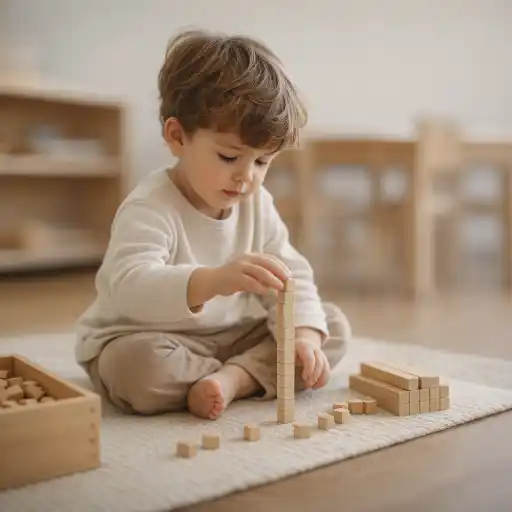 Common schemas include:
- Trajectory: dropping, throwing, rolling, or pouring;
- Transporting: carrying, loading, delivering, or relocating;
- Enclosing or enveloping: hiding, wrapping, covering, or building boundaries;
- Rotation: spinning, twisting, stirring, or turning wheels;
- Positioning: lining up, sorting, arranging, and creating patterns; and
- Connecting: joining, linking, fastening, and separating materials.
The ChildCareEd overview of sensory classroom design and play schemas emphasizes looking for a #pattern across materials and settings. For example, a child who transports blocks, dolls, and pretend food may be investigating movement and delivery rather than merely “wandering.” A child who repeatedly encloses objects may be exploring boundaries, privacy, or object permanence.
Schema-aware observation helps educators avoid deficit-based interpretations. It also supports stronger curriculum decisions: the child’s chosen action becomes the starting point for adding ramps, baskets, tubes, maps, fabric, measuring tools, or dramatic-play language.
How should educators observe and document repeated play?
Observation is most useful when it is specific, brief, and repeated over time. Instead of recording “Jordan was obsessed with cars,” write what happened: “During outdoor play, Jordan rolled four cars down the ramp 12 times. He changed the starting height twice and said, ‘This one goes faster.’” The second note provides evidence of experimentation, comparison, vocabulary, and persistence.
Use a simple observation cycle:
- Notice: Identify the repeated action, materials, setting, and companions.
- Record: Capture exact movements, words, expressions, and changes in strategy.
- Interpret cautiously: Consider possible interests without treating an interpretation as fact.
- Plan: Add one material, word, question, or social possibility.
- Revisit: Observe whether the child expands, transfers, or abandons the investigation.
Helpful documentation prompts include:
- What remains constant in the play?
- What changes with each attempt?
- Does the child transfer the action to new materials?
- What problem is the child trying to solve?
- How does the child communicate the idea—through words, gesture, movement, drawing, or action?
- Do peers enter the play, and what support might make participation more equitable?
🎯 A practical tool is a three-column note: “What I saw,” “What the child may be exploring,” and “One possible extension.” Documentation should guide responsive planning, not turn every play episode into a formal assessment.
How can educators extend repeated play without taking over?
The goal is to preserve the child’s purpose while opening another avenue for investigation. The adult’s contribution may be very small: a descriptive comment, a new object, a pause, or a genuine question. The ChildCareEd guidance on extending children’s play recommends observing before intervening and offering support that expands possibilities rather than replacing the child’s idea.
Try these extensions:
- Follow the action: “You are carrying every block to the blue basket.”
- Add variation: Offer containers of different sizes, ramps with different heights, or materials with contrasting textures.
- Introduce vocabulary: Use words such as “heavier,” “faster,” “inside,” “beside,” “stable,” “compare,” or “predict.”
- Invite prediction: “What do you think will happen if the ramp is higher?”
- Offer representation: Add clipboards, signs, photographs, puppets, books, or drawing materials.
- Support peer participation: Suggest roles such as builder, recorder, delivery driver, observer, or storyteller.
Keep the child’s agenda central. If the child ignores the added material, that is useful information rather than a failure. Step back, wait, and allow the child to decide whether the invitation belongs in the play.
When should repeated play be supported, adapted, or discussed with families?
Most repeated play is developmentally appropriate and beneficial. The appropriate response is usually to protect time, ensure safety, and provide thoughtful opportunities for variation. However, educators should remain attentive to the whole child. Repetition deserves closer collaborative attention when it is consistently accompanied by distress, prevents access to basic routines, creates a safety concern, or appears alongside loss of communication or previously acquired skills.
This is not a reason to label or diagnose. Instead:
- document what occurs, including context and frequency;
- consider sensory, communication, cultural, and environmental factors;
- consult families about patterns observed at home;
- adapt materials and participation pathways; and
- follow program referral procedures when concerns persist across settings.
For teams supporting children with autism or other developmental differences, Play with Purpose: Supporting Children with Autism  Buy Now
 $55.00$40.00 offers strategies related to observation, communication, sensory regulation, choice, and inclusive play. It should complement—not replace—individualized family and specialist collaboration.
Directors can help staff respond consistently by creating shared observation forms, protecting uninterrupted play blocks, and scheduling reflective conversations. State requirements vary - check your state licensing agency for documentation, supervision, inclusion, and referral expectations.
What common mistakes should educators avoid?
Well-intentioned adults can unintentionally interrupt valuable learning. Common mistakes include:
- Stopping repetition too quickly: Redirect only for safety, conflict, or a clear need; otherwise observe first.
- Calling the play “meaningless” or “obsessive”: Use neutral, strengths-based descriptions.
- Over-questioning: Balance questions with silence, narration, and attentive presence.
- Imposing a product: Do not turn a child’s investigation into an adult-designed craft or performance.
- Changing materials too often: Novelty is not always better; stable access helps children deepen ideas.
- Ignoring cultural context: Families may interpret carrying, arranging, caregiving, or pretend routines in meaningful ways.
A useful staff reflection is: “Did my intervention make the child’s thinking more visible, or did it replace the child’s thinking with mine?” When the answer is unclear, return to observation and wait time.
How can directors build a classroom culture that values repeated play?
Repeated play becomes easier to honor when the environment and schedule communicate that sustained investigation is valued. Provide accessible, open-ended materials and enough uninterrupted time for children to become deeply engaged. The educator’s role in facilitating play-based experiences includes designing well-stocked play spaces, co-planning from observations, documenting learning, and using conversations to extend children’s thinking.
Program-level practices might include:
- protecting longer blocks of child-directed play;
- keeping favorite materials available while adding purposeful variations;
- using team meetings to analyze one observation at a time;
- sharing strengths-based learning stories with families;
- offering multiple ways to communicate and participate; and
- connecting repeated play to emergent curriculum goals without making it a scripted lesson.
For practical support in translating observations into curriculum, consider From Play to Planning: Building Culturally Competent, Child-Centered Curriculum Buy Now $55.00. The course focuses on emergent learning, scaffolding, cultural responsiveness, and inclusive planning—skills that help teams move from noticing repeated play to designing meaningful next steps.
Conclusion: Why should educators let children repeat the same play?
Children repeat play because they are still discovering something: how objects move, how materials fit, how bodies coordinate, how stories unfold, how problems can be solved, or how a familiar action feels under new conditions. Repetition is often practice, experimentation, communication, regulation, and mastery at the same time.
Educators should let children repeat when the play is safe and meaningful, while remaining present enough to notice development and offer carefully timed extensions. Observe without labeling, document concrete evidence, add small variations, invite language and peer participation, and collaborate with families when patterns raise questions. The repeated action is not a detour from learning; it is frequently the child’s chosen pathway into #learning, #development, #schemas, #observation, and confidence.
FAQ
How long should I allow repeated play to continue?
There is no universal time limit. Continue while the child is engaged, safe, and showing exploration or progression. Step in when safety, distress, or access to essential routines becomes an issue.
Is repeated play always a play schema?
No. Repetition may reflect skill practice, sensory regulation, emotional processing, social learning, or a schema. Observe across contexts before drawing conclusions.
Should I introduce a new activity if a child refuses?
Not necessarily. Preserve the child’s choice and offer a nearby variation without pressure. Engagement is more informative than compliance.
How can I explain repeated play to families?
Use specific, strengths-based language: “We noticed that Maya repeatedly carried objects between the shelf and basket. She is practicing movement, planning, and persistence. We are offering different containers so she can explore further.”
When should I seek additional support?
Document and collaborate with families when repetition is linked to distress, injury, regression, substantial communication concerns, or persistent barriers to participation. Follow local referral procedures; state requirements vary - check your state licensing agency.
Five professional learning options
- The Best Promotion is Play Buy Now $35.00
- From Play to Planning: Building Culturally Competent, Child-Centered Curriculum Buy Now $55.00
- Play with Purpose: Supporting Children with Autism Buy Now
$55.00$40.00 - Tracking Progress, Shaping Futures: Observation & Assessment Skills Buy Now $55.00
- Creating Engaging and Meaningful Learning Experiences Buy Now $55.00
- Lesson Planning for Preschoolers
- Bienvenido! Welcoming All Families
- 45 Hour Infant and Toddler Methods and Materials
- Pediatric RSV First Aid & CPR/AED
- CDA Bridge Bundle: Family Child Care without Portfolio Review
- CDA Bridge Bundle: Infant/Toddler without Portfolio Review
- CDA Bridge Bundle: Preschool without Portfolio Review
- Texas Director Credential
- Let’s Talk: Effective Communication
- CDA Certification en Español: Recursos y Consejos para Educadores Bilingües
- 🌙 ¿Cómo afecta el tiempo frente a las pantallas el sueño y el comportamiento infantil? 😴
- Cuáles Son las Señales de Alerta en el Desarrollo Infantil que Todo Educador Debe Conocer?
- 😫🧸 ¿Qué hacer cuando un bebé no quiere dormir la siesta en el aula?
- Teaching kids to solve problems with words
- Recursos en Español sobre el Sueño Seguro del Bebé
- ¿Cuáles son las mejores actividades del Día de la Tierra para niños en casa o en el aula?
- ¿Cómo puedo usar escenarios de juego de roles de primeros auxilios en mi aula?
- Consejos de Supervisión Activa para Salones de Preescolar y el Juego al Aire Libre
- Retraso del Habla en la Guardería: Cómo Pueden Ayudar los Proveedores
- Canciones, juegos y preguntas de círculo para niños
- Cómo simplificar la capacitación para sus empleados de daycare
- Why Do Children Repeat the Same Actions? Understanding Play Schemas and the 'Why' Behind Repetitive Play
- Why Do Children Repeat the Same Play—and Why Should Educators Let Them?
- How Can Child Care Providers Teach Beginning Sounds with Tracing, Pictures, and Repetition?
- When Should Educators Demonstrate and When Should Children Experiment?
- How Can One Science Question Become a Preschool Investigation?
- How Can You Repeat a Toddler Activity Without Repeating the Exact Same Lesson?
- How Can You Explain Montessori Classroom Choices to Families Without Jargon?
- How Can Toddler Sensory Play Become a Science Investigation?
