Could a small basket of clean socks become a meaningful lesson in thinking and self-reliance? With a few pairs and a supportive adult, preschoolers can practice noticing details, sorting by a rule, and taking part in everyday routines. The ChildCareEd course Supporting Children’s Independence  Buy Now $24.00 offers a deeper look at age-appropriate ways to foster children’s confidence and persistence; explore it as a next step for strengthening your classroom practice.
Why does a sock activity matter beyond matching?
Matching socks is an inviting, real-life task: children can see the purpose, handle familiar objects, and contribute to a routine adults already perform. Yet the learning is not simply “find two alike.” A child attends to features such as color, length, pattern, and size, compares two items, and decides whether they belong together. This supports visual discrimination and introduces classification—the process of organizing objects according to shared attributes.
These everyday comparisons are part of early mathematical thinking. As described in ChildCareEd’s discussion of visual matching in preschool, matching can encourage attention, comparison, memory, and early problem-solving. The laundry context also gives the task a practical purpose: putting pairs in a basket or returning them to a designated place helps children see themselves as capable contributors.
For providers, the key is to treat the activity as an invitation rather than a performance test. Children do not need to fold perfectly or finish quickly. The goal is meaningful participation, with adults noticing effort and offering just enough help for the child to keep trying.
What skills can children practice while matching and sorting?
One small laundry task can bring together several areas of development. When a child compares socks, they may notice that two are both striped, or that a similar-looking pair differs in size. That observation is visual discrimination. When they group socks by owner, color, pattern, or type, they are practicing classification and learning that a collection can be organized by different rules.
The activity naturally supports language, too. Providers can introduce words such as pair, same, different, stripe, ankle, long, short, and belong. Questions like “What do you notice?” and “How did you decide these go together?” invite children to describe their reasoning without requiring a single scripted answer. A child may respond by speaking, pointing, signing, or showing the pair.
- Comparing color, size, pattern, and length builds careful observation.
- Grouping pairs by a chosen feature introduces classification and early math concepts.
- Picking up, turning, and folding socks can involve hand-eye coordination and fine-motor practice.
- Taking part in a familiar routine can nurture #independence and a sense of contribution.
Keep expectations responsive to the child. Some preschoolers may enjoy finding identical pairs; others may be ready to sort completed pairs into family or classroom baskets. The ChildCareEd overview of sorting and early thinking emphasizes that children benefit from comparing, explaining, and trying a new sorting rule as their skills develop.
How can providers set up a safe, engaging sock invitation?
Choose a calm moment when children can focus—perhaps during a classroom practical-life activity or a planned small-group invitation. Use clean, dry socks and a small, manageable collection. Begin with a few pairs that are easy to tell apart, such as one solid pair and one clearly patterned pair. A crowded pile of similar socks can make the activity unnecessarily difficult.
Place socks in a shallow basket and provide a second basket or clearly marked space for matched pairs. If children are sorting by person, use photographs or simple labels for the intended baskets. Demonstrate one example aloud: “I see two socks with blue stripes. I’ll put them together.” Then give children time to explore rather than completing the task for them.
- Start with two or three pairs, then add more when the child is comfortable.
- Use socks with clear visual differences at first; introduce similar patterns later.
- Keep the work surface uncluttered and materials within children’s reach.
- Supervise closely and follow your program’s safety practices, especially with small items such as clips or loose parts.
- 🧺 Invite children to choose whether they want to match, sort by owner, or fold a pair.
There is no need to turn the activity into a worksheet or elaborate craft. The real socks are the learning materials. As the sock-matching activity guide illustrates, pairing socks and placing them into family baskets can connect visual matching with categorization and participation in household tasks. In a child care program, adapt the idea to your setting, routines, supervision plan, and children’s abilities.
How can adults scaffold independence without taking over?
Children become more capable through supported practice—not through being left to manage a task that is too difficult, and not through adults doing every step. Begin by observing what the child can already do. If they match two obvious pairs independently, acknowledge the strategy: “You looked at the stripes and found the same pattern.” If they hesitate, offer a small prompt such as “Let’s compare the heels” rather than naming the answer immediately.
Break the routine into simple steps and model only as much as needed: choose one sock, look closely, find a possible partner, check the details, and place the pair in the basket. Folding can be an optional extension, not a required measure of success. Children may also direct a peer or adult to move the socks if handling them is challenging. The aim is to preserve the child’s meaningful role while adapting access.
Use encouraging, specific feedback that recognizes process: “You checked the colors before choosing,” or “You kept looking after the first sock was not a match.” Avoid praise that pressures children to be fast or perfect. The ChildCareEd course Student Success: Expectations & Independence Buy Now $16.00 explores age-appropriate expectations and ways to balance support with opportunities for children to practice autonomy.
How can you adapt the task for different learners?
Inclusive practice keeps the meaningful goal—comparing and organizing—while offering different ways to participate. A child may point to a matching sock, place a pair beside its partner, use a communication device, or work with a peer who handles materials at the child’s direction. Spoken explanations are valuable, but they are not the only evidence of understanding.
Consider the sensory and visual demands. Use larger, high-contrast socks when helpful, avoid relying on color alone, and pair color with pattern or texture. Reduce the number of choices for children who are overwhelmed by a large pile. For children who need additional time, allow a slower pace and a quieter workspace. Home-language words, photographs, gestures, and familiar clothing can make the task more welcoming and understandable.
- Offer a small set of pairs and gradually add choices.
- Use picture labels or photographs if children are sorting by person or destination.
- Accept pointing, gestures, signs, words, or partner-assisted responses.
- Let children explore a different sorting rule when they are ready: by pattern, size, or type.
Everyday routines can be adjusted without diminishing the thinking involved. A child who sorts three pairs with a visual cue is participating meaningfully; another may be ready to explain a rule or reorganize the same pairs in a new way. State requirements vary - check your state licensing agency when considering how professional development or classroom routines relate to local expectations.
How can you observe progress and avoid common pitfalls?
A sock activity offers a natural chance to notice children’s strategies, but it should not become a high-pressure assessment. Observe whether a child scans the available socks, compares details, remembers a feature, persists after an unsuccessful choice, or changes the sorting rule. Brief, objective notes are more useful than broad labels. For example: “Matched three pairs by pattern with one verbal prompt,” or “Sorted pairs into two baskets using photo labels.”
Watch for common pitfalls that can take the joy out of an otherwise simple task:
- Offering too many similar socks before the child understands the matching process.
- Turning the task into a race or focusing on speed instead of careful noticing.
- Correcting every choice immediately instead of asking the child to explain or check it.
- Expecting identical folding or a perfectly tidy result as proof of learning.
- Assuming success with one set of socks means a child will automatically generalize the skill to every sorting activity.
Use what you observe to choose a reasonable next step. You might add one pair, introduce a second attribute, or connect matching to putting away classroom materials. For deeper support in documenting preschool learning, explore Preschool Assessments & Observations Buy Now $24.00, which focuses on objective observation and using information to plan responsive experiences.
Conclusion: Are preschoolers ready to help with laundry?
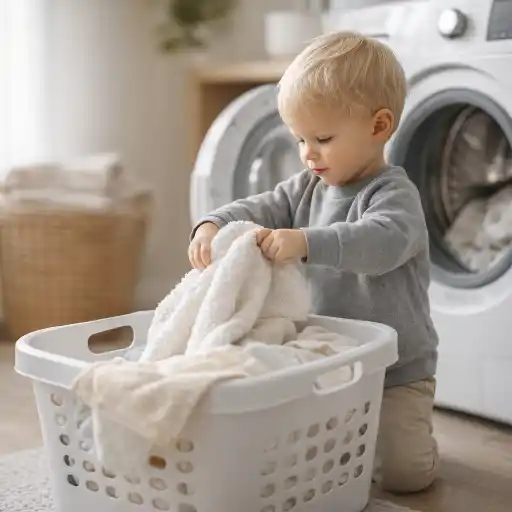
Many preschoolers can take part in simple laundry-related activities when the materials are safe, the task is manageable, and an adult offers patient support. Matching socks provides concrete practice in visual discrimination and classification while making a familiar routine an opportunity for contribution. Children may also exercise language, coordination, persistence, and early independence along the way.
Start with a few clean pairs, model how to look and compare, and let children participate in a way that fits their abilities and interests. Celebrate careful observation and willingness to try—not speed, perfection, or a single “right” folding style. A modest basket of socks can become a warm, practical invitation for children to notice, think, and help.
Five relevant ChildCareEd courses
- Supporting Children’s Independence Buy Now $24.00
- Early Mathematics Through Play Buy Now $24.00
- Student Success: Expectations & Independence Buy Now $16.00
- Inclusive Lessons for Preschoolers Buy Now $16.00
- Preschool Assessments & Observations Buy Now $24.00
- 45 Hour Child Growth and Development
- Teacher-Child Interactions for Stronger CLASS® Outcomes
- Birth to Five CDA Credential with Portfolio Review
- Pediatric RSV First Aid & CPR/AED
- CDA Bridge Bundle: Family Child Care without Portfolio Review
- CDA Bridge Bundle: Infant/Toddler without Portfolio Review
- CDA Bridge Bundle: Preschool without Portfolio Review
- Lesson Planning for Preschoolers
- Texas Director Credential
- CDA Certification en Español: Recursos y Consejos para Educadores Bilingües
- ¿Cuánto tiempo se tarda en obtener una certificación CDA?
- ¿Cómo empiezo mi certificación CDA en Florida en línea?
- ¿Cómo obtengo la certificación CDA en línea en Florida?
- Actividades de Motricidad Gruesa que Desarrollan el Equilibrio, la Coordinación y la Fuerza
- ¿Qué preguntas aparecen en el examen CDA para preescolar?
- ¿Qué Preguntas Vienen en el Examen CDA de Nacimiento a los Cinco Años?
- Cómo Crear Tu Portafolio CDA Paso a Paso
- Proporciones de Cuidado Infantil y Tamaños de Grupo por Edad en Maryland (Guía Rápida para Centros y Hogares)
- Cómo Celebrar el Día Nacional del Kindergarten
- Temas y Actividades para el Día Nacional del Kindergarten para Proveedores
- What Kind of Property Works for a Child Care Center?
- Celebrando la amistad en el cuidado infantil durante el Día de los Mejores Amigos
- Can simple soccer games build gross motor skills in young children?
- How Can I Help Children Understand Shapes and Patterns?
- How Can Child Care Programs Build Meaningful School Readiness?
- How Can You Make a Math Activity Work for Children at Different Skill Levels?
- Are Preschoolers Ready to Help With Laundry?
