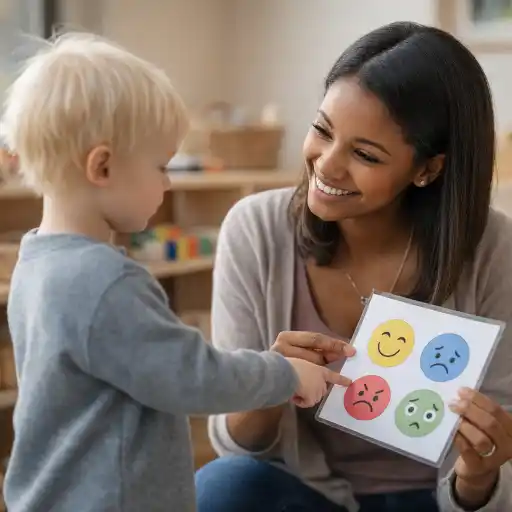
A preschooler can point to “angry” on a feelings chart and still need help when a tower falls or a friend takes a toy. The next step is teaching children to connect feelings with safe, useful coping choices—skills you can strengthen through daily classroom routines and playful practice. For a deeper, practical study of preschool self-regulation, explore ChildCareEd’s From Tantrums to Triumphs: Equipping Preschoolers with Self-Regulation Skills Buy Now $25.00; it offers strategies for teaching children to manage emotions and navigate challenges.
Why is naming a feeling only the beginning?
Naming an emotion gives a child language for an experience, but it does not automatically show what to do with that experience. Preschoolers are still developing the communication, impulse control, and flexible thinking needed to pause, choose a response, and carry it out. When a child says “mad” and then hits, the child may understand the feeling label while still needing adult support to stay safe and communicate a need.
Emotion awareness becomes more useful when it links three things: what happened, what the child feels or notices in their body, and what action could help. For example: “The block tower fell. You look frustrated, and your hands are tight. Would you like help rebuilding or a short break?” This sequence respects the feeling while making a next step visible.
Research on emotional self-awareness and regulation describes both recognizing emotions and accessing coping skills as important parts of regulation. NAEYC likewise emphasizes responsive relationships and support for children’s developing emotional understanding. The goal is not to suppress feelings or demand instant calm; it is to build a child’s growing ability to communicate, recover, and choose a safe response.
- Feelings provide information; they are not misconduct.
- Children may need co-regulation before they can use a strategy independently.
- Unsafe actions require clear, kind limits alongside emotional validation.
How can educators connect a feeling to a coping choice?
Use a brief, repeatable sequence: Notice → Name → Choose → Practice. Notice the child’s words, body cues, and context. Offer a tentative feeling word rather than insisting you know exactly what the child feels. Then present a small set of realistic options and practice the chosen strategy with the child.
- Notice: “Your voice is getting louder, and your hands are tight.”
- Name: “You might feel frustrated because the paint spilled.”
- Choose: “Would you like a breath with me or help cleaning it up?”
- Practice: Model the strategy and stay nearby while the child tries it.
Offer two options at most when a child is distressed. A short menu might include breathing together, asking an adult for help, moving to a quieter spot, squeezing play dough, or using words such as “my turn next.” Strategies need to fit the child, the situation, and the classroom’s safety plan. A choice board can make options easier to understand; ChildCareEd’s Monster Calm-Down Choice Board for Preschool Coping Skills Buy Now $2.00 offers visual examples children can point to, gesture toward, or name.
Make clear that choosing a strategy is not a test. If one option does not help, respond with curiosity and offer support: “That breath didn’t feel helpful. Would you like me to stay with you or find a quieter place?”
Why does co-regulation come before independent coping?
When strong feelings take over, children may have less access to words, memory, and problem-solving. In those moments, a calm adult lends organization: a steady voice, a safe boundary, fewer words, and a familiar strategy. This co-regulation is not a reward for unsafe behavior or a substitute for teaching. It is the support that makes learning possible until the child is ready to reflect and practice.
Try a simple classroom response: connect, calm, then coach. Move close without crowding and acknowledge the experience: “You’re upset the truck is being used.” Set a clear safety limit if needed: “I won’t let you hit.” Offer one coping option: “You can squeeze this ball with me or stand beside me.” After the child has recovered, return to the event and rehearse a next step: “Next time, you can say, ‘Can I have a turn?’”
Adjust the amount of adult guidance to the child’s developmental readiness. Some children may need the educator to lead the calming process; others can follow a simple prompt; children with more experience may choose a strategy themselves. Gradually reduce prompts as skills grow, while continuing to provide help whenever it is needed.
- Keep language short during escalation; save discussion for later.
- Stay attentive to safety and follow program procedures.
- Use observations—not assumptions—to decide what kind of support may help.
How can coping choices become part of the everyday classroom?
Children are more likely to recognize a strategy during a difficult moment if they have practiced it during calm, ordinary times. Keep practice short, playful, and frequent. Use puppets, stories, role-play, and familiar transitions to explore what a character might feel and what could help next. A puppet who is disappointed about waiting for a turn can practice asking for help, taking a breath, or choosing another activity.
Build coping language into daily routines. During arrival, invite children to point to a feeling picture and select a support, without requiring public sharing. Before cleanup, show a visual sequence: finish play, take a breath, choose a cleanup job, and move to the next activity. At a calm moment, model your own appropriate coping: “I’m frustrated that the papers fell. I’ll pause and pick them up.”
Classroom design can make choices more accessible. Post a small visual menu at children’s eye level and provide ways to communicate beyond speech, including pointing, gestures, signs, home-language words, or communication devices. Keep a calm area voluntary, supervised, and supportive—not a punishment or a place of forced isolation. Partner with families to learn the words, comfort routines, and strategies that feel familiar to each child.
Directors can help staff use consistent language by agreeing on a few shared prompts and making time for brief reflection. A practical next step is to choose two coping strategies for the group, model them daily for a week, and observe which children use or accept them.
What mistakes can get in the way of learning what to do next?
Well-intentioned responses can miss the teaching opportunity when they focus only on stopping behavior or naming the feeling. Children benefit when adults validate feelings, maintain limits, and explicitly teach a workable alternative.
- Mistake: Asking “How do you feel?” repeatedly during a meltdown. Try instead: Reduce language and offer presence and one familiar choice.
- Mistake: Saying “Calm down” without showing how. Try instead: Model a breath, offer help, or point to the practiced visual.
- Mistake: Expecting every child to use the same tool. Try instead: Notice individual communication, sensory, and movement needs.
- Mistake: Teaching coping only after a problem. Try instead: Practice during stories, games, and predictable routines.
- Mistake: Treating a calm space as a consequence. Try instead: Teach it as an optional, supervised support.
Record patterns objectively when a child repeatedly struggles: what happened beforehand, what the child did, the adult response, and what appeared to help. Share observations respectfully with families and colleagues. If distress is persistent, intense, or creates safety concerns despite consistent support, collaborate with families and appropriate specialists or consultants. State requirements vary - check your state licensing agency for relevant training, documentation, and supervision expectations.
Educators who want to extend their professional learning can explore ChildCareEd’s Self-Regulation & Change: Helping Children Cope  Buy Now $16.00, focused on coping with change, responsive care, routines, and self-regulation. For broader social-emotional and classroom strategies, see Social Foundations and Responsive Classrooms Buy Now $24.00, which includes positive guidance, conflict resolution, and age-appropriate problem-solving.
How can educators help children move from feelings to action?
Naming feelings matters, but it is only the opening step. Preschoolers learn what to do next through warm relationships, clear safety limits, a manageable set of coping choices, and repeated practice in everyday classroom life. When adults connect a feeling to an action—“You’re disappointed; would you like help asking for a turn or choosing something else?”—children gain a practical bridge from awareness to coping.
Keep the routine simple: notice, name, choose, practice. Co-regulate when a child needs support, reflect and teach after the child is ready, and adapt strategies to individual needs. Small, consistent moments help children build confidence that strong feelings are manageable and that they have safe ways to ask for help, recover, and rejoin play.
To explore a more complete professional learning experience, consider ChildCareEd’s CDA Subject Area 3 Buy Now $80.00, a 10-hour course covering social-emotional development, self-regulation, predictable care, and responsive guidance. Check with your licensing agency about whether a specific course meets your local training requirements.
- 45 Hour Child Growth and Development
- 45 Hour Preschool Methods and Materials
- What Makes Me Special: An Overview of Autism and ADHD
- CDA Bridge Bundle: Preschool
- Pediatric RSV First Aid & CPR/AED
- Anxiety: Signs & Strategies
- Art from the Heart for Preschoolers: Open Ended Art Projects that Build Self-Esteem
- Building Equity: Inclusionary Practices in Preschool
- Behind the Scenes: Baby Routines ONLINE
- Bienvenido! Welcoming All Families
- 🚨 Reporte Obligatorio en Nevada
- Recursos en Español sobre el Sueño Seguro del Bebé
- Capacitación en Salud y Seguridad Preventiva en Línea para Proveedores de Cuidado Infantil
- Capacitación Previa al Servicio para Proveedores de Cuidado Infantil en Dakota del Norte
- Cómo simplificar la capacitación para sus empleados de daycare
- How Saying No Supports Children’s Emotional Development
- Why Are Coping Skills Important for Preschoolers?
- How Can Child Care Providers Respond When Children Exclude Others From Play?
- How Can Child Care Providers Help Children Recover After They Make a Mistake?
- How Can We Build an Emotion Vocabulary Children Can Actually Use?
- What Should You Do When a Child Wants to Remove Their Contribution from Group Artwork?
- How Can Child Care Providers Help a Child Who Worries About Family During the School Day?
- What Should You Say When a Child Tells a Teacher “I Hate You”?
- How Can Child Care Providers Help Children Repair a Conflict Beyond “Say Sorry”?
- What Should Teachers Do When a Child Becomes Frustrated by Writing or Drawing Tasks?
- How Can Child Care Providers Help Children Negotiate Shared Outdoor Play?
- How Can Educators Build a Classroom Where Every Child’s Voice Counts?
- Why Isn’t Naming Feelings Enough—and What Should Preschoolers Do Next?
- How Can Teachers Help Preschoolers Talk About Their Feelings Through Art?
