When a child hears “You can’t play,” the moment can quickly become painful, confusing, or unsafe—but it can also become a meaningful lesson in belonging. Child care providers can strengthen their responses through Building Equity: Inclusionary Practices in Preschool  Buy Now $10.00, which offers practical strategies for creating welcoming classrooms and meeting professional learning goals. For a deeper focus on social-emotional guidance and conflict resolution, explore Social Foundations and Responsive Classrooms Buy Now $24.00.
Why does responding to exclusion matter?
Exclusion is common in early childhood because children are still learning how to enter play, negotiate roles, manage strong feelings, and understand another child’s perspective. That developmental context deserves compassion, but it does not mean providers should ignore repeated rejection, identity-based comments, or power imbalances. Children need adults to protect safety while teaching more effective ways to communicate.
Belonging is more than sitting in the same room. It means children experience the message, “This place is for me, and people here want me here.” Research and professional guidance emphasize that meaningful participation—not simple physical proximity—is central to inclusion. A child who watches from the edge, repeatedly approaches a group, or leaves quickly may be communicating a need for support with language, confidence, sensory regulation, mobility, or understanding the game.
Inclusive responses also support #empathy, friendship, and learning. As ChildCareEd explains in its article on social skills in action, children who feel accepted are better positioned to participate, cooperate, and focus. The goal is not to force every child into identical social behavior. The goal is to remove barriers and create authentic opportunities for every child to contribute.
What should a provider say when a child excludes another child?
Start with a calm, brief response that stops harm without labeling the child. Get close enough to support the interaction, use a neutral voice, and describe the classroom expectation:
- “I heard you say, ‘You can’t play.’ In our classroom, everyone belongs.”
- “You may keep your idea for the game, and we will find a safe role for your friend.”
- “Let’s make space and decide how this child can join.”
A useful three-step sequence is:
- Stop the exclusion: “I won’t let you block the doorway or tell others someone cannot play.”
- Name the goal: “Everyone deserves a fair chance to participate.”
- Coach the next step: “You can say, ‘We are using the kitchen now. You can be the customer.’”
This approach protects the existing play while expanding access. Inclusion does not require children to surrender every material or abandon a complex game. It may mean offering a realistic role, a nearby activity, a turn after the timer, or a cooperative task. The provider’s language should be concise enough for children to remember and repeat.
When a child has been excluded, validate without increasing shame: “You wanted to play and that felt hurtful. I will help you find a way in.” Then offer choices such as watching first, carrying materials, joining beside the group, or practicing a joining phrase. The three-step conflict approach described by NAEYC similarly emphasizes naming behavior and feelings, explaining implications, and offering an appropriate alternative.
How can providers teach children to invite others into play?
Children benefit from explicit teaching rather than assumptions that they will naturally know how to include a peer. Introduce short scripts during calm moments, then rehearse them through puppets, stories, and guided play. Useful phrases include:
- “You can play with us.”
- “Do you want to build here?”
- “You can be the driver.”
- “Let’s make room.”
- “You can have the next turn.”
Model more than one way to participate. A child may join by talking, pointing, imitating an action, passing a tool, drawing a plan, using sign, or selecting a picture. This is particularly important for dual language learners, children with disabilities, and children who need additional processing time. Avoid treating spoken language, eye contact, or rapid entry as the only evidence of social competence.
Plan brief, authentic practice opportunities:
- 😊 Cooperative building: Give two or three children one shared goal, such as constructing a bridge. Assign meaningful roles, then rotate them.
- Puppet problem-solving: Have a puppet stand outside a pretend game and ask children what the group could say or do.
- Invitation cards: Use pictures showing “invite,” “help,” “share,” and “ask.” Celebrate attempts rather than competition.
- Partner jobs: Pair children to water plants, distribute napkins, or return books. Shared purpose makes interaction easier.
As ChildCareEd’s friendship skills guidance notes, short scripts work best when practiced during real play, not only after conflict. Provide a prompt, wait, and gradually step back as children begin responding to one another independently.
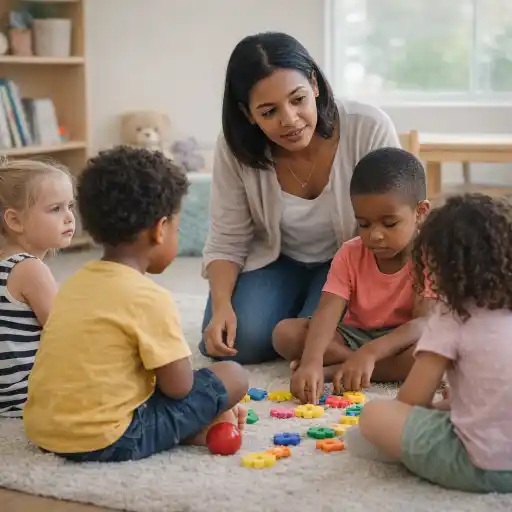
How can the classroom environment reduce exclusion?
Room arrangement influences who can enter play, how long children remain engaged, and whether adults can notice subtle rejection. Create defined play areas that support small groups without creating inaccessible or hidden corners. Place attractive, cooperative materials where children can reach them, and ensure pathways, seating, and tools accommodate varied movement and sensory needs.
Consider these environmental adjustments:
- Use picture and word labels so children can understand where activities happen.
- Offer duplicate high-interest materials, visual turn-taking supports, and timers.
- Provide a quiet space where a child can regulate without being removed from the community.
- Use shared materials such as large puzzles, dramatic-play props, and block sets that encourage teamwork.
- Reduce crowding in popular centers and create nearby options for children who need a smaller group.
A visual schedule, role card, or communication board can make participation more predictable. Tennessee’s child care inclusion guidance similarly identifies visual schedules, calming areas, accessible routes, and adapted materials as practical supports. The Classroom Setup for Child Care Buy Now $24.00 course can help providers connect room design with accessibility, development, and belonging.
Directors can support consistency by establishing shared staff phrases such as “Everyone belongs,” “How can we make space?” and “Ask for a role.” During team meetings, ask who entered play successfully, who remained on the edge, and which environmental change might help tomorrow. State requirements vary - check your state licensing agency.
How should providers respond when exclusion is repeated or identity-based?
Repeated exclusion deserves careful observation and a coordinated response. A single disagreement may reflect immature problem-solving; a persistent pattern may indicate relational aggression, bullying-like behavior, or bias related to race, language, disability, gender, culture, family structure, or another aspect of identity. Providers should use behavior-based documentation rather than fixed labels.
Record:
- the date, time, location, and activity;
- the exact words or observable actions;
- what happened immediately beforehand;
- who attempted to join and how peers responded;
- the adult intervention and what happened afterward.
Support the targeted child privately and promptly: “You did the right thing by telling me. This was not your fault, and we will make a plan for safety and belonging.” Speak with the child who excluded separately when calm. Avoid public humiliation, forced apologies, or asking the targeted child to confront the peer. Instead, teach replacement skills and guide meaningful repair, such as making room, returning a material, rebuilding a structure, or practicing an inclusive phrase.
Identity-based exclusion requires an anti-bias response. NAEYC’s four anti-bias goals emphasize identity, comfort with diversity, recognition of unfairness, and the confidence to stand up for oneself and others. Use accurate, respectful language and address unfairness directly: “That rule leaves someone out because of how they communicate. Our classroom makes changes so everyone can participate.” Review books, dramatic-play materials, dolls, images, and classroom language for representation and bias.
Partner with families using factual, strengths-based communication. Ask what helps the child connect at home, which communication methods are familiar, and what interests might support peer relationships. If the pattern persists, involve the director and appropriate specialists according to program policy.
What common mistakes should providers avoid?
Even caring responses can unintentionally increase shame or isolation. The following pitfalls are common and preventable:
- Forcing participation: Replace “You have to join” with “You can watch, help, or try one part.”
- Making one child responsible for inclusion: Teach the whole group to welcome peers; do not assign a permanent helper.
- Overhelping: Offer a brief bridge, then pause so children can own the interaction.
- Using long lectures: In the moment, use one limit, one feeling word, and one next step.
- Assuming physical proximity equals belonging: Check whether the child has a meaningful role and influence.
- Ignoring quiet forms of exclusion: Notice blocked entry, repeated refusal, mocking, and recruiting others to reject a peer.
- Expecting immediate change: Track small gains, such as approaching, responding, staying longer, or using a script.
Providers should also distinguish a child’s preference for solitude from unwanted isolation. Some children genuinely need observation time or a quieter activity. The question is whether the child has meaningful choices and access to connection, not whether the child is constantly social.
When adults consistently model #inclusion, children learn that belonging is a shared responsibility. The You’re Not My Friend Anymore: Learning Conflict Resolution Buy Now $16.00 course provides additional professional learning on developmentally appropriate conflict-resolution strategies.
Conclusion: How can providers turn exclusion into belonging?
Responding to exclusion requires more than telling children to be nice. Providers must protect safety, validate feelings, teach concrete scripts, adapt play environments, and monitor patterns over time. A calm response might sound like: “Everyone belongs. You may keep your game, and we will find a role. Let’s practice what to say.”
Begin with one shared phrase, one guided-play activity, and one environmental adjustment. Invite families and colleagues into the process, celebrate small attempts, and revisit supports when they are not working. With steady coaching, children can move from “You can’t play” toward “You can be the builder,” “Let’s make room,” and “Can we try again?”
Five courses to explore:
- 45 Hour Child Growth and Development
- 45 Hour Preschool Methods and Materials
- CDA Family Child Care Credential with Portfolio Review
- 45 Hour Infant and Toddler Methods and Materials
- 45 Hour School Age Methods and Materials
- CDA Bridge Bundle: Family Child Care
- The Best Promotion is Play
- 45-Hour Infant and Toddler Curriculum
- Texas Director Credential
- ¿Cuáles son las mejores actividades del Día de la Tierra para niños en casa o en el aula?
- 10 Ejemplos de Cómo la Cultura Influye en el Desarrollo Infantil
- Proporciones de Cuidado Infantil y Tamaños de Grupo por Edad en Maryland (Guía Rápida para Centros y Hogares)
- Proporciones de Cuidado Infantil y Tamaños de Grupo por Edad en Virginia (Guía Rápida para Centros y Hogares)
- Por Qué la Supervisión Activa Es Clave para la Seguridad en el Cuidado Infantil
- Retraso del Habla en la Guardería: Cómo Pueden Ayudar los Proveedores
- Celebrando la amistad en el cuidado infantil durante el Día de los Mejores Amigos
- Canciones, juegos y preguntas de círculo para niños
- Do Toys Come Alive: How Can Pretend Play Spark Creativity in Your Daycare?
- Sick or Not Sick? How Do We Make Exclusion Decisions in Child Care?
- Daycare Teacher Discounts: Deals and Benefits You May Be Missing
- How Can Child Care Providers Prevent and Respond to Bullying?
- How Can Child Care Providers Respond When Children Exclude Others From Play?
- What Are the Social-Emotional Milestones From Birth to Age 5?
- What Early Signs of Autism May Child Care Providers Notice?
- When One Child Always Chooses the Same Pretend Play Role, What Should Educators Do?
- How Can Child Care Providers Respect Families Who Decline Handmade Classroom Gifts?
- How Many Training Hours Do Child Care Providers Need Each Year?
- When Does Exclusion in an After-School Group Become a Pattern?
- Bullying or Peer Conflict? What Should After-School Staff Look For?
