A shared story can sound like two different adventures when each child notices, feels, and remembers something different. Comparing narrators and retelling familiar events from another viewpoint gives child care providers a practical way to strengthen children’s comprehension and perspective-taking. Explore Language Development in Early Childhood  Buy Now $16.00 to build strategies for supporting children’s communication, vocabulary, and early literacy; for ages 6–12, Language Development in School Age Buy Now $16.00 offers focused approaches to school-age language and literacy growth. Both courses can deepen the professional knowledge you bring to meaningful story discussions—continue reading for activities you can try with your group.
Why do children describe the same event differently?
A story is more than a sequence of events. Each narrator selects details through a personal lens: what they noticed, what they already knew, what they wanted, and how they felt. Imagine two children describing a class pet escaping its enclosure. One remembers the sudden movement and calls it a thrilling chase; another recalls worrying that the pet might get hurt. Both accounts may reflect the same event, yet emphasize different details and meanings.
For educators, this difference is an opening to explore how perspective works. Point of view identifies who tells a story; perspective describes how that narrator understands what happened. Children may initially blend these concepts, or assume that the narrator knows everything and agrees with the main character. Gently asking, “Who is telling this part?” and “What might they be thinking?” helps make the distinction concrete.
Comparing versions also supports careful reading. Children look for clues in dialogue, actions, illustrations, and omissions. They begin to ask whether a narrator has all the information, whether feelings affect interpretation, and what another character might have noticed. These habits help children become more thoughtful readers while practicing #empathy: considering a viewpoint without needing to declare it the only correct one.
How does comparing narrators support comprehension?
When children compare narrators, they must hold onto the shared events while attending to the details each narrator emphasizes. That work encourages recall, sequencing, inference, and attention to character motivation. A child may notice that one character describes a noise as a “crash,” while another calls it a “bump,” then infer that the first was startled and the second felt less worried.
Narrative retelling can also make language and story structure visible. Children practice describing who was involved, what happened, where it occurred, and why a character responded in a particular way. Research on narrative intervention identifies storytelling and retelling as useful contexts for working on story grammar, vocabulary, inferencing, and social communication. A longitudinal study also found that vocabulary and planning skills were associated with aspects of children’s later narrative comprehension. These findings support thoughtful opportunities to talk about stories, without implying that one activity alone determines reading outcomes.
For a read-aloud, pause at a meaningful moment and invite children to find evidence: “What did the narrator notice?” “What might the other character say?” Invite them to point to a picture or reread a line rather than relying only on memory. Familiar picture books and stories with multiple voices can make comparisons accessible. A resource on picture books for teaching point of view describes how illustrations and narrator clues can prompt these conversations.
Keep the purpose clear: children are not simply identifying a pronoun or choosing a “right” version. They are learning how narration shapes what readers know, feel, and question.
How can providers guide a retelling from another viewpoint?
Begin with an event children know well—a familiar book, a classroom routine, or a brief pretend adventure. Retell the same key events through two characters, then invite children to contribute details. A short visual sequence can help everyone follow the plot while leaving room for interpretation.
- Choose a simple, familiar situation with at least two characters, such as two friends searching for a missing ball.
- Make the narrators easy to distinguish with puppets, character cards, or different colored props.
- Retell the main events from the first character’s view, then tell the same events from the second character’s view.
- Ask what each narrator noticed, wanted, knew, or felt. Use one open question at a time and allow a pause.
- Invite children to retell a scene through words, drawings, gestures, or role-play.
Model contrasts without labeling one account as foolish or false: “Mina thought the room was noisy because she heard the blocks fall. Jay was focused on the music and barely noticed.” Then ask, “What detail might Jay include?” or “What could Mina not see from where she stood?”
A familiar tale retold by a different character can also work well. After children know the original, a new narrator lets them focus on motive and missing information instead of learning an unfamiliar plot. For school-age groups, invite children to cite a line or illustration that supports their interpretation. For a practical extension into interactive reading and storytelling, consider Reading Aloud and Storytelling Buy Now $16.00.
How can educators make perspective-taking inclusive?
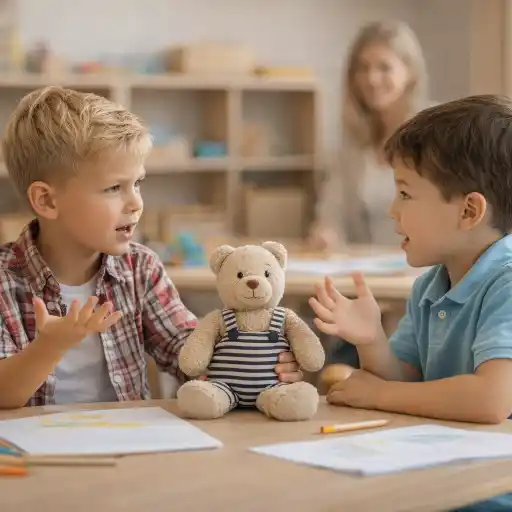
Not every child will want to speak in front of a group, and spoken language is not the only way to show understanding. Offer several ways to take part: a child can move a puppet, select a feeling card, draw what a character sees, point to an illustration, add a sound, or contribute a phrase in a home language. These choices support access while respecting children’s different communication styles and comfort levels.
Use prompts that invite thinking rather than test for one predetermined answer. For instance, “What might the rabbit be worried about?” can welcome more than one reasonable idea. If a child responds with a few words, expand gently: “You think the rabbit is worried because the path is dark.” This models vocabulary and a reason without requiring the child to repeat your sentence.
Small groups and predictable turns can help balance participation. Some children may want to lead; others may prefer to observe before contributing. A child who is listening quietly can still be engaged, so offer an invitation and the option to pass or return later. For additional support in creating language-rich experiences, explore Classroom Tools for Emergent Literacy Buy Now $25.00.
- 🧸 Offer a puppet or prop as a comfortable way to speak through a character.
- Use pictures, gestures, drawing, movement, and home languages as valid forms of storytelling.
- Give children wait time; avoid rushing to fill every silence.
- Notice whose ideas are being heard and adjust turn-taking so participation is shared.
Welcome multiple ways of telling a story while helping children understand the shared sequence. This balance honors each child’s contribution and supports #inclusion in the group.
What common pitfalls should providers avoid?
A few well-intentioned habits can close down the very thinking this activity is meant to encourage. Correcting every imaginative detail may shift attention from interpretation to compliance. Asking a string of questions without giving children time to think can make story discussion feel like a quiz. And treating one narrator’s account as the truth can suggest that other characters’ feelings or knowledge do not matter.
Instead, listen for the idea behind a child’s response and invite them to connect it to the story. If children disagree, reflect both perspectives: “Lena heard thunder, and Marcus thought it was a drum. What clues might each one be using?” Their difference can become a new story problem, rather than a disagreement the adult must settle.
- Do not assume that a quiet child has nothing to contribute; offer a nonverbal option or another turn later.
- Do not confuse point of view (who tells the story) with perspective (how that person interprets events).
- Do not expect children to infer feelings without clues; revisit words, actions, and illustrations together.
- Do not require every child to produce a polished oral retelling; brief phrases, drawings, and play can communicate understanding.
Afterward, record a few observations: Did children sequence events, identify a narrator, notice different details, or respond to a peer’s idea? Use those notes to plan a next step, such as a smaller group, more visual supports, or a new story with two narrators. If professional learning hours are relevant, state requirements vary - check your state licensing agency.
How can providers carry the learning beyond storytime?
Perspective-taking becomes more meaningful when children revisit an idea across different activities. Add a “two views” chart to the literacy area, with space for a character’s observation, feeling, or belief. Children can dictate a sentence, draw two panels, or use figures to act out how each narrator experienced the same moment. Return to the story later and ask whether new details have changed their interpretation.
Everyday classroom experiences can also offer gentle practice. After a group activity, children might draw what they remember, then compare details: one child may recall the music while another remembers the materials. Keep the conversation focused on differences in attention and experience, not on deciding who has the best memory. This helps children apply the idea that people can share an event and still experience it differently.
For directors, staff reflection can strengthen consistency. Invite educators to share prompts that generated thoughtful responses, consider whether children had varied ways to participate, and discuss how they handled disagreement. If you work with children ages 6–12, Language Development in School Age Buy Now $16.00 provides further professional learning about language and literacy in this age range. State requirements vary - check your state licensing agency when determining whether a course meets a local training requirement.
For more ideas on using stories with children, see ChildCareEd’s storytelling as a teaching tool. You can also explore Language Development in Early Childhood Buy Now $16.00 for strategies to support children’s communication and language growth.
Conclusion: What can two different stories teach us?
Two children can tell different versions of the same story because each narrator notices, knows, wants, and feels different things. Comparing those accounts gives children a concrete way to strengthen comprehension: they recall events, examine clues, make inferences, and consider how a narrator’s perspective shapes a story.
Start with a familiar event, make the narrators visible, and invite children to retell through words, props, art, movement, or home languages. Welcome differing interpretations, support ideas with details from the story, and avoid demanding one “correct” emotional response. The goal is not to decide which child is right; it is to help children understand how the same event can look different from another point of view. That thoughtful practice builds stronger readers and more attentive listeners—one shared story at a time.
- Emergency Preparedness and Response Planning Resulting from a Natural or Man-Made Event
- 45 Hour Preschool Methods and Materials
- What Makes Me Special: An Overview of Autism and ADHD
- Positive Attention: Interactions & Supervision of Infants & Toddlers
- Emergency Preparedness and Response Planning Resulting from a Natural or Man-Made Event
- Pediatric RSV First Aid & CPR/AED
- Lesson Planning for Preschoolers
- Texas Director Credential
- 45-Hour Infant and Toddler Curriculum
- Theories on How I Grow
- CDA Certification en Español: Recursos y Consejos para Educadores Bilingües
- 🚨 Reporte Obligatorio en Nevada
- Recursos en Español sobre el Sueño Seguro del Bebé
- Proporciones de Cuidado Infantil y Tamaños de Grupo por Edad en Nueva Jersey (Guía Rápida para Centros y Hogares)
- Proporciones de Cuidado Infantil y Tamaños de Grupo por Edad en Virginia (Guía Rápida para Centros y Hogares)
- Lista para Guardería en Casa en Illinois: Cómo Iniciar una Guardería en el Hogar
- Canciones, juegos y preguntas de círculo para niños
- Cómo simplificar la capacitación para sus empleados de daycare
- Affidavit for Child Care Employment in Texas: What Form 2985 Is Really Asking
- What Makes Task Cards a Teacher’s Time-Saving Favorite?
- How Can You Keep a Group Story Going When Children Introduce Conflicting Characters?
- What Should You Do When Two Versions of a Staff Checklist Are Both in Use?
- How Can Two Narrators Tell the Same Pretend Adventure in Different Ways?
- How Can Child Care Providers Help Children Talk About Inspiration and Ownership?
- Juego Compartido y Autismo: Cómo Fomentar la Participación sin Exigir Contacto Visual
- How Can a Squirrel Story Help Preschoolers Discover Subtraction?
- Why Can Two Children Tell Completely Different Versions of the Same Story?
- How Can You Plan Fall Activities for Groups That Shrink and Grow?
