A familiar pretend adventure can become a rich language experience when children tell it from two different points of view. For practical strategies to support children’s vocabulary, listening, and communication as they create stories, explore Language Development in Early Childhood  Buy Now $16.00; it offers a focused way to strengthen your classroom practice while you try this activity.
In this approach, a shared adventure—perhaps a journey to rescue a lost teddy bear—is retold by two characters who see events differently. Children discover that a story is not only what happens; it is also what a narrator notices, feels, and believes. With a simple structure and responsive prompts, providers can make perspective-taking playful, accessible, and language-rich.
Why tell one adventure through two narrators?
Changing narrators invites children to consider that two characters can experience the same event in different ways. The explorer may describe a dark forest as thrilling, while the small mouse travelling beside them may call it enormous and frightening. Children can compare these accounts without needing to decide that one is correct. This makes pretend storytelling a natural place to explore point of view, emotions, and the reasons behind a character’s actions.
The activity also gives children meaningful opportunities to practice oral language. They recall a sequence of events, choose descriptive words, explain a character’s feelings, and listen for how a peer’s contribution changes the story. Oral storytelling can support vocabulary, meaning-making, and understanding of narrative structure; the Victorian government’s early childhood storytelling guidance highlights these language-learning opportunities.
For providers, the goal is not to produce a polished plot or require sophisticated speech. A child may show a narrator’s viewpoint through a gesture, drawing, sound, home-language phrase, or a few words. Responding to these contributions communicates that every child’s ideas matter. It also helps build #empathy and #language through an enjoyable, shared #story.
How can you set up the two-narrator adventure?
Choose a familiar, flexible pretend premise and two characters with different roles or needs. For example, a rabbit and a turtle might travel to find a missing picnic basket. Keep the setup brief so children can supply the details. A few picture prompts, puppets, toy figures, or objects from the classroom can help children remember who is speaking and what has happened.
- Introduce the shared situation: “The basket is missing. Rabbit and Turtle are going to look for it.”
- Give each narrator a simple identity or visual cue, such as a puppet, card, or colored prop.
- Tell one short version from the first character’s perspective, then retell the same key events from the second character’s perspective.
- Use a visual sequence—beginning, problem, attempt, and ending—to help children track the adventure.
Model a clear contrast without making one character seem silly or wrong: “Rabbit says the hill was easy to climb. Turtle says it felt steep and took a long time.” Pause to invite children to add a detail, imitate a voice, or show what the character might see. The National Literacy Trust recommends using prompts, role-play materials, and records of children’s stories to encourage storytelling; see its early years storytelling ideas.
Keep the experience short and responsive. If children want to change the setting or invent a new character, incorporate the idea when possible. The structure should support their imagination, not take control of it.
What prompts help children compare the narrators?
Open-ended questions help children notice differences in what each character knows, sees, wants, or feels. Ask one question at a time, then allow a pause. Children may need time to think, observe a peer, or communicate with a prop or movement before answering. Instead of looking for a single “right” response, invite interpretations and build on what children say.
- “What did Rabbit notice first? What did Turtle notice?”
- “Did the hill feel the same to both characters? How can you tell?”
- “What might each character be hoping to find?”
- “What happened that one character did not see?”
- “How could we tell this part using the other character’s voice?”
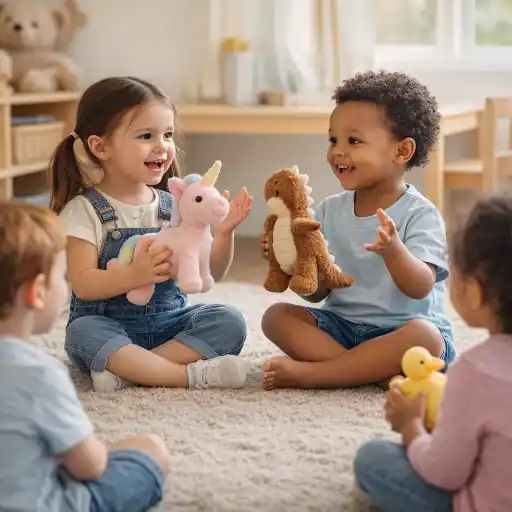
Model expansions in a warm, conversational way. If a child says, “Turtle scared,” you might respond, “Turtle felt scared because the trees looked so tall.” This adds vocabulary and a causal connection without demanding that the child repeat the sentence. Invite children to select feeling cards or draw what a narrator sees if spoken explanations are difficult.
For multilingual children, welcome contributions in home languages and use pictures, gestures, and family knowledge as supports. NAEYC’s guidance on embracing linguistic diversity encourages educators to value children’s home languages and create opportunities for storytelling and dramatic play. Diverse forms of expression help every child participate in the #adventure and communicate a point of view.
How can you make participation inclusive and manageable?
Some children will eagerly take a narrator role; others may prefer to watch, act, draw, or contribute a sound. Offer several ways to participate rather than treating spoken sentences as the only meaningful response. A child can hold the character card, move a puppet, point to an image, choose a feeling, or add one word to a shared line. A predictable turn-taking routine can also help children know when their ideas are welcome.
Use a small group when possible, and keep turns connected to the shared story. After a contribution, briefly reflect it back: “Turtle thought the cave was too dark, so Rabbit held the lantern.” This confirms that you heard the child and helps the group retain the sequence. Then invite another child to add an idea or choose the next narrator.
- 🧸 Offer a puppet or prop to make speaking feel less direct and more playful.
- Let children pass and return to them later, without pressure.
- Use pictures or simple cards for narrator, setting, feeling, and event.
- Make room for gestures, drawing, movement, sounds, and home languages.
- Notice whose contributions are being heard and adjust turns so participation is shared.
Dramatic play can give children a context for language-rich interaction, cooperation, and perspective-taking. NAEYC describes these connections in its article on dramatic play areas that support literacy. In practice, inclusion means following children’s cues and adapting the activity—not asking every child to perform in the same way.
How can you handle disagreements and extend the story?
Children may disagree about what a character saw or how an event felt. Treat these differences as useful material rather than a problem to shut down. You might say, “Rabbit thought the sound was a drum, and Turtle thought it was thunder. What could each character do next?” This validates both contributions and turns the difference into a story question. Avoid telling children what a character must feel; ask what clues in the story might support their ideas.
If the group cannot combine two versions, preserve both. Tell the scene twice, make the narrators’ accounts into parallel panels, or let children choose which character speaks first. Keep a simple record with drawings, dictated words, or photos of props in sequence. Revisiting the story later lets children compare the accounts, add vocabulary, or invent an ending.
Afterward, reflect on the activity with questions such as “Which detail changed when the narrator changed?” and “What helped you understand how each character felt?” For providers and directors, brief notes can capture whether children sequenced events, used new descriptive words, responded to a peer’s idea, or communicated nonverbally. Use these observations to plan next steps, such as adding visual supports or offering a smaller group.
Common pitfalls include correcting every imaginative inconsistency, asking too many questions in quick succession, or treating quiet observation as nonparticipation. Keep the story playful and allow children’s interpretations to remain distinct. If training hours are relevant to your role, state requirements vary - check your state licensing agency.
Conclusion: What makes a two-narrator story meaningful?
A two-narrator pretend adventure gives children practice noticing, describing, and listening to different points of view. Start with one simple premise, keep the sequence visible, and invite children to express each character’s perspective through words, props, movement, drawing, or home-language contributions. The educator’s role is to model language, make room for multiple ideas, and keep the experience safe and enjoyable.
The main question is not which narrator is right, but how the same adventure can look and feel different to two characters. When children explore that question together, storytelling becomes a practical way to support language, narrative thinking, participation, and empathy. For deeper professional learning, revisit Language Development in Early Childhood Buy Now $16.00 and adapt the strategies to the children and families in your program.
Explore five relevant ChildCareEd courses
- Lesson Planning for Preschoolers
- CDA Home Visitor Subject Area 3 Part 3 Birth to 5
- Language Development in Early Childhood
- 45 Hour Preschool Methods and Materials
- Language and Literacy Foundations in Pre-K
- Pediatric RSV First Aid & CPR/AED
- 45-Hour Infant and Toddler Curriculum
- Creating Environments that Nurture Growth and Community
- Anxiety: Signs & Strategies
- Bridging Cultures: Family Communication & Collaboration
- CDA Certification en Español: Recursos y Consejos para Educadores Bilingües
- ❄️ ¿Qué actividades al aire libre funcionan bien para los niños de Illinois en cada estación? 🌷🍂
- 👶 ¿Cuáles son las proporciones y grupos requeridos en Dakota del Norte? 🏫
- Recursos en Español sobre el Sueño Seguro del Bebé
- 10 Ejemplos de Cómo la Cultura Influye en el Desarrollo Infantil
- ¿Cómo solicito la licencia para una guardería en California?
- Regulaciones de Licenciamiento de Cuidado Infantil en California para Centros y Hogares de Cuidado Infantil Familiar
- Proporciones de Cuidado Infantil y Tamaños de Grupo por Edad en Maryland (Guía Rápida para Centros y Hogares)
- Proporciones de Cuidado Infantil y Tamaños de Grupo por Edad en Nueva Jersey (Guía Rápida para Centros y Hogares)
- Proporciones de Cuidado Infantil y Tamaños de Grupo por Edad en Virginia (Guía Rápida para Centros y Hogares)
- Lista para Abrir una Guardería en Casa en Dakota del Norte: Cómo Empezar
- Lista para Guardería en Casa en Illinois: Cómo Iniciar una Guardería en el Hogar
- Consejos de Supervisión Activa para Salones de Preescolar y el Juego al Aire Libre
- Cómo Trabajar en el Cuidado Infantil en Carolina del Norte: Requisitos y Pasos
- Cómo Ser Maestra de Preescolar en Illinois
- Celebrando la amistad en el cuidado infantil durante el Día de los Mejores Amigos
- Canciones, juegos y preguntas de círculo para niños
- Cómo simplificar la capacitación para sus empleados de daycare
- How Can Two Narrators Tell the Same Pretend Adventure in Different Ways?
