When a child adds a superhero just as another child insists the story belongs to a dragon, the group hasn’t lost the plot—it has found a chance to create one together. Strengthen your facilitation skills with ChildCareEd’s Reading Aloud and Storytelling  Buy Now $16.00 course, which explores interactive ways to support children’s language, comprehension, and shared storytelling. Read on for practical strategies, and consider the course for a more complete learning experience you can apply in your classroom.
Why are conflicting characters a storytelling opportunity?
In a group story, children bring different interests, experiences, and ideas about what should happen next. A dragon may be a friend to one child and a fearsome creature to another; a superhero may seem essential to one storyteller and completely out of place to a peer. These differences are not necessarily disruptions. They reveal that children are actively imagining, interpreting, and negotiating meaning.
Collaborative storytelling gives children meaningful practice in listening, expressing an idea, responding to a peer, and adapting a narrative. The challenge for educators is to protect each child’s contribution while helping the group find a story path they can follow together. Research and practice accounts of storytelling emphasize the importance of listening and honoring children’s voices; as the Bing Nursery School account of collaborative storytelling describes, children’s additions can enrich a shared storyline and encourage respect for different perspectives.
It helps to remember that the goal is not a perfectly consistent plot. Young children may change characters, settings, and rules quickly. Our role is to offer just enough structure for their ideas to connect, without taking authorship away from them. That balance builds #creativity, language, peer connection, and a sense that every child can contribute to the group’s #story.
How can you acknowledge each idea without choosing a favorite?
When two ideas collide, pause before deciding which one “wins.” Reflect both contributions neutrally so children hear that you have understood them. For example: “Maya wants the dragon to guard the cave, and Luis wants the astronaut to explore it. We have a dragon and an astronaut in our story.” This response names the difference without judging either idea.
Then invite the children to help shape the next step. Use open prompts that support thinking rather than asking for a quick vote every time:
- “What might the dragon and astronaut both want?”
- “Could they meet in the same place?”
- “What could happen that gives each character something important to do?”
- “Would you like to tell us, draw it, or show it with a prop?”
Give children time to respond. A child might need to point, gesture, use a home-language word, or watch before joining verbally. Those are meaningful ways to participate. If the group is stuck, you can offer two or three possible bridges, then let children choose or adapt one. For instance, the astronaut could land near the dragon’s cave because both characters are searching for a missing map.
A shared-story resource such as Story Stones Adventure can also provide visual prompts. A stone showing a character, object, or setting gives children something concrete to refer to as they build the narrative together.
What story structures help different characters belong?
Simple story structures help children see where their ideas might fit. Instead of requiring one main character, create a flexible frame with a setting, a shared problem, and a resolution. Characters with different personalities can then take different roles in addressing the same problem.
For example, if children introduce a dinosaur, a fairy, and a firefighter, the educator might say: “They all arrive at the playground just as a strong wind blows away the class picnic blanket. What could each character do?” The dinosaur might hold a corner, the fairy might find a safe place, and the firefighter might help everyone work together. The solution does not need to be realistic; the shared purpose helps the story hold together.
Try language that makes the story’s structure visible:
- Setting: “Where are all the characters?”
- Connection: “What brings them together?”
- Problem: “What has happened that they can respond to?”
- Resolution: “How do they decide what to do?”
Story circles and open-ended play can give children space to express ideas at their own pace. NAEYC’s discussion of story circles, art, and play highlights the value of predictable routines, child agency, and attentive listening. Keep the structure light: it should hold the story, not restrict children’s imagination. Offer #characters different jobs, and help children notice how each one contributes to the group’s #collaboration.
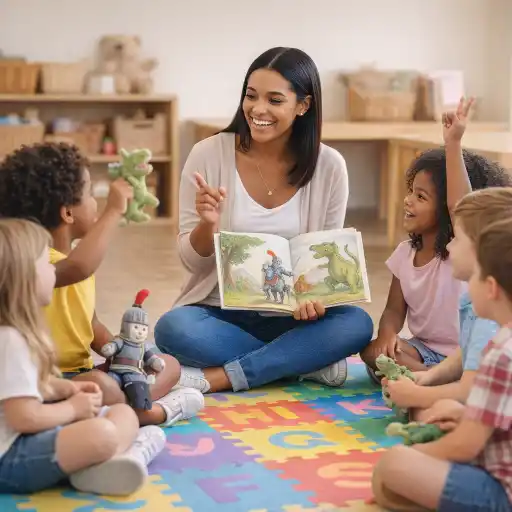
How can you guide turn-taking while keeping the story lively?
Some children naturally speak quickly and often; others need more time, a predictable invitation, or a nonverbal role. A clear turn-taking routine makes participation more equitable without making storytelling feel like a formal debate. You might pass a story object, invite one contribution from each child, or use a visual card to show whose turn is next.
Keep turns brief and connected. After a child adds an idea, repeat or expand it in a sentence that links it to what came before: “The astronaut finds the map, and now the dragon knows where to look.” This models narrative language and helps the group retain the storyline. Ask another child to build on the idea: “What might the dragon do when she sees the map?”
Use props thoughtfully. A puppet, picture card, or fabric piece can help children show an idea rather than explain it in words. The National Literacy Trust offers practical approaches for supporting young children to tell stories, including prompts, role-play materials, and recording children’s stories. A group can also use a simple “story keeper” role: one child holds the character cards while the educator or another child keeps track of the sequence.
- 🧩 Let children pass if they prefer to listen, then offer another chance later.
- Use a repeated phrase such as “Then something surprising happened…” to invite the next storyteller.
- Record key ideas with quick sketches or a few dictated words so the group can revisit them.
- Use gestures, sounds, drawing, and movement alongside spoken contributions.
These routines make #listening visible and help educators include children with different communication styles, languages, and comfort levels.
What can you do when the group cannot agree?
Sometimes children do not want to combine ideas. One child may want the dragon to be kind, while another wants it to chase everyone away. You can validate the difference and look for a narrative reason both versions might make sense: “Maybe the dragon is kind to friends but feels worried when strangers enter the cave. What could help the dragon feel safe?” This connects the conflict to character motivation rather than treating one child’s idea as incorrect.
Other times, the ideas may not fit comfortably in the same story. Offer a few constructive options:
- Two-part story: “First we’ll tell the dragon’s adventure, then the astronaut’s.”
- Parallel scenes: “The characters are in different places, and we can find out how their stories connect.”
- Group choice: Invite children to select from a small number of clear options, while ensuring each child’s idea remains represented.
- Open ending: Keep both possibilities in the story and ask what the audience thinks might happen next.
Avoid resolving every disagreement for children. Offer language they can use—“I have another idea,” “Could we try both?” or “What if they meet later?”—then allow time for peer negotiation. If tension rises, pause the story, name the feeling without blame, and return to the activity when the children are ready. Storytelling can support emotional expression, but it should not pressure children to disclose personal experiences or settle a real conflict in front of the group. With predictable expectations and responsive support, children can practice #problem-solving while still enjoying the imaginative work.
How can providers reflect on and extend a shared story?
After a group story, make time to revisit what the children created. Ask what they remember, which character surprised them, or how the characters helped one another. Children might retell the story with props, draw a scene, act it out, or dictate a new ending. These follow-ups help children see that their ideas have value and give educators a window into how children organize events, communicate, and respond to peers.
Document the process, not only the final story. Note whose ideas were added, who used gestures or objects, whether children built on a peer’s contribution, and what kinds of prompts helped the group move forward. Use those observations to adjust the next experience: a smaller group, more visual choices, an extra pause for thinking, or a familiar opening phrase may make participation more accessible.
For directors, shared storytelling can be part of a team’s reflective practice. Staff can compare how they respond when children disagree and share language that protects child agency while maintaining a coherent narrative. ChildCareEd’s Reading Aloud and Storytelling course Buy Now $16.00 offers a more complete opportunity to explore interactive read-aloud and storytelling practices that support early language and literacy. State requirements vary - check your state licensing agency when applying professional learning toward a training requirement.
Conclusion: How do you keep a group story going?
When children introduce conflicting characters, treat the differences as material for storytelling—not a problem that must be quickly corrected. Reflect each idea fairly, invite children to find a connection, and use a light narrative frame such as setting, shared problem, and resolution. Predictable turn-taking and multiple ways to contribute help more children take part.
Most of all, remember that children are learning how to listen, negotiate, imagine, and build meaning with others. A story may wander before the characters find a common adventure, and that process is valuable. Keep the tone playful, make space for different voices, and let the group’s ideas lead toward the next surprising page.
- Tiny Hands, Big Dreams: Fostering Creativity in Preschoolers
- 💛🧩 ¿Cómo puedo hacer que mi enseñanza sea inclusiva para los niños con autismo?
- Recursos en Español sobre el Sueño Seguro del Bebé
- Regulaciones de Cuidado Infantil en Maryland para Centros y Hogares de Cuidado Infantil Familiar
- Proporciones de Cuidado Infantil y Tamaños de Grupo por Edad en Virginia (Guía Rápida para Centros y Hogares)
- Retraso del Habla en la Guardería: Cómo Pueden Ayudar los Proveedores
- Celebrando la amistad en el cuidado infantil durante el Día de los Mejores Amigos
- Canciones, juegos y preguntas de círculo para niños
- La mejor manera de hacer seguimiento a la capacitación de su equipo de daycare How to Organize Staff Training for Your Child Care Center Cómo organizar la capacitación del personal para su centro de cuidado infantil
- Cómo simplificar la capacitación para sus empleados de daycare
- How Can I Build a Diverse and Inclusive Classroom Library?
- Dr. Seuss Book List for Teachers: Easy Ways to Use It for Story Time and Learning
- Beyond “How Are You?” Circle Time Questions Kids Actually Want to Answer
- How Can Emergent Readers Make Story Time More Interactive?
- How Can Puppets Support Communication and Literacy in Early Childhood?
- How Can Young Storytellers Make It Clear Who “He,” “She,” or “They” Means?
- What Should You Do When Children Disagree with a Storybook’s Ending?
- How Can You Keep a Group Story Going When Children Introduce Conflicting Characters?
- How Can You Help a Child Hold Two Feelings About the Same Event?
- How Can Providers Use Feelings Pictures with Autistic Children Without Making Assumptions?
