Tracing numbers can help children practice numeral formation, but tracing alone doesn’t build strong number understanding. In this article, we’ll explore when tracing is useful, what skills it supports, and what educators can add to make number practice more meaningful. Math Foundations in Early Childhood  Buy Now $16.00 offers strategies for building early number sense, while the Number Tracing 1–20: Trace and Write Practice Buy Now $1.49 gives children a simple way to practice forming numerals with growing independence.
Why does number tracing deserve a balanced approach?
Tracing is tempting because it produces a visible product. A child follows a dotted numeral, completes a page, and adults can easily see that something was practiced. Yet early mathematics is broader than pencil control. Children need opportunities to connect a written symbol with a quantity, compare groups, use number language, recognize patterns, and explain their thinking.
NAEYC describes infants and toddlers as active mathematical thinkers when they fill and dump containers, compare amounts, explore shape, and use spatial relationships. In preschool, these experiences become increasingly intentional through counting games, block play, measurement, and conversation. Early math learning is strongest when children can act on materials and communicate what they notice, not simply reproduce a printed form.
A balanced approach also reflects developmentally appropriate practice. Children differ in motor development, visual processing, language, attention, and prior experience. A child who struggles with tracing may understand quantity very well; another may trace accurately while still counting objects inconsistently. Treating a worksheet as the complete assessment can therefore hide important strengths.
Think of tracing as one possible tool—not the curriculum. Its value depends on the goal, the child’s readiness, the quality of adult guidance, and what happens before and after the page.
When can number tracing be useful?
Number tracing can help when the learning goal is clearly defined and the activity is brief. It may offer controlled practice with visual attention, hand movement, directionality, and recognition of a familiar numeral. Some children enjoy the predictability of a road, dotted path, or highlighted starting point. These cues can make an unfamiliar task feel manageable.
Tracing is most useful after children have encountered the numeral in meaningful contexts. For example, children might count four blocks, match a card showing 4 to a collection, find the numeral 4 in the classroom, and then briefly trace it. The symbol is more likely to carry meaning because it is connected to quantity and experience.
- Use a small number of numerals that children recognize or are currently exploring.
- Provide a clear starting dot, arrows, or sequential color cues when formation is the goal.
- Model the movement slowly and describe it with consistent language.
- Offer a short practice opportunity rather than a full page of repetition.
- Follow tracing with independent formation, construction, counting, or a game.
Tracing may also be appropriate as a fine-motor or visual-motor activity when that is the intentional objective. In that case, do not claim that the page alone demonstrates number understanding. Observe whether the child can identify the numeral, connect it to a quantity, and use a similar motor plan without the dotted guide.
Why is tracing alone insufficient for number learning?
Tracing can encourage children to focus on the line immediately in front of the pencil rather than the numeral as an integrated form. If a child begins at an inconsistent point or follows the path in an inefficient sequence, repetition may reinforce an unhelpful motor plan. This concern is especially relevant when children are asked to trace symbols they do not yet recognize.
There is also a conceptual gap between writing a number and understanding it. A child may trace 7 beautifully but be unable to make a set of seven objects, identify which of two groups has more, or state how many remain after one is removed. Conversely, a child may demonstrate strong #numberSense with blocks and counters while still developing the hand strength and coordination needed for paper tasks.
One-to-one correspondence is a critical foundation. Children need to touch or move each object once while saying one number word for each object. They also need to understand cardinality: the final number said tells how many are in the set. These understandings develop through concrete activity and math talk, not through tracing alone.
Use tracing cautiously when:
- the child does not yet recognize the numeral;
- the task causes fatigue, frustration, or avoidance;
- the worksheet is replacing manipulatives, movement, conversation, or play;
- adults are emphasizing neatness or speed over reasoning;
- the child is expected to copy forms without individualized support.
State requirements vary - check your state licensing agency when selecting curriculum materials or documenting math progress.
What should providers add before and after tracing?
The most powerful extension is a multisensory sequence that moves from meaning to movement and back to meaning. Begin with real objects. Ask children to build a collection, count it, compare it, and locate a matching numeral. Then offer a tactile or large-motor representation before introducing paper.
- Build it: Make numerals with playdough, string, linking cubes, craft sticks, or magnetic pieces.
- Move it: Walk, jump, or drive a toy car along a large number path while counting spaces.
- Feel it: Form numerals in sand, shaving cream, or a sealed sensory bag, using safe and supervised materials.
- Find it: Hide numeral cards and invite children to identify them, then collect the matching number of objects.
- Show it: Use counters, ten-frames, dot cards, or fingers to represent a quantity.
- Use it: Add numerals to dramatic-play menus, bus routes, recipes, attendance charts, or block-building plans.
Number-path games are particularly useful because they combine numeral recognition, stable counting order, one-to-one correspondence, and comparison. A child can roll a die, move a token, name the numeral, and discuss which player is closer or farther. This is a richer learning experience than tracing the same numeral repeatedly.
For younger children, emphasize large movements, sensory exploration, filling and dumping, stacking, and simple quantity language. For older preschoolers, invite them to copy a numeral from a model, create a matching collection, solve “one more” problems, or explain how they formed the number. Keep the experience playful and allow multiple ways to participate.
How can teachers support formation and fine-motor development?
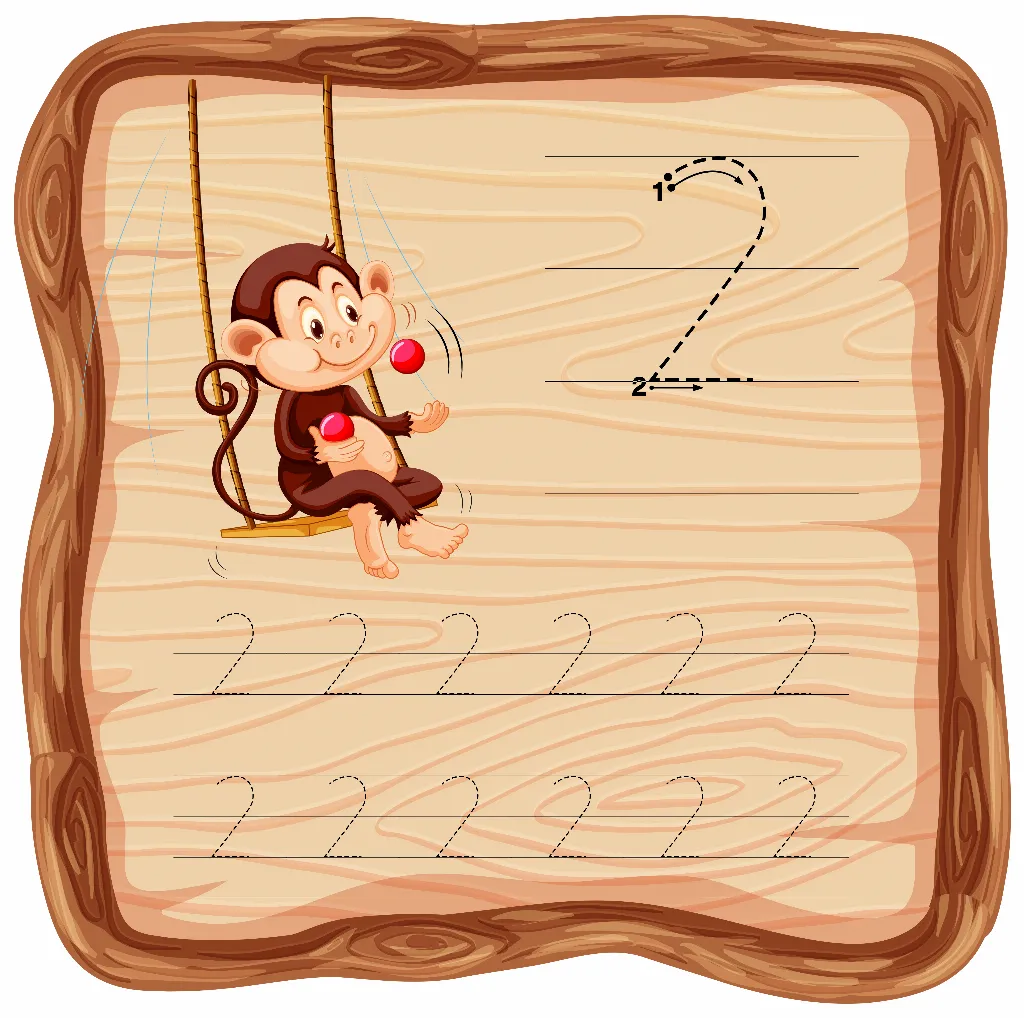
Number formation depends on more than finger movement. Children benefit from postural stability, shoulder strength, wrist control, bilateral coordination, visual-motor integration, and hand strength. These foundations develop through climbing, crawling, drawing on vertical surfaces, painting, cutting, building, manipulating playdough, and using tongs or tweezers.
Offer short, varied opportunities throughout the day rather than expecting sustained pencil work from every child. Large paper taped to a wall or easel encourages broader arm movements and can make formation easier to see. Chalk outdoors, water painting on sidewalks, and drawing in sensory materials provide repetition without the pressure of a worksheet.
When modeling a numeral, use a consistent verbal script. For example, describe the movement as “start at the top, curve around, and come down,” adapting the language to the numeral and the child. Demonstrate one step at a time, then invite the child to try. Avoid physically forcing a child’s hand; brief shared guidance should support motor planning, not replace it.
- Offer thick crayons, short chalk, triangular crayons, or adaptive grips when appropriate.
- Use vertical and large-scale writing before small paper forms.
- Let children choose between drawing, building, tracing, stamping, or forming with manipulatives.
- Watch for fatigue and stop before practice becomes discouraging.
- Celebrate strategy, persistence, and improvement—not only a correctly formed numeral.
Consult families and relevant specialists when concerns about motor development, vision, or persistent skill loss arise. Providers should document observations and follow their program’s referral procedures.
How can programs assess whether children are learning?
Assessment should examine the whole skill rather than the appearance of a tracing page. Observe children in several contexts and record what they can do independently, what prompts they need, and what they understand about quantity.
A brief observation might note: “Jordan identifies 5, counts five bears with one-to-one correspondence, and matches the numeral to the set. Jordan traces 5 but begins at the bottom and needs a verbal cue for formation.” This note separates conceptual knowledge from motor formation and supports a more precise next step.
- Recognize: Can the child identify the numeral among several choices?
- Represent: Can the child make or select a matching quantity?
- Count: Does the child touch or move each object once?
- Explain: Can the child describe how they know the answer?
- Form: Can the child make the numeral with a model, a tactile material, and eventually without one?
Common mistakes include using tracing as the primary math lesson, introducing too many numerals at once, correcting every mark, and comparing children’s handwriting. Replace these habits with short cycles of observe, model, practice, and reflect. Use photographs of constructions, samples of children’s representations, dictated explanations, and one-line notes to reduce paperwork.
Families can reinforce learning through ordinary routines: count socks, compare spoonfuls, notice house numbers, make collections on walks, or play a simple number-path game. Share the mathematical goal rather than sending home repetitive pages.
Conclusion: What should providers add beyond number tracing?
Number tracing helps most when it is brief, purposeful, and connected to experiences children already understand. It may support visual attention, controlled movement, and familiar numeral formation, but it cannot replace counting real objects, comparing quantities, using math language, developing fine-motor strength, or solving playful problems.
The guiding question is not “How many tracing sheets did the child finish?” but “Can the child connect a numeral to quantity, use a meaningful motor plan, and explain mathematical thinking?” Build that connection through manipulatives, movement, sensory materials, games, routines, and responsive conversation. With thoughtful scaffolding, tracing becomes one small part of a rich #playbased math environment—rather than the endpoint of learning.
For additional professional learning, ChildCareEd courses such as Math Foundations in Early Childhood Buy Now $16.00, Letter & Number Planning in Child Care Buy Now $24.00, Lesson Planning for Preschoolers Buy Now $24.00, and How Preschoolers Develop Buy Now $32.00 can help providers strengthen planning, observation, and developmentally appropriate classroom practice. Review each course description and confirm local acceptance before counting training toward a requirement.
- 45 Hour Child Growth and Development
- Toddlers and Theories
- CDA Home Visitor Subject Area 2 Part 3 Birth to 5
- 45 Hour Preschool Methods and Materials
- Power of Art: Bldg Self-Esteem & Positive Behavior for ALL Abilities
- Bienvenido! Welcoming All Families
- 45 Hour Infant and Toddler Methods and Materials
- 45 Hour School Age Methods and Materials
- Creating Environments that Nurture Growth and Community
- ❤️ ¿Cómo ayudan los educadores a las familias a acceder a los servicios que necesitan?
- ⏰ Cómo puedo facilitar las transiciones y las rutinas diarias en mi aula?
- ¿Cómo empiezo mi certificación CDA en Florida en línea?
- Canciones, juegos y preguntas de círculo para niños
- How can child care programs build prewriting skills without worksheets?
- What Are the Best Print-and-Play Activities for Substitute Teachers?
- How Can Play Help Children Distinguish Uppercase and Lowercase Letters?
- How Can Child Care Providers Teach Beginning Sounds with Tracing, Pictures, and Repetition?
- How Can Child Care Providers Teach Less-Frequent Letters Without Relying on Worksheets Alone?
- What Should Effective Beginning-Sound Practice Include?
- How Can Meaningful Juneteenth Vocabulary Support Early Writers?
- How Can You Increase Maze Difficulty Without Frustrating Young Learners?
- How Can Dot Markers Make Number Recognition Practice More Meaningful?
- How Can Child Care Providers Move Beyond Shape Names to Attributes and Comparisons?
- How Can Tracing and Painting Build Multisensory Prewriting Skills?
- How Can Easter Mazes Build Fine-Motor Skills Without Losing Sight of Learning?
- ¿Todos los niños deben participar en el tiempo de círculo?
- How Can Child Care Providers Make Room for Floor Projects That Grow Beyond Their Starting Area?
- How Can One Shape Exploration Engage a Mixed-Age Montessori Group?
- How Can You Teach a New Word So Children Use It Beyond the Activity?
