When children confuse capital and lowercase forms, playful comparison can turn frustration into discovery. Explore Science of Reading Foundations in the Pre-K Classroom Buy Now $16.00 to deepen your understanding of alphabet knowledge and gain practical strategies for creating print-rich learning experiences. Pair these strategies with the Sorting Mat - Upper Case or Lower Case Buy Now $1.49, a hands-on resource that helps children practice recognizing, comparing, and sorting uppercase and lowercase letters in an engaging way.Why does distinguishing letter case matter?
Recognizing uppercase and lowercase letters is more than memorizing two visual lists. Children are learning that one alphabetic identity can appear in different forms: A and a represent the same letter even though their shapes differ. This flexible understanding supports #letter recognition, print knowledge, emergent writing, and later word reading.
Uppercase letters may initially seem easier because they often have consistent height and clearer geometric features. Lowercase letters, however, occur more frequently in books, labels, and continuous text. Children therefore benefit from seeing both forms in meaningful contexts rather than mastering capitals first and encountering lowercase letters much later.
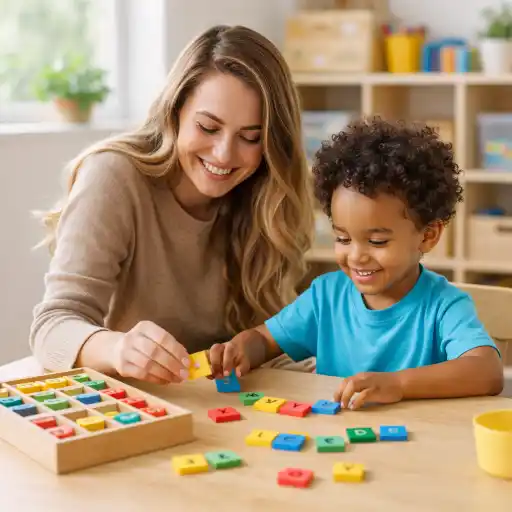
Play matters because it gives children repeated opportunities to look closely, talk, move, and make decisions without the pressure of a formal test. A sorting game can simultaneously build visual discrimination, memory, vocabulary, and fine-motor coordination. The ChildCareEd resource uppercase- and lowercase-letter sorting emphasizes that children learn by comparing features and explaining how they know where a letter belongs.
Which playful activities make letter-case learning engaging?
Effective activities are brief, hands-on, and easy to repeat. Begin with four to six familiar letters, especially those found in children’s names or classroom labels. Model the thinking aloud: “I see uppercase M. It is tall and has straight lines. Now I will find lowercase m, its partner.”
- 🔤 Letter treasure hunt: Hide uppercase and lowercase cards around the room. Children find a card, name it, and place it beside its partner.
- Magnetic-letter café: Invite children to “order” a capital letter and serve its lowercase partner.
- Letter hop: Place mixed-case cards on the floor. Call a letter and ask children to jump to either its uppercase or lowercase form.
- Clothespin match: Write capitals on cards and lowercase letters on clothespins. Children clip each match together.
- Environmental-print walk: Search books, signs, name cards, and labels for examples of both cases.
Keep the learning target stable while varying the format. Repetition is valuable when it feels fresh; the ChildCareEd discussion of purposeful repetition explains why revisiting skills strengthens memory and confidence.
How can sensory and movement experiences strengthen recognition?
Multisensory instruction gives children several pathways for connecting a symbol with its name. Children might trace a letter in sand, build it with play dough, say its name, and then match it to a card. The combination of sight, touch, hearing, and movement can make abstract forms more memorable, particularly for children who do not thrive with seated paper tasks.
Try a shallow tray of sand or salt for tracing selected uppercase and lowercase pairs. Provide a clear model, then invite children to describe the lines, curves, height, or “tail” they notice. Avoid requiring perfect handwriting; the goal is to attend to letter identity and formation. For safety, supervise sensory materials and follow age-appropriate small-parts practices.
Movement can also reinforce meaning. Children may stretch tall for uppercase letters and crouch low for lowercase letters, or make a large capital with their arms and a small lowercase form with finger movements. These metaphors should support—not replace—accurate visual instruction.
For children with visual, motor, language, or attention differences, adapt the materials:
- Use large, high-contrast cards and a defined workspace.
- Offer foam, magnetic, or textured letters instead of requiring cutting.
- Allow pointing, matching, or verbal responses when writing is difficult.
- Pair spoken letter names with gestures and visual models.
How should providers scaffold instruction and connect letters to meaning?
A thoughtful progression prevents children from feeling overwhelmed. Start with identical-letter matching or a small number of visually distinct pairs. Move to mixed uppercase/lowercase sorting, then connect letters to names, objects, sounds, and familiar words. The “I do, we do, you do” sequence is especially useful: model one example, solve several together, and then invite independent attempts.
Meaningful print makes the distinction more memorable. Display children’s names at arrival, label classroom areas, and use menus, tickets, signs, and order forms in dramatic play. Ask questions such as, “Can you find the lowercase letter in your name?” or “Where might we see an uppercase letter here?”
Do not require every activity to include phonics. Letter naming, visual recognition, sound awareness, and writing are related but distinct skills. When children are ready, add a beginning-sound connection: “This is uppercase B and lowercase b. The letter name is B, and it can represent /b/ in ball.” Include children’s home languages and family print when appropriate; multilingual experiences are assets, not obstacles.
For purposeful planning, Letter & Number Planning in Child Care  Buy Now $24.00 can help providers design developmentally appropriate literacy activities that account for individual needs.
How can providers differentiate, observe, and avoid common mistakes?
Children develop alphabet knowledge at different rates, so differentiation is essential. A beginning learner may match two identical forms. A developing learner may sort several pairs. An extending learner may identify letters in words, produce a beginning sound, or build a name with mixed cases.
- Beginning: use two or three highly contrasting letters and provide direct modeling.
- Developing: offer several uppercase/lowercase pairs and reduce prompts gradually.
- Extending: introduce varied fonts, environmental print, sounds, and simple word building.
- Access supports: enlarge materials, increase contrast, limit choices, and provide partner work.
Observe rather than overcorrect. Record which forms children recognize independently, which they confuse, and what prompts help. Confusions such as b/d or p/q are common and should be addressed through calm comparison, not alarm. Use photographs, brief anecdotal notes, or work samples to document progress. The Assessment of Language and Literacy Skills Buy Now $24.00 course offers further guidance on objective observation and translating evidence into meaningful goals.
Common mistakes include presenting all 26 letters at once, relying only on worksheets, treating speed as mastery, and correcting every attempt. Keep sessions short, celebrate effort, and connect practice to authentic reading and writing.
State requirements vary - check your state licensing agency when planning documentation, instructional expectations, or professional development.
How can a classroom make letter-case learning part of daily life?
Letter learning becomes stronger when it is embedded across routines rather than isolated in a single lesson. At arrival, children can locate their name card and notice its initial. During read-alouds, providers can briefly point out a meaningful capital or lowercase letter without interrupting the story. In the writing center, children can use stamps, magnetic letters, clipboards, and pretend forms to apply what they know.
Directors can support consistency by ensuring that staff use shared language and provide accessible materials. A small basket of case-matching cards, name cards, alphabet books, and writing tools can travel between centers. Rotate themes while keeping the learning goal stable: match letters in a post office, sort them at a grocery store, or “rescue” them from a sensory bin.
Family partnerships extend practice naturally. Share a simple suggestion such as finding one uppercase and one lowercase letter on a walk or matching the letters in a child’s name. Avoid assigning drills; playful observation at home is enough.
For additional professional learning, consider these relevant ChildCareEd courses:
- Play Safe, Think Big: Literacy Through Play supports literacy-rich play and supervision strategies.
- Language and Literacy Foundations in Pre-K Buy Now $16.00 explores language-rich classroom practices and emerging literacy.
- Reading Aloud and Storytelling Buy Now $16.00 strengthens interactive experiences with books and oral language.
- Classroom Tools for Emergent Literacy Buy Now $25.00 provides practical materials and strategies for print-rich classrooms.
- Assessment of Language and Literacy Skills Buy Now $24.00 supports objective observation and individualized planning.
Conclusion: What helps children distinguish uppercase and lowercase letters?
Children distinguish uppercase and lowercase letters best when providers combine explicit modeling with playful, repeated, meaningful practice. Sorting, matching, movement, sensory exploration, environmental print, and name-based activities help children understand that different visual forms can represent the same alphabetic identity.
The most effective approach is responsive rather than rigid: begin with a manageable set, use multiple senses, connect letters to children’s lives, observe progress, and adjust support. With patient guidance, letter-case learning becomes an enjoyable investigation—and a strong foundation for later reading and writing.
- Turning Behavior Around for Toddlers and Preschoolers
- Science of Reading Foundations in the Pre-K Classroom
- CDA Home Visitor Subject Area 3 Part 3 Birth to 5
- CDA Home Visitor Subject Area 2 Part 3 Birth to 5
- Building Early Science Foundations
- The ABCs of Behavior: Turning Challenges into Learning Opportunities
- Emergent Learning & Development
- Creating Environments that Nurture Growth and Community
- Texas Director Credential
- Montessori Cultural Activities: Exploring the World Through Play and Learning
- CDA Certification en Español: Recursos y Consejos para Educadores Bilingües
- 10 Ejemplos de Cómo la Cultura Influye en el Desarrollo Infantil
- Proporciones de Cuidado Infantil y Tamaños de Grupo por Edad en Nueva Jersey (Guía Rápida para Centros y Hogares)
- Proporciones de Cuidado Infantil y Tamaños de Grupo por Edad en Virginia (Guía Rápida para Centros y Hogares)
- Consejos de Supervisión Activa para Salones de Preescolar y el Juego al Aire Libre
- Cómo Trabajar en el Cuidado Infantil en Carolina del Norte: Requisitos y Pasos
- Celebrando la amistad en el cuidado infantil durante el Día de los Mejores Amigos
- Canciones, juegos y preguntas de círculo para niños
- Cómo simplificar la capacitación para sus empleados de daycare
- What Are the Best Print-and-Play Activities for Substitute Teachers?
- How Can Clip Cards Prepare Little Hands for Writing?
- Why Is Upper- versus Lowercase Sorting Great for Letter Recognition?
- How Can Child Care Providers Help Children Recognize Letters Through Play?
- How Can Play Help Children Distinguish Uppercase and Lowercase Letters?
- How Can Child Care Providers Teach Beginning Sounds with Tracing, Pictures, and Repetition?
- How Can Visual-Motor Practice Strengthen Alphabet Order?
- How Can Child Care Providers Teach Less-Frequent Letters Without Relying on Worksheets Alone?
- What Should Effective Beginning-Sound Practice Include?
- How Can Providers Connect Letter Formation, Sound, and Vocabulary in Phonics Instruction?
- How Can Hands-On Dot-Marker Activities Build Alphabet Knowledge?
