Many programs are asking: What does the new 40-hour rule mean for our daily work? This short guide gives clear, practical steps you can use today to protect your program, document care, and help families. You will see simple lists, short routines, and links to helpful resources. Remember: state requirements vary - check your state licensing agency. This article focuses on helping #CCAP providers in #NorthDakota meet new #attendance expectations while keeping children safe and families supported.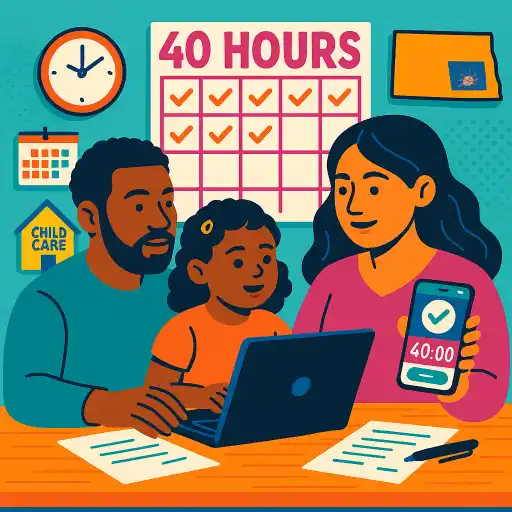
Why it matters: these attendance changes affect how your program gets paid and how audits are reviewed. The federal Department of Health and Human Services has moved states back toward attendance-based billing and stricter verification to reduce improper payments, making accurate daily records more important than ever. Accurate records help you avoid payment delays, keep spots filled, and show funders you are a reliable #provider.
What is the 40-hour rule, and why does it matter?
The 40-hour rule is the practical idea many states use: CCAP payments and verifications are tied to actual hours children attend, often up to a standard work-week, like 40 hours per child. While North Dakota’s CCAP specifics come from state guidance, the national policy shift back to attendance-based billing was announced by the U.S. Department of Health and Human Services (HHS) as a way to restore attendance verification and reduce improper payments (HHS announcement). For local details, see ChildCareEd’s North Dakota CCAP overviews (Demystifying CCAP in North Dakota).
Key points to know:
- States can require payment based on verified #attendance rather than enrollment alone. This means you may be paid only for the hours children actually attend.
- Many families use CCAP for work or training hours; hours billed usually match the family’s authorized schedule and what your attendance records show. See North Dakota provider guidance on authorizations and uploads (what employers should track).
- Keeping daily times and authorizations together helps avoid payment holds and overpayment recoveries.
Why this matters to your program:
1) Money flow: attendance-based billing links payment to documented hours. 2) Audit risk: Poor attendance records increase the chance of audits and holdbacks. 3) Family trust: clear records help families who rely on CCAP keep their benefits. For a practical provider's view on bonuses, recordkeeping, and how payments work in ND, see ChildCareEd’s CCAP provider bonuses guide (CCAP provider bonuses).
How can we track attendance so CCAP payments stay smooth?
Good attendance tracking is simple when it is routine. North Dakota uses attendance uploads (SFN 1220 or portal uploads) and the Provider Self Service Portal (SSP) to verify hours, so prepare records that match what you upload. ChildCareEd explains what to collect and how often in a helpful guide for employers and providers (attendance & verification guide).
Quick daily routine (5–10 minutes):
- 📝 Staff record arrival and pick-up times for each child on the same day.
- 📂 Director checks for missing times and signs or initials daily logs.
- 💻 Add notes for unusual days (field trips, closures, doctor appointments).
Weekly routine (10–20 minutes):
- 🔎 Reconcile classroom logs with billing sheets.
- 📤 Prepare the attendance upload for the SSP or fill SFN 1220 forms if used by your program (details in the ND provider guide referenced in ChildCareEd).
- 🧾 File copies of authorizations that show approved hours for each CCAP child.
Monthly routine (20–40 minutes):
- 📊 Compare billed dates/times to payments received and investigate gaps.
- 🗂 Keep backups together: daily attendance + authorizations + payment notices.
Keep it simple: same-day entries, one staff check, and one monthly reconciliation will protect your payment stream and reduce stress. Save scanned copies and label them by month so audits are quick and calm. #providers #attendance
What paperwork and staff records should I keep for audits and workforce verification?
The most useful records are those that prove care happened on the days and times you billed. North Dakota uses specific forms and the Workforce Benefit Verification (SFN 354) for staff who ask for CCAP workforce help — see the ChildCareEd employer checklist for details (workforce benefit verification).
Essential items to keep (simple folder list):
- 🗂 Child files: enrollment, emergency contacts, immunizations, and signed permission forms.
- 🕘 Attendance logs: daily arrival/pick-up times, staff initials, notes for absences.
- 📜 CCAP authorizations: approved hours and dates from ND HHS or the family’s authorization notice.
- 🧾 Billing records: invoices you sent, payments received, and deposit records.
- 🧑💼 Staff files: hire date, weekly hours, job title, and the SFN 354 are completed when workforce verification is requested.
How to organize them (one easy system):
- 📁 One digital folder per child and one paper folder per child.
- 📁 One "CCAP Billing" binder with monthly tabs (attendance, authorizations, payments).
- 📁 One "Workforce Benefit" staff folder containing SFN 354 forms, job descriptions, and timesheets for any staff using the benefit.
Helpful reminders from ND guidance and ChildCareEd:
- 🔎 Keep the SFN 354 employer section up-to-date for staff requesting workforce help and the SFN 1220 for attendance uploads (see the employer verification guide).
- 📅 Keep at least monthly reconciliations so you can answer questions quickly if payment notifications or recoupments arrive.
- 🧾 Scan and store certificates and forms; having both paper and digital copies makes licensing visits and audits easier.
Tip: When you complete SFN forms, keep a checklist of required attachments so nothing is missing when you submit verification. Properly organized files help you qualify for CCAP provider bonuses and incentives and reduce stress during reviews (provider bonuses guide).
What common mistakes should I avoid, and how can I set simple systems to comply?
Many payment problems come from small, fixable mistakes. A few simple habits prevent most issues and keep your staff calm. Below are the most common pitfalls and quick fixes drawn from provider experiences and ChildCareEd guides.
Common mistakes and fixes (easy list):
- ❌ Missing or late attendance entries. ✅ Fix: require same-day logging and a daily check by the lead teacher or director.
- ❌ Billing for closed days or child absences. ✅ Fix: flag closures in your billing system and cross-check with daily logs before upload.
- ❌ Incomplete SFN or verification forms. ✅ Fix: use a pre-submission checklist for SFN 354 and SFN 1220 (see employer verification help at ChildCareEd: what employers should track).
- ❌ Not saving authorizations. ✅ Fix: store every authorization in the child’s file and in your monthly CCAP binder.
Simple systems to put in place this week (priorities):
- 🟢 Create a 5-minute end-of-day attendance check and assign a person to sign off.
- 🟢 Make a single CCAP folder (digital + paper) and move items to monthly tabs.
- 🟢 Schedule one staff time each month to reconcile attendance, billing, and payments.
When an issue appears, follow these steps in order
- 🔎 Review your attendance record for the date in question.
- 🧾 Check the authorization (hours approved).
- 📞 Contact your ND HHS CCAP provider contact or use the SSP if unsure.
- ✍️ Document any corrections and why it was made.
Navigating these new attendance mandates requires more than just better filing; it requires a shift in how you manage your time and team. To help directors handle these evolving state expectations without burnout, the course The Balancing Act for Administrators  Buy Now $16.00 offers practical strategies for prioritizing daily CCAP documentation alongside your other leadership duties. For those looking to build a more robust operational foundation, our comprehensive Child Care Management Buy Now $80.00 training provides the high-level skills needed to oversee financial records, staff compliance, and the long-term sustainability of your program under the 40-hour rule
FAQ (short):
- Q: Do I need to use SFN 1220? A: North Dakota allows upload via SSP; SFN 1220 is the state attendance form if you prefer paper — see the employer guide in ChildCareEd (employer verification guide).
- Q: How long do I keep records? A: Keep records long enough for audits—follow ND guidance and your licensing rules; when unsure, keep at least one year plus any audit window noted by ND HHS.
- Q: What if a family’s authorized hours change? A: Update the authorization in the child file and note changes in your attendance reconciliation log.
Final encouragement: small daily habits protect your program. Pick one change to try this week — for example, start the 5-minute end-of-day attendance check. These few steps will improve your #compliance, reduce payment delays, and protect the families you serve.
Key resources cited in this article: ChildCareEd’s CCAP overview (Demystifying CCAP in North Dakota), the ND employer & attendance guide (What should employers track), CCAP provider bonuses and recordkeeping (Provider bonuses), and the federal HHS announcement about attendance verification (HHS rule update).
Need a quick checklist to print? 1) Same-day attendance entries. 2) Daily sign-off by staff lead. 3) Monthly reconciliation. 4) Maintain SFN and authorization files. 5) Back up digital scans. Follow these five steps, and your program will be in a strong place to manage the 40-hour expectations. #providers #NorthDakota
Conclusion: The 40-hour change asks for steady records, not extra paperwork. With short daily routines, one monthly review, and simple filing, your program can protect payments and support families. If you need help, ChildCareEd offers training and checklists that map to North Dakota rules — and state requirements vary - check your state licensing agency.
- Birth to Five CDA Credential with Portfolio Review
- CDA Family Child Care Credential with Portfolio Review
- Pediatric RSV First Aid & CPR/AED
- CDA Infant/Toddler Credential with Portfolio Review
- CDA Bridge Bundle: Family Child Care without Portfolio Review
- CDA Bridge Bundle: Infant/Toddler without Portfolio Review
- CDA Bridge Bundle: Preschool without Portfolio Review
- CDA Preschool Credential with Portfolio Review
- Texas Director Credential
- What Should Employers in North Dakota Track for CCAP Workforce Benefit Verification?
- North Dakota Child Care Training Hours: What You Need Each Year
- North Dakota Child Care Grants and Supports: Where to Look and What to Prepare Before You Apply
- North Dakota Child Care Rules: A Guide for Family Child Care, Group Child Care, and Center Child Care Providers
- North Dakota Home Daycare Checklist: How to Start a Daycare at Home
- Lista para Abrir una Guardería en Casa en Dakota del Norte: Cómo Empezar
- In-Home Daycare Requirements in North Dakota
- Daycare Center Requirements in North Dakota
- What is the Infant & Toddler Bonus and how can ND providers use it to improve care?
- How can I manage North Dakota’s new 40-Hour CCAP attendance rule?
- How can North Dakota child care programs plan now for tourism and population surges?
- How Can North Dakota Close the Rural Child Care Gap with Funding and Expansion?
- How can I build an attendance-tracking system that meets North Dakota’s 40-hour bonus rule?
- How can I explain CCAP changes to families at my North Dakota program?
- How can I prepare my North Dakota program for the July 13 CCDF rule changes?
- How Can North Dakota Child Care Providers Help Families Cope with Economic Stress?
- How Can North Dakota Providers Show Quality and Attract Families?
- How can North Dakota fill the gap for school-age children before and after school?
- How do I open a licensed group child care home in North Dakota?
