Young children do not need an app or a science kit to think like investigators—they need intriguing materials, time to try ideas, and an adult who is willing to wonder alongside them. Explore practical activities you can use in your program, and consider Basic Science in Early Childhood Buy Now $25.00 for focused training in planning investigations that build scientific reasoning. For a deeper look at intentional, child-led teaching, Facilitating Learning in the Preschool Classroom Buy Now $35.00 offers additional strategies you can bring into everyday practice.
Why do screen-free STEM experiences build problem-solving skills?
Screen-free STEM gives children a direct way to explore cause and effect: they move, combine, balance, sort, and test real objects, then see what happens. During this process, children practice noticing a problem, imagining possibilities, making a prediction, trying a solution, and deciding what to change. These habits are useful far beyond a science center; they support flexible thinking in play, routines, relationships, and future learning.
STEM is not a collection of advanced facts or equipment. A child using a cardboard tube as a tunnel is exploring design; a child comparing which objects float is investigating materials; and a child counting blocks to measure a tower is using mathematics. The National Association for the Education of Young Children describes early STEAM as inquiry that can nurture critical thinking, communication, problem-solving, and reflection (Breaking Down STEAM for Young Children).
Screen-free also does not mean technology-free. In early STEM, technology can include simple tools that help children accomplish a task—such as a funnel, magnifier, measuring cup, or child-safe tongs. The adult’s role is to make exploration safe and inviting, then allow children to do the intellectual work.
- Children learn to persist when a first idea does not work.
- They build language as they describe evidence, compare outcomes, and explain plans.
- Shared challenges encourage cooperation, negotiation, and listening.
Which low-preparation activities can children investigate?
Start with familiar materials and one open-ended challenge. Provide enough time for children to repeat the activity and change their approach; the learning often lies in the second, third, or fourth attempt. These activities work well in centers, small groups, or outdoor play, with adaptations to suit children’s ages and abilities.
- 🚗 Ramp tests: Place a sturdy cardboard ramp on blocks and roll toy cars or other large objects down it. Ask children how they could make an object travel farther or slower. Change one feature—such as the ramp height or surface—at a time and compare results.
- Build a bridge: Offer blocks, cardboard strips, or sturdy recycled containers. Invite children to make a bridge that spans a small gap and supports a toy. When it bends or falls, ask what they could change.
- Sink-or-float inquiry: With close adult supervision, offer a shallow basin and safe, large objects. Children predict, test, sort, and look for patterns in what floats or sinks.
- Nature sorting: Collect leaves, pinecones, or large stones. Invite children to create their own sorting rule—perhaps by shape, texture, or size—and then try a different rule.
- Shadow exploration: Use sunlight or a flashlight with large objects to make shadows. Children can move the object or light source, trace a shadow, and observe how its shape or size changes.
For children who still mouth objects, avoid small components and select materials appropriate to their age and developmental needs. Screen-free activities should remain open-ended: the aim is not a single correct product, but a meaningful process of #exploration, testing, and revision.
How can educators guide thinking without taking over?
It can be tempting to fix a wobbly tower or show children the fastest way to complete a challenge. Yet solving the problem for them can remove the very thinking the activity is meant to invite. Try observing first, then offer a short prompt that helps children decide what to do next. NAEYC’s discussion of the design process in preschool engineering describes a child-accessible cycle of identifying a problem, imagining and planning, creating, and improving.
- “What do you notice?”
- “What are you trying to find out?”
- “What might happen if we change this part?”
- “How could we make it stronger, taller, or more stable?”
- “What did you learn from that try?”
After asking, pause. Children may answer with words, gestures, drawings, actions, or home-language explanations. A thoughtful wait gives them time to process and signals that their ideas matter. Introduce precise words naturally—such as balance, compare, measure, predict, and material—without turning play into a vocabulary quiz.
When an attempt fails, frame the result as useful evidence: “The bridge dipped when the toy crossed. What could we test next?” Notice effort and thinking, not just a finished structure: “You changed the base and tried again.” This supports #persistence and helps children experience revision as a normal part of problem-solving. A photo and a brief quote from a child can help you remember what they tried and plan a meaningful next invitation.
How can you make activities safe and accessible to every child?
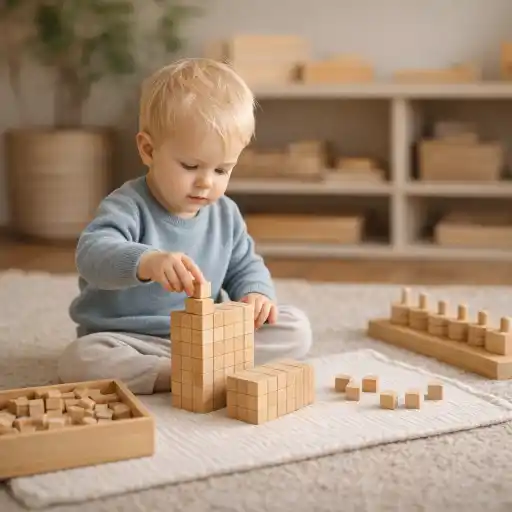
A successful STEM area is organized for children’s independence and adults’ supervision. A small set of purposeful materials is often more inviting than an overflowing collection. Place items in shallow trays or clearly labeled bins, and offer a stable work surface where children can reach, choose, and return materials.
- Inspect materials before use; remove sharp edges, broken pieces, choking hazards, and items that cannot be cleaned appropriately.
- Supervise water play closely, use a shallow amount of water, and empty containers promptly after the activity.
- Offer adapted tools, larger materials, visual instructions, nonslip surfaces, or a partner option when helpful.
- Allow children to participate by building, observing, pointing, drawing, explaining, or taking a classroom role.
- Use family-relevant and culturally familiar materials, and welcome children’s home languages and ways of communicating.
Plan with varied entry points. One child may test whether a structure stands; another may compare its height or sketch a plan. Both can engage meaningfully in the same challenge. For ideas on making instruction accessible, explore Inclusive Lessons for Preschoolers  Buy Now $16.00. When considering supervision, sanitation, and permitted materials, state requirements vary - check your state licensing agency.
Keep the atmosphere supportive. Some children enjoy messy materials or busy group work; others may prefer quieter exploration, a predictable sequence, or a smaller choice of tools. Adjusting the setting is not lowering expectations—it is removing barriers so each child can contribute and think.
How can providers turn activities into an ongoing learning routine?
Screen-free STEM works best as a recurring part of the day, rather than a one-time special event. Select one activity, identify the problem-solving skill you hope to observe, and decide how you will capture children’s thinking. Then let their ideas influence what comes next. If children are fascinated by a ramp, keep it available and offer a new surface or a different kind of vehicle later.
- Invite: Present a simple problem or question, such as “How can we move this toy across the gap?”
- Explore: Give children time to choose materials, build, test, and repeat.
- Talk: Ask what they noticed and listen for their explanations, predictions, and questions.
- Document: Take a photograph, record a short quote, or make a simple drawing or tally with the group.
- Extend: Change one condition, add a new material, or revisit the idea in outdoor play or another classroom center.
Assessment can be observation-based rather than a formal test. Notice whether children make predictions, try more than one approach, compare outcomes, communicate an idea, or ask for help in a purposeful way. These observations give educators useful information for planning and family conversations. Directors can support staff by sharing a common materials checklist and setting aside brief time to discuss: What did children try? What did they discover? What might we offer next?
For additional training in play-based investigation, explore Building Early Science Foundations Buy Now $16.00. The focus is on extending children’s curiosity through developmentally appropriate opportunities to explore, experiment, and discover.
What common pitfalls can educators avoid?
In a busy child care day, STEM activities can become too adult-directed, complicated, or rushed. A few intentional choices keep the experience manageable and preserve children’s ownership of the problem. You do not need expensive kits; everyday objects, careful supervision, and thoughtful questions can offer rich opportunities to reason and invent.
- Showing a model to copy: Present a challenge instead of a finished example so children can generate their own designs.
- Giving too many instructions: Introduce the materials and one clear question, then let children begin.
- Changing several things at once: When you want to compare results, alter one feature at a time so children can notice what changed.
- Rushing to the next activity: Leave time for repetition and allow a project to continue across days when practical.
- Calling an attempt a failure: Treat an unexpected outcome as information and invite children to consider what they might try next.
A clean-up plan can make hands-on learning feel more manageable: use trays, washable surfaces, labeled containers, and simple jobs children can help with. Keep materials within sight and reach only when they are appropriate for the children using them and can be supervised safely. Most importantly, remember that the value of a STEM experience lies in the thinking children do—not in how polished the final creation looks.
Conclusion: What screen-free STEM activities help children solve problems?
Ramps, bridges, nature sorting, sink-or-float tests, and shadow play are accessible ways to invite young children to notice, predict, test, communicate, and revise. These activities need little more than everyday materials and an educator who can protect time for exploration, ask a purposeful question, and resist taking over. The result is not simply a fun center: it is practice in the flexible thinking and persistence children use throughout their lives.
Choose one activity to try this week. Keep the materials simple, make participation accessible, and document one moment of children’s thinking. Then build on what they discovered. Screen-free STEM is most powerful when it grows from children’s own questions—and when providers create the conditions for every child to see themselves as a capable problem solver.
Related ChildCareEd courses
- What Makes Me Special: An Overview of Autism and ADHD
- 45 Hour Infant and Toddler Methods and Materials
- Pediatric RSV First Aid & CPR/AED
- CDA Bridge Bundle: Family Child Care without Portfolio Review
- CDA Bridge Bundle: Infant/Toddler without Portfolio Review
- CDA Bridge Bundle: Preschool without Portfolio Review
- CDA Certification en Español: Recursos y Consejos para Educadores Bilingües
- 🎉STEM-sational Fun: How Can You Spark Preschoolers’ Curiosity with Engaging STEM Activities? 🔬🧪🔢
- 🔍 ¿Qué ves cuando observas a un niño aprender?
- Learning Through Creative Daycare Activities
- How Do Art Activities Support Cognitive Growth in North Dakota Preschoolers?
- Celebrando la amistad en el cuidado infantil durante el Día de los Mejores Amigos
- Canciones, juegos y preguntas de círculo para niños
- How can preschool teachers use simple STEM activities to spark big learning?
- How can child care programs balance screen time, educational technology, and active-learning alternatives?
- Can your program go screen-free with engaging analog activities?
- How Can Preschool Teachers Help Children Build Problem-Solving Skills?
- How can I use simple STEM activities to spark curiosity in preschoolers?
- Why do children need more boredom and less constant entertainment?
- How can early childhood educators effectively teach digital citizenship to young children?
- How can child care programs effectively support school-age children's social and emotional development?
- After-School Activities for Kids: Calm, Creative, and Active Ideas for Every Energy Level
- Can You Build a Leaf Bridge? Fall STEM Challenges for Pre-K
- How Can Everyday Classroom Problems Become Child-Led Investigations?
- How Can Patterned Practice Help Young Children Master Subtraction Facts?
- What Screen-Free STEM Activities Help Young Children Develop Problem-Solving Skills?
