Cold days can shrink the play space, but children’s need to move does not go away. Find simple, adaptable games you can weave into the classroom day, and explore Engaging Indoor Activities for Inclement Weather  Buy Now $24.00 for a deeper planning toolkit. This three-hour training offers ideas for selecting varied indoor experiences so you can turn weather-related disruptions into purposeful movement and learning.
Why does indoor movement matter when the weather turns cold?
Movement is more than an outlet for extra energy. Through large-muscle play, children practice strength, balance, coordination, body awareness, and spatial judgment. Games with peers also create real opportunities to listen, take turns, cooperate, and manage excitement. A short dance break before circle time or a simple pathway during a transition can support participation without requiring a separate gym period.
The CDC’s early care and education physical activity standards encourage programs to provide adequate space for indoor and outdoor play, promote active play, and offer structured movement opportunities across the day. The standards also emphasize that active play should not be withheld as a consequence. These principles are helpful when planning winter routines, though programs should follow applicable local rules and policies.
Cold-weather indoor days can test even experienced teams: rooms feel crowded, children may be restless, and staff are balancing supervision with the rest of the schedule. Predictable routines, a clear movement zone, and a consistent stop signal can make active play more manageable. Keep activities playful rather than competitive, and notice each child’s effort and growing confidence.
For more professional learning about incorporating movement into daily schedules, consider Balancing Physically Active Play in Child Care Buy Now $25.00. It focuses on planning structured and unstructured activity and using available materials to promote children’s development.
Which low-preparation games get children moving right away?
A few reusable materials—painter’s tape, soft balls, beanbags, scarves, paper, and music—can support a surprisingly broad set of activities. Choose one or two games based on the space available, the children’s interests, and the group’s energy. Brief experiences are easy to repeat and adjust.
- ❄️ Snowball target toss: Crumple paper or use soft balls. Invite children to toss underhand into baskets set at different distances. Move the target closer or farther to adjust the challenge.
- Winter animal parade: Waddle like penguins, stomp like bears, tiptoe like foxes, or flap like owls. Children can invent an animal movement of their own.
- Freeze dance: Play music while children move in their own safe space. Pause the music and invite them to freeze in a snowflake, snowman, or other pose.
- Mitten-match walk: Place paper mittens around the room and invite children to walk, march, or tiptoe to find matching colors or patterns.
- Balloon keep-up: In a small group, work together to keep a balloon in the air using gentle taps. Use active supervision and a clear boundary for the play area.
For infants, offer age-appropriate floor play and supervised tummy time when awake. Toddlers may enjoy rolling a ball or crawling through a safe, low tunnel. Preschoolers may be ready for simple relays or movement prompts. Activities should reflect each child’s developmental abilities and the materials’ safety requirements.
How can a small classroom become a movement course?
A course does not need elaborate equipment or a long route. A clear patch of floor, low-tack tape, cushions placed securely on the floor, and a soft target can create opportunities to step, crawl, balance, and reach. Keep the route short and demonstrate it before children begin. Consider making stations so everyone spends more time moving and less time waiting.
- Snowy bridge: Follow a straight or zigzag tape line, arms out for balance. Children can step beside the line or hold an adult’s hand if that is a better fit.
- Ice ponds: Step between broad tape circles or paper shapes. Offer stepping as an alternative to hopping.
- Animal den: Crawl through a stable play tunnel or under a sturdy, approved structure, then walk to a marked finish spot.
- Snowball finish: Roll or toss a soft ball into a nearby basket to end the route.
Think about what skill you want children to practice—balance, changing direction, or following a sequence—and adjust one feature at a time. For example, widen a pathway before asking children to move faster. Avoid using unstable furniture or improvised structures that could tip. ChildCareEd’s ideas for keeping children active indoors on cold days offer additional ways to adapt activities and organize small groups.
When children help choose a safe course variation, they have a meaningful role in the activity. Invite suggestions such as “Should the next step be a crawl or a march?” and keep the route flexible enough to accommodate different comfort levels.
How can movement connect with music, stories, and learning?
Familiar songs and pretend play can make movement feel inviting, especially for children who are hesitant to join a formal game. A short winter story can become a sequence of actions: put on imaginary mittens, stomp through pretend snow, duck under a branch, and tiptoe into a warm cabin. Children can suggest the next part, adding language and imagination to whole-body movement.
- Action-song choices: Use a familiar movement song and invite children to suggest a new motion, such as reaching, marching, or turning.
- Snowflake stepping: Place paper shapes on the floor. Call a color, number, or shape and invite children to move to one that matches.
- Copy-the-leader: Take turns leading simple movements. Keep sequences short and let children choose a comfortable pace.
- Story-in-motion: Make up a journey through a winter landscape, pairing each part of the story with a movement children can adapt.
These activities can naturally reinforce early concepts. Children might count steps, name colors, compare fast and slow, or describe where their bodies are in relation to a marker. The learning focus should remain light and responsive; the goal is not to turn every movement game into a test.
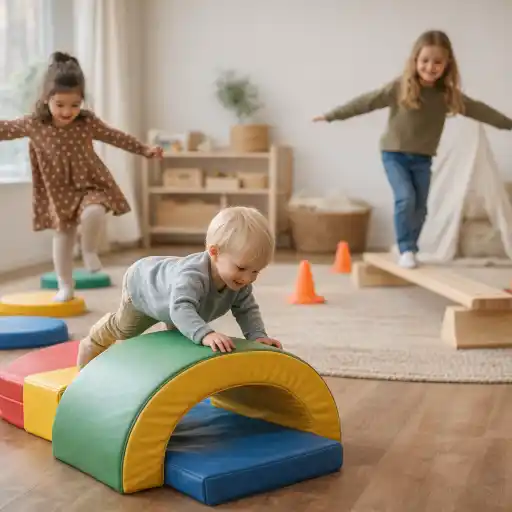
Watch for cues that the group needs a change of pace. A lively dance may work well before a quiet activity, while slow stretches or gentle animal movements can help children transition afterward. A predictable closing cue—such as three slow breaths or a calm walk to the next area—helps bring the group back together.
How can providers make indoor movement safe and inclusive?
Begin with an environmental check. Clear hard or sharp objects, pick up loose toys, make sure the floor is dry, and define the movement boundary. Choose lightweight props and inspect them for damage. Teach one consistent signal, such as “Freeze,” and position adults so they can see the entire area and anticipate where children may move.
Inclusion means providing meaningful ways for each child to participate, rather than expecting everyone to perform the same movement. Offer choices such as step or hop, roll or toss, and seated or standing. Picture cues, demonstrations, short directions, larger soft balls, reduced distances, or a partner role can make an activity more accessible. Follow children’s individual plans and collaborate with families or specialists when adaptations are needed.
- Make group size and station layout appropriate for the available space.
- Keep movement pathways clear and remove tripping hazards.
- Use age-appropriate materials and follow supervision procedures.
- Celebrate persistence, strategy, and participation—not speed or comparison.
- State requirements vary - check your state licensing agency.
A child may want to watch before joining, or prefer a quieter, seated version. That is useful information, not a reason to exclude them. Offer an inviting entry point and revisit the activity later. For additional planning ideas on active play and healthy routines, see Wellness in Action: Teaching Healthy Habits to Children Buy Now $55.00.
How can programs make movement a sustainable winter routine?
Movement is easier to maintain when it is part of the daily rhythm rather than an occasional event. Try a five-minute animal walk after arrival, a two-minute freeze dance before group time, or a short course during a planned active-play block. The CDC standards recommend opportunities for structured movement as well as space for active play; use relevant guidance to shape a schedule alongside your program’s requirements.
A simple weekly rotation keeps planning manageable while giving children chances to revisit favorite skills:
- Monday: tape pathways and balance games
- Tuesday: music and movement
- Wednesday: short obstacle course
- Thursday: soft-ball or beanbag targets
- Friday: child-chosen animal parade or movement story
Keep a small basket of reusable materials ready. After an activity, take a moment to reflect: Did children have enough space? Were turns too long? Did a child need a visual cue, simpler route, or calmer ending? Make one practical adjustment next time. Document observations about individual progress when useful and share appropriate strengths with families.
Common pitfalls are usually fixable. If children are waiting in long lines, add stations or reduce group size. If an activity feels too difficult, simplify the route and offer an easier option. If excitement becomes chaotic, pause, restate the boundary, and practice the stop signal before restarting.
Conclusion: What indoor gross motor activities can keep children active during cold weather?
Indoor gross motor activities can keep children moving through cold weather when they are playful, varied, developmentally responsive, and safely supervised. Tape paths, animal walks, dance, soft-ball tosses, movement stories, and simple obstacle courses can fit many classroom spaces and require only a few everyday materials.
Plan short opportunities throughout the day, offer options for different abilities and comfort levels, and pair active play with thoughtful transitions. A few flexible routines can support children’s physical skills, cooperation, confidence, and engagement—even when the playground is out of reach. For broader activity-planning support, explore Engaging Indoor Activities for Inclement Weather Buy Now $24.00 and Balancing Active Play in Child Care Buy Now $16.00.
Five English-language ChildCareEd courses to explore
- Engaging Indoor Activities for Inclement Weather Buy Now $24.00
- Balancing Physically Active Play in Child Care Buy Now $25.00
- Wellness in Action: Teaching Healthy Habits to Children Buy Now $55.00
- Active Supervision: A Strategy That Works Buy Now $35.00
- Inclusive Lessons for Preschoolers Buy Now $16.00
- 45 Hour Child Growth and Development
- Moving About the Classroom: Effective Transitions for Everyday
- What Makes Me Special: An Overview of Autism and ADHD
- Engaging Indoor Activities for Inclement Weather
- Creating Environments that Nurture Growth and Community
- Texas Director Credential
- Bienvenido! Welcoming All Families
- Moving About the Classroom: Effective Transitions for Everyday
- Indoor and Outdoor Activities
- ❄️ What Outdoor Activities Work Well for Illinois Kids in Every Season? 🌷🍂
- ❄️ ¿Qué actividades al aire libre funcionan bien para los niños de Illinois en cada estación? 🌷🍂
- Winter Classroom Activities for Child Care Providers
- Actividades de Motricidad Gruesa que Desarrollan el Equilibrio, la Coordinación y la Fuerza
- Consejos de Supervisión Activa para Salones de Preescolar y el Juego al Aire Libre
- Indoor and Outdoor Gross Motor Activities for Kids
- Gross Motor Games for Preschool and Kindergarten
- Can simple indoor movement games teach listening and cooperation to preschoolers in Oklahoma?
- Canciones, juegos y preguntas de círculo para niños
- Indoor and Outdoor Activities for School-Age Children
- How can I build gross motor skills indoors and outdoors for the children in my program?
- How can I keep Children Active Indoors On Cold Days?
- How can child care programs prevent seasonal safety hazards like heat, cold, allergies, holiday risks, and outdoor play dangers?
- Indoor and Outdoor Activities for School-Age Programs
- How Can Child Care Providers Keep Toddlers and Preschoolers Active Indoors During Winter?
- Is It Too Cold to Play Outside? How Can Child Care Providers Make Safe Winter Decisions?
- What Indoor Gross Motor Activities Can Keep Children Active During Cold Weather?
- How Cold Is Too Cold for Outdoor Play in Childcare Settings?
- How Can Childcare Providers Prevent Frostbite and Hypothermia During Winter Play?
