Children build strength, balance, coordination, and confidence through everyday movement, but knowing what to look for can make planning and observation more intentional. Explore the age-by-age guide below, then consider Balancing Physically Active Play in Child Care Buy Now $25.00 to deepen your ability to combine structured and unstructured movement while supporting healthy development and documenting meaningful progress.
Why does gross motor development matter in early childhood?
Gross motor skills involve the large muscles of the arms, legs, trunk, and torso. Crawling, walking, running, climbing, jumping, throwing, kicking, and balancing are not merely physical accomplishments; they help children participate in routines, explore environments, regulate energy, and engage with peers. Stable posture and body control also support later fine-motor tasks such as drawing, manipulating tools, and early writing.
Movement is likewise connected to cognitive and social learning. A child navigating an obstacle course is planning, sequencing, and solving problems. A child participating in a ball game is practicing turn-taking, communication, and frustration tolerance. The CDC explains that developmental milestones include how children play, learn, speak, act, and move; movement should therefore be considered within the broader context of whole-child development.
- Physical foundation: strength, balance, coordination, and endurance.
- Learning readiness: body organization and attention for classroom participation.
- Social-emotional growth: confidence, cooperation, and self-regulation.
- Independence: navigating spaces and participating in self-care routines.
Meaningful movement opportunities matter because children need repeated practice in environments where they feel safe enough to try, pause, and try again. A strengths-based approach values effort and individual progress rather than comparing children publicly.
What gross motor skills are common during infancy?
Infants develop movement in a sequence that gradually strengthens head control, trunk stability, reach, and mobility. The exact timing varies, especially for children born prematurely or those with differing opportunities, health histories, or sensory preferences. Use the CDC developmental milestone guidance as a reference for observation, not as a rigid pass-or-fail test.
- Birth to about 3 months: lifts or turns the head, moves arms and legs, and begins developing control during supervised tummy time.
- About 4–6 months: pushes up on arms, rolls, reaches for objects, and may sit with support or lean on hands while sitting.
- About 7–9 months: sits more steadily, transitions into sitting, pivots, scoots, crawls, or otherwise moves toward desired objects.
- About 10–12 months: pulls to stand, cruises while holding furniture, changes position, and may take initial independent steps.
Providers can support infants through safe floor-based play, low-interest materials placed within reach, varied positions, and responsive interaction. Avoid forcing a child into a position they cannot yet control. Position yourself close enough to supervise while allowing the infant time to explore.
Document what the child actually does: “Rolled from back to side to reach the rattle twice” is more useful than “good mobility.” This evidence helps teachers plan the next manageable challenge and communicate concretely with families.
What movement milestones are typical for toddlers?
Toddlers often make rapid gains in mobility and independence. MedlinePlus describes the 1–3-year period as one in which children commonly develop walking, running, and climbing alongside expanding self-help and social skills. Progress may appear uneven: a child may run confidently but hesitate on stairs, or climb well but need support when kicking.
- 12–18 months: walks independently or with increasing confidence, climbs onto low furniture with supervision, throws a small ball, and begins carrying objects while walking.
- 18–24 months: walks quickly, begins running, climbs with support, kicks a ball, squats and stands, and experiments with stepping over low obstacles.
- 2–3 years: runs with greater control, jumps with both feet, walks up and down stairs with increasing independence, pedals or attempts to pedal, and may briefly balance on one foot with support.
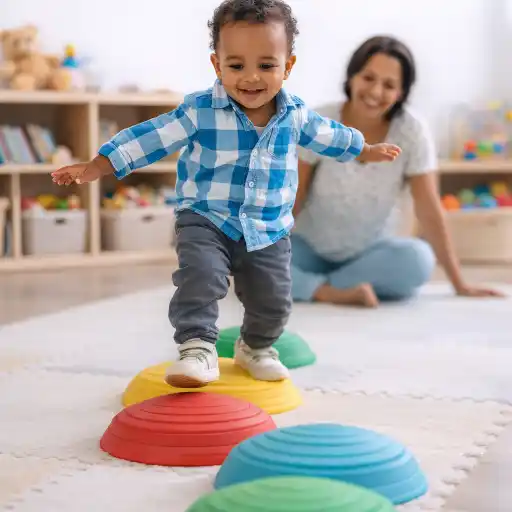
Offer short, repeated experiences: pushing and pulling toys, walking along taped pathways, rolling balls, carrying lightweight materials, dancing, and navigating low, safe obstacle courses. Toddlers benefit from choices such as “step or crawl” and “roll or throw.” These options preserve agency while allowing teachers to adjust difficulty.
Because toddlers are still developing hazard awareness, active supervision is essential. Arrange clear pathways, remove unstable equipment, and remain close during climbing or stair practice. State requirements vary - check your state licensing agency when planning equipment use, ratios, and outdoor procedures.
What skills should preschoolers develop between ages three and five?
Preschool years are characterized by improved coordination, balance, motor planning, and control of speed and direction. The CDC’s age-based checklists provide more complete examples, while classroom observation reveals how children apply movement in authentic contexts.
- Around age 3: runs and stops with increasing control, jumps with both feet, climbs playground equipment, pedals a tricycle, throws overhand, and begins catching a large ball.
- Around age 4: hops on one foot, catches a large ball more consistently, changes direction while running, balances briefly, and coordinates simple dance or rhythmic movements.
- Around age 5: skips or attempts a mature skipping pattern, hops repeatedly, jumps over small objects, balances longer, throws and catches with improved accuracy, and coordinates more complex playground or game movements.
Preschoolers need both structured instruction and open-ended exploration. Try tape balance paths, animal walks, freeze dance, beanbag targets, balloon keep-up, tricycle circuits, and nature obstacle courses. Integrate learning goals naturally: children can hop to a color, toss a beanbag into a numbered basket, or move like characters in a story.
Watch for process as well as outcome. Can the child plan the next movement? Adjust speed? Follow a stop signal? Persist after an unsuccessful attempt? These observations reveal motor planning and self-regulation, not just athletic performance. Celebrate strategies with language such as, “You slowed your body down to stay on the line.”
How can educators observe, support, and adapt gross motor development?
Effective observation is specific, repeated, and connected to planning. The CDC recommends acting early when a child is not meeting one or more milestones, loses previously acquired skills, or when a family or provider has concerns. Observation is not diagnosis; it is a professional responsibility that helps adults decide when to collaborate with families and qualified specialists.
Use a simple cycle:
- Observe the child in more than one context, such as indoor play, outdoor play, and transitions.
- Record the date, setting, skill, prompts, and level of support required.
- Plan one achievable next step and provide repeated opportunities to practice.
- Review progress with colleagues and families while protecting confidentiality.
Inclusive practice means adapting the activity rather than excluding the child. Consider:
- Offering “hop or step,” “walk or roll,” and seated or supported versions.
- Using larger, softer, lighter, or textured equipment.
- Widening pathways, lowering targets, shortening distances, or slowing music.
- Providing visual cues, demonstrations, predictable routines, and peer or adult support.
- Consulting families and specialists about mobility devices, orthotics, communication supports, or sensory needs.
For deeper preparation, Developmental Screening in Early Childhood  Buy Now $16.00 can strengthen staff knowledge of screening, documentation, and collaboration. Providers may also explore Including All Children and the Americans with Disabilities Act Buy Now $35.00, which focuses on accommodations and inclusive child care practices.
How can programs create a daily movement plan?
Gross motor development is strongest when movement is part of the daily rhythm rather than a once-a-week special event. Short, frequent opportunities are practical for busy programs and allow children to repeat skills without becoming overwhelmed.
- Arrival: offer a simple pathway, stretching, or carrying job.
- Transitions: invite children to march, tiptoe, crawl, or move like an animal.
- Outdoor play: combine free play with one optional challenge, such as a target game or balance route.
- Before quiet work: use a brief freeze dance, breathing movement, or wall push.
- End of day: document one observed strength and one possible next step.
Safety planning should include clear boundaries, equipment inspections, appropriate surfaces, adult sight lines, and a consistent stop signal. Teach children how to pause and listen before introducing a new game. Directors can support consistency by adding movement goals to lesson plans and staff meetings.
Professional development can help teams translate milestone information into practice. For a broader developmental foundation, consider 45 Hour Growth and Development Birth-age 12 ONLINE Buy Now $399.00$275.00. Always verify course applicability and training-hour acceptance with the appropriate licensing agency or professional registry.
Conclusion: What should early educators remember about gross motor skills by age?
Gross motor development progresses from head and trunk control to walking, running, climbing, jumping, balancing, and coordinated play. Age ranges provide useful expectations, but children develop at different rates and may show strengths unevenly across domains. The most effective response is intentional observation, playful practice, thoughtful adaptation, and respectful partnership with families.
- Use milestone checklists to guide observation, never to label or rank children.
- Provide daily opportunities for structured and child-directed movement.
- Document concrete behaviors, prompts, and progress over time.
- Adapt equipment, space, pace, and expectations so every child can participate.
- Act early when concerns persist, skills are lost, or families request support.
The central question is not whether every child performs a skill on the same date. It is whether the environment offers safe, meaningful opportunities for each child to move, participate, and grow. With attentive adults and consistent practice, ordinary classroom moments can become powerful developmental experiences.
- Terrible Two's Can Be Terribly Fun!
- Bye Bye Winter: The Role of Outdoor Play in Early Childhood Development
- Identifying Developmental Milestones in Children
- How motor skills shape child development and creative ways educators can foster them.
- CDA Certification en Español: Recursos y Consejos para Educadores Bilingües
- Gross Motor Games for Preschool and Kindergarten
- Can simple indoor movement games teach listening and cooperation to preschoolers in Oklahoma?
- Team-Building Activities for Daycare: Helping Children Learn Together
- What age-appropriate learning activities should we use for infants, toddlers & preschoolers in New York?
- What Kindergarten Readiness Skills Should My Program Build?
- How can Michigan preschool programs build strong fine and gross motor skills?
- How can I build gross motor skills indoors and outdoors for the children in my program?
- Can simple soccer games build gross motor skills in young children?
- Get Moving: How Can Child Care Programs Build Physical Activity Into the Daily Routine?
- What should providers expect at different ages and when should they recommend further evaluation?
- How can child care programs create safe climbing and movement experiences for toddlers?
- What fun, practical activities help build fine and gross motor skills in early childhood classrooms?
- How Can Child Care Providers Support Gross Motor Development in Every Child?
- What Gross Motor Skills Should Children Develop at Each Age?
