Keeping children safe is part of our daily work. This short guide helps Nevada child care providers and directors learn the m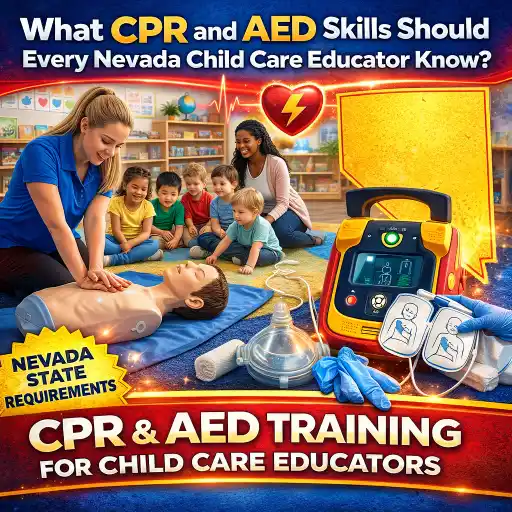 ost important CPR and AED skills to keep on hand. Read the steps, facts, and simple actions you can use at your center or home child care. Remember: state requirements vary - check your state licensing agency. For a motivating, caregiver-focused reminder of why First Aid and CPR training matters, see Superheroes Wear Capes...And Take First Aid & CPR Classes.
1) What CPR and AED skills are required for Nevada child care staff?
Nevada rules ask that employees be trained in first aid and cardiopulmonary resuscitation. The state regulations list training and certification for staff and directors, including CPR, first aid, and emergency plans. See the Nevada licensing standards for details: NRS Chapter 432A. ChildCareEd also explains the training Nevada expects in plain language: What Training Do I Need for Childcare in Nevada?
Key facts you should know:
- CPR must cover infants, children, and adults. Many licenses ask for pediatric-focused training (infant/child) as part of first aid courses — see CPR and First Aid Training for Child Care Providers.
- Centers should have access to an AED or a plan to reach one quickly. Training includes how to use an AED safely on a child or adult.
- Documentation matters: keep certificates in personnel files and update them when they expire.
2) How do educators get certified and keep skills current?
Getting and keeping CPR and AED skills is a step-by-step process. Child care staff often take blended or in-person courses that combine online learning with hands-on skills checks. ChildCareEd lists approved blended and in-person classes that meet licensing needs and give a 2-year certification: First Aid and CPR Certification: What to Expect and specific class listings like Pediatric Blended First Aid & CPR/AED. When it’s time to renew, many providers choose to renew their First Aid, CPR, and AED certification with ChildCareEd, which explains renewal steps, timelines, and options to help keep credentials current.
- 📝 Enroll: Choose a pediatric-first-aid course approved for child care.
- 📚 Learn online: Complete any online modules at your pace.
- 👐 Practice: Attend the skills session to practice compressions, breaths, choking relief, and AED steps.
- 📄 Keep records: Store your certificate and schedule re-certification (usually every 2 years).
Preparing well helps. ChildCareEd’s guide explains how to prepare for a blended class: Preparing for your First Aid & CPR Training. Also consider local options like Red Cross or AHA classes if they meet state rules. Remember: state requirements vary - check your state licensing agency.
3) When and how do you use CPR and an AED with infants and children?
Knowing when to act saves time and lives. For children and infants, the steps are different from those for adults. Training teaches age-based techniques and choking responses so you feel ready and calm. For a focused, step‑by‑step walkthrough of responding to a choking child, see The Longest Minute: When a Child is Choking.
- 🆘 Check safety and responsiveness. Tap and shout (or for an infant, tap the foot).
- If unresponsive and not breathing normally: start CPR right away (infant: two fingers compressions; child: one or two hands depending on size).
- Use an AED as soon as it is available. Most AEDs have child pads or a child mode. Follow the voice prompts. If child pads are not available, many AEDs allow safe use with adult pads on a child.
Practical tips from training:
- Practice compressions on infant and child manikins so you know hand placement and depth.
- Run regular drills so staff builds muscle memory and speed. For summer-specific scenarios and tips for camps and drop-in programs, see Summer Fun Meets Summer Safety: The Importance of Pediatric First Aid and CPR Training.
- Post a clear emergency action plan and AED location so all staff can find it fast.
ChildCareEd and other providers cover these steps in pediatric classes: Importance of Pediatric First Aid and CPR. For video practice and blended options see their in-person and blended course pages: In-Person and Blended.
4) How can centers prepare staff and avoid common mistakes?
Preparation is more than one course. It is a plan, practice, and paperwork. Here are practical steps your program can take to reduce errors and be ready.
- 📋 Plan and assign roles. 1) Who calls 911? 2) Who starts CPR? 3) Who gets the AED? 4) Who supervises other children?
- 🔁 Practice drills quarterly. Short, frequent drills build confidence and speed.
- 📁 Keep certificates current and in each staff file. Nevada licensing requires evidence of training — see Nevada training summaries at Nevada Child Care Training and Courses.
- ⚠️ Common mistakes and how to avoid them:
- • Mistake: Waiting too long to start CPR. Fix: Start compressions immediately if unresponsive and not breathing normally.
- • Mistake: Wrong hand placement or depth. Fix: Practice on manikins often and review trainer feedback.
- • Mistake: Not having an AED plan. Fix: Map AED location, check batteries, and train staff on pad placement for children.
Also build relationships with local EMS and invite them to a drill. Use trusted training partners like ChildCareEd and national organizations to make sure your practice and policies match current guidelines: Why Every Childcare Worker Needs CPR & First Aid. For a straightforward, classroom-friendly primer on staying calm and responding in pediatric emergencies, see Don't Let Emergencies Make You Scream!!
Conclusion
Every Nevada educator should know pediatric CPR, choking relief, and how to use an AED. Follow these steps:
- Get a pediatric-focused course and skills practice.
- Keep certificates and run drills.
- Make a written emergency plan and post AED locations.
Why it matters: Quick action by trained staff can save a child’s life and prevent long-term harm. If you need training options, ChildCareEd has approved courses and clear guidance: First Aid and CPR: What to Expect. For hands-on, pediatric-focused instruction that emphasizes child-specific techniques and real-world skills practice, consider ChildCareEd's pediatric first aid and CPR training. Keep your team prepared, calm, and confident. #Nevada #CPR #AED #safety #educators
FAQ
- Q: How often do I need to recertify? A: Most pediatric CPR certifications last 2 years — check your course rules and Nevada licensing.
- Q: Do educators need adult CPR too? A: Yes. Training usually covers infant, child, and adult CPR.
- Q: Can a family child care home use online-only training? A: Some agencies require hands-on verification. Blended or in-person skills checks are often needed — review course details and state rules.
- Q: Where can I find Nevada-approved courses? A: ChildCareEd lists many Nevada-approved trainings and resources on their site: Nevada Child Care Training and Courses.
- 45 Hour Child Growth and Development
- Bienvenido! Welcoming All Families
- Pediatric Blended First Aid & CPR/AED Adult, Child, Infant
- Pediatric RSV First Aid & CPR/AED
- Pediatric In-Person First Aid & CPR/AED Adult, Child, Infant
- 45 Hour School Age Methods and Materials
- Recognizing and Reporting Child Abuse and Neglect
- Texas Director Credential Renewal
- Texas Director Credential
- Supporting the Nevada Childcare Workforce
- Keeping Our Youngest Students Safe: The Vital Importance of Pediatric First Aid and CPR Training for Teachers
- Getting Ready for the New School Year: Prioritizing Safety with First Aid and CPR Training
- CDA Certification en Español: Recursos y Consejos para Educadores Bilingües
- 😫🧸 ¿Qué hacer cuando un bebé no quiere dormir la siesta en el aula?
- 🩺 Cumplimiento de Salud e Inmunización en Cuidado Infantil de Nevada ✔️
- 🚨 Reporte Obligatorio en Nevada
- ¿Cómo pueden los equipos de cuidado infantil practicar habilidades rápidas de primeros auxilios en situaciones reales?
- Proporciones de Cuidado Infantil y Tamaños de Grupo por Edad en Maryland (Guía Rápida para Centros y Hogares)
- Lista para Guardería en Casa en Texas: Cómo Iniciar una Guardería en el Hogar
- Capacitación Previa al Servicio para Proveedores de Cuidado Infantil en Nevada
- Online Child Care Courses in Nevada: Training Made Simple
- What CPR and AED skills should every Nevada child care educator know?
- How can DC early childhood classrooms stay ready with CPR and AEDs?
- Pediatric First Aid for Teachers: Are Your Skills Still Fresh When an Emergency Happens?
