Beginning-sound practice can build early literacy without asking every child to learn in the same way. Explore Planning for Every Child: Responsive Strategies in Action  Buy Now $55.00 for practical ideas on differentiated instruction, observation, accessibility, and supporting children’s languages and abilities. The activity adaptations below offer a useful starting point—and a chance to notice how small changes can open meaningful participation for every learner.
Why adapt a beginning-sound activity instead of using one approach for everyone?
Beginning-sound activities ask children to coordinate several skills: understanding a word, attending to speech, noticing its initial sound, and sometimes connecting that sound with a printed letter. A child may know the pictured object but find it difficult to answer verbally; another may hear that two words begin alike but not yet recognize the corresponding letter. A single format can make these different learning needs look like the same difficulty.
Differentiation keeps the learning goal—listening for a word’s first sound—while varying the supports, materials, and ways children respond. This is not lowering expectations or creating a separate lesson for every child. It is removing unnecessary barriers so children can participate and show what they know. Playful sound exploration also belongs in a broader, oral-language-rich literacy environment; NAEYC recommends weaving phonological awareness into planned activities and everyday word play.
Before the activity, consider what you want to observe: Does the child name the picture? Hear whether two words begin alike? Identify the sound? Connect it to a letter? Separating these steps helps you choose useful support rather than treating the task as simply right or wrong. A flexible plan gives each child an entry point and helps you identify a manageable next step.
How can you make the activity accessible from the start?
Plan the activity around one clear sound and a small set of familiar words. Use real objects, photographs, or clear illustrations, and check that children know what each item is called. If an image is unfamiliar or ambiguous, difficulty may reflect vocabulary or picture interpretation rather than sound awareness. Pairing spoken words with meaningful objects and simple visual cues makes the task easier to understand.
Arrange materials so children can see and reach them. Reduce visual clutter, offer a quiet or smaller-group space when helpful, and provide predictable directions. Model the process: “This is a ball. Ball starts with /b/. Listen—ball.” Say the word naturally; avoid stretching it so far that it no longer sounds like the word. Start with two contrasting choices, then add complexity as children become comfortable.
- Use a few familiar pictures or objects instead of a large, crowded set.
- Show the target sound with a picture cue, gesture, or letter card.
- Give children time to look, listen, and respond without rushing.
- Offer a clear place to sort or match items, such as two baskets or mats.
- 🧸 Let children handle safe objects as they name and compare them.
Make the activity inviting and low-pressure. A brief, successful experience can build confidence and provide a clearer picture of children’s developing skills than a long drill.
What response options support different abilities and communication styles?
Children do not need to answer aloud to demonstrate attention to a beginning sound. Some can say the sound or name another word; others may point, touch, place a picture in a basket, use a gesture, sign, or communication device. These options help children with emerging speech, expressive-language differences, motor challenges, or developing English participate in the same shared learning objective.
Offer different ways to interact with the materials. Children can sort large picture cards, select between two obj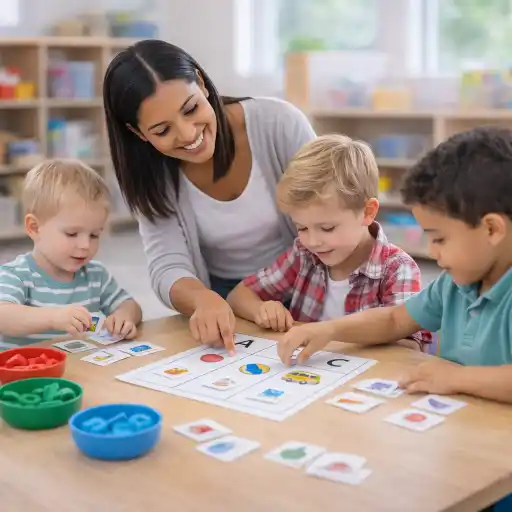 ects, move to a sound station, or indicate a choice with eye gaze or an accessible communication tool. For a child who finds cutting or pencil control difficult, remove scissors from the task: provide pre-cut pictures, larger cards, a magnetic board, or reusable hook-and-loop pieces. If holding materials is a barrier, stabilize the page or place objects within easy reach.
Keep expectations focused on the skill rather than the method of response. You might ask, “Which one starts like sun?” and accept a point to sock as meaningful evidence. For a child who is ready for more, invite them to explain the match or think of another /s/ word. The goal is meaningful participation, not identical performance.
- Use picture choices, gestures, signs, or a communication device.
- Allow children to listen and match before expecting them to produce a sound.
- Adapt card size, page position, and tools to support access and motor control.
- Offer a peer or adult model, then allow the child to make their own choice.
How can you scaffold the sound challenge for varied readiness?
Adjust the number of choices and the amount of prompting to match what each child is ready to do. A child just beginning may listen to one familiar word and then choose between two objects. Another may sort several pictures by two initial sounds. A child ready for an added challenge might generate a new example, connect the sound to its letter, or notice the same initial sound in a classmate’s name.
Use a gradual teaching sequence: model, practice together, offer a cue if needed, and then give the child a chance to try independently. For example, say “moon” and emphasize the first sound; then compare moon with milk. If the child is unsure, repeat the word, reduce the choices, or provide a gesture. When the child responds, acknowledge the thinking specifically: “You listened to moon and found another word that starts with /m/.”
Keep the learning goal steady while adapting the pathway. The Beginning Sounds Worksheet Buy Now $1.25 includes cutting, sorting, and matching pictures to beginning sounds. Use it as one option within an interactive sequence: name the pictures together first, invite children to sort them orally, and then offer the worksheet with adaptations such as pre-cut pieces, fewer items at a time, or a pointing response. It should support—not replace—listening, conversation, and play.
How can you support children’s languages and sensory needs?
Language experience shapes how children recognize and produce sounds. A dual language learner may understand the activity but be more comfortable naming an object in a home language, or may encounter a sound contrast that works differently across languages. Include familiar words, invite family input on useful vocabulary, and honor home-language knowledge as an asset. A pronunciation influenced by a child’s language or dialect is not a reason to shame or exclude them.
When the objective is English beginning-sound awareness, model the English word and sound respectfully while accepting a range of participation. Pair spoken directions with pictures, demonstrations, and gestures. A child can show understanding by matching images or choosing an object, even while building confidence in spoken English. Consider noise, lighting, texture, and movement: some children focus best in a calm space, while others benefit from standing, moving, or handling a tactile letter.
Build in choice without losing clarity. Offer a quiet listening spot or a movement-based sound hunt, and let children use a preferred tool when it supports access. Partner with families and relevant specialists when you need guidance on communication supports or an individualized plan. Responsive teaching begins with observing the child, not assuming what a particular diagnosis, language background, or learning style requires.
How should educators observe progress and avoid common pitfalls?
Use the activity as an opportunity to learn about children’s strategies, not to label their ability. Observe over several occasions and note the context, the child’s response, and the support provided. For instance: “During a small-group sort, Kai named ‘sun’ and matched it with ‘sock’ after the words were repeated.” This is more useful than recording only “got it wrong” because it points to a possible next step.
- Check that the child recognizes the object and knows the word before asking about its sound.
- Separate hearing a sound from naming a letter; these are related but distinct skills.
- Avoid introducing too many sounds or choices at once.
- Do not insist on a spoken answer when pointing, sorting, signing, or using AAC can show understanding.
- Give specific, encouraging feedback rather than correcting publicly or rushing a response.
If a child has difficulty, simplify the task, model the sound, and revisit it in a playful context. Discuss persistent concerns with the family and follow your program’s procedures for collaboration with appropriate professionals. State requirements vary - check your state licensing agency.
Conclusion: How can one beginning-sound activity welcome different learners?
Keep the sound-learning goal clear, then adapt materials, prompts, pacing, sensory conditions, and response options. Familiar objects, explicit modeling, home-language respect, and flexible ways to answer help children with varied abilities participate together. Observe what support helps, celebrate each child’s contribution, and use that information to plan the next opportunity. A worksheet can be a useful tool, but the richest practice also includes listening, conversation, movement, and play.
For deeper professional learning on observation-based planning and differentiated instruction, explore Planning for Every Child: Responsive Strategies in Action Buy Now $55.00. Use the activity adaptations here as a practical starting point for making early phonics more accessible and engaging for the children in your care.
Additional ChildCareEd courses for continued learning
- Safe and Sound: Creating Healthy Environments for Every Child
- Planning for Every Child: Responsive Strategies in Action
- From Play to Planning: Building Culturally Competent, Child-Centered Curriculum
- Birth to Five CDA Credential with Portfolio Review
- 24 Hour Texas Pre-Service
- CDA Bridge Bundle: Family Child Care without Portfolio Review
- CDA Bridge Bundle: Infant/Toddler without Portfolio Review
- Texas Director Credential
- Wellness in Action: Teaching Healthy Habits to Children
- Supporting Families and Caregivers in Language and Literacy
- How to Include Kids in the Kitchen
- 💛🧩 ¿Cómo puedo hacer que mi enseñanza sea inclusiva para los niños con autismo?
- ¿Cómo incluir a niños con necesidades especiales en cuidado infantil? Guía práctica y sencilla
- ¿Cómo puedo enseñar habilidades de primeros auxilios con escenarios de juego de roles?
- Actividades de Motricidad Gruesa que Desarrollan el Equilibrio, la Coordinación y la Fuerza
- Proporciones de Cuidado Infantil y Tamaños de Grupo por Edad en Virginia (Guía Rápida para Centros y Hogares)
- Celebrando la amistad en el cuidado infantil durante el Día de los Mejores Amigos
- Canciones, juegos y preguntas de círculo para niños
- Why Are Self-Checking Clip Cards Great for Independent Practice?
- How Can Child Care Providers Help Children Recognize Letters Through Play?
- How Can Child Care Providers Build a Developmentally Appropriate Curriculum for Infants?
- How Can Child Care Providers Teach Beginning Sounds with Tracing, Pictures, and Repetition?
- How Can Child Care Providers Move Children from Letter Recognition to Beginning-Sound Awareness?
- How Can Providers Connect Letter Formation, Sound, and Vocabulary in Phonics Instruction?
- How Can Hands-On Dot-Marker Activities Build Alphabet Knowledge?
- How Can Providers Notice Emerging Infant Skills Before They Become Reliable?
- How Can You Make a Classroom Cooking Activity Accessible to Children with Different Abilities?
- Teaching Syllables Through Play: What Should Preschoolers Notice?
- How Can You Adapt a Beginning-Sound Activity for Different Learning Needs?
