When children can picture the bed they sleep in or the cup they use at snack, phonics becomes less abstract and more inviting. Pairing familiar objects with missing-vowel practice helps children connect speech sounds, letters, and meaning; the Play Safe, Think Big: Literacy Through Play  Buy Now $10.00 course offers providers a broader foundation for weaving early literacy into safe, engaging play. Read on for practical ways to teach CVC word completion—and explore the course for additional strategies you can apply across classroom routines.
Why use familiar household vocabulary to teach CVC completion?
CVC words follow a consonant-vowel-consonant pattern, as in cup or bed. When the middle vowel is missing, children must attend to the word’s sounds, select a letter that represents the vowel, and blend the completed word. The task brings together phonological awareness, letter-sound knowledge, decoding, and early spelling in a short, focused activity.
Household words offer an especially useful entry point because children can connect many of them to objects they have seen, handled, or talked about. Familiar meaning gives a child a clue without replacing the sound work: a picture of a mop supports vocabulary and recognition, while saying /m/–/o/–/p/ directs attention to the vowel sound. The aim is not to guess from the picture alone, but to use meaning alongside careful listening and print.
This approach also validates children’s everyday knowledge. A pot, lid, or rug belongs to their lived experience, so an early literacy task can feel purposeful rather than disconnected from life. Familiarity can invite conversation, participation, and confidence—particularly for children who are just beginning to explore print.
- Connect spoken words to concrete objects and images.
- Practice hearing and identifying the short vowel in a three-sound word.
- Build confidence through meaningful, manageable practice.
How should providers model the sound-to-letter process?
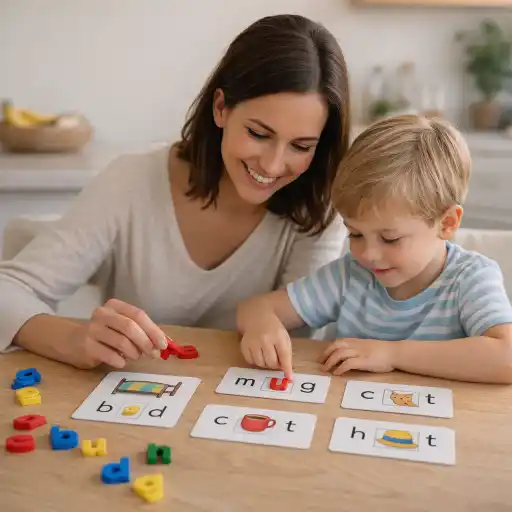
Begin with a small set of words whose pictures and meanings are clear. Before children write, model the process aloud: “This picture shows a cup. I’ll say the word slowly: /c/ /u/ /p/. I hear /u/ in the middle, so I’ll write u in the blank. Now I can blend it: cup.” This makes the thinking visible and shows that successful completion depends on hearing and blending, not simply naming the picture.
Keep the pace deliberate. Say the whole word naturally, then stretch or tap its three sounds without adding an extra vowel after consonants. Invite children to repeat the word, listen for the middle sound, and identify the matching vowel. If a child responds quickly, ask how they know; if they need time, offer a second pronunciation or model the sound again.
Picture-supported resources can make the task accessible while still requiring active phonics thinking. Complete the Words - Around the House Buy Now $1.00 focuses on filling the missing middle letter in twelve everyday words: bed, cup, pan, pot, mat, rug, fan, lid, jug, mop, tub, and bin. Providers can use it for a short literacy-center activity, guided practice, or a quick informal observation of children’s emerging skills.
- Say the word, segment its sounds, identify the middle vowel, and blend again.
- Use accurate letter-sound language; distinguish the letter name from its sound.
- Offer wait time and supportive prompts before supplying the answer.
How can you make a worksheet feel like meaningful play?
A worksheet can be one moment in a broader play-based experience rather than the whole lesson. Before children complete words, invite them to search a pretend kitchen, dramatic-play area, or classroom picture set for objects that appear in the activity. Ask, “Which item helps us clean the floor?” or “What might we put a lid on?” Children can handle safe props or point to images, name the objects, and then connect those spoken words to the incomplete print.
After the written practice, extend the learning with movement and conversation. Children might match picture cards to real or toy objects, place letter cards in the blank, or take turns being the “sound detective” who explains the middle vowel. If using household objects as props, choose age-appropriate materials, remove choking hazards, and maintain active supervision.
Play helps make the target skill purposeful: children have a reason to say, compare, and revisit words. The course Play Safe, Think Big: Literacy Through Play Buy Now $10.00 addresses both appropriate supervision and emerging literacy, helping providers think about how to support learning during everyday activities.
- 🔎 Try a brief “find it, say it, sound it, write it” routine with familiar pictures or safe props.
- Use songs, dramatic play, and conversation to repeat target words in context.
- Keep the focus on sounds and meaning, not speed or competition.
How can you differentiate practice and observe progress?
Children may be at different points with vocabulary, sound awareness, letter recognition, handwriting, or attention. Adjust the support to the skill that is developing rather than assuming every incorrect answer has the same cause. One child may recognize the object but not hear the middle vowel; another may hear it but not yet recall the matching letter. Observation helps providers choose a useful next step.
- For emerging learners: work with fewer words, say each word aloud, and offer two vowel choices or letter tiles.
- For children ready for more challenge: ask them to write the whole word, name each sound, or generate another word with the same vowel sound.
- For multilingual learners: check that the pictured word is familiar, invite home-language connections, and use gestures or real objects to clarify meaning.
- For children who find writing difficult: allow pointing, choosing a letter card, or dictating a response while still attending to the sounds.
Notice and record observable actions: Does the child name the object? Say the word? Identify its middle sound? Select a corresponding vowel? Blend the completed word? A brief note—such as “identified the vowel sound with a spoken model, then selected the matching letter”—is more informative than a simple right-or-wrong score. Use this information to plan short follow-up practice and celebrate effort, strategies, and growing independence.
What common pitfalls should educators avoid?
One common pitfall is allowing the picture to do all the work. Pictures support meaning, but children also need opportunities to listen to the spoken word and connect sounds with letters. Prompt the child to say the word and listen for its sounds before choosing a vowel. Another pitfall is turning a short phonics activity into a long, repetitive drill. Children benefit from clear modeling and repeated practice, but attention and motivation matter; stop or shift the format when fatigue or frustration appears.
Avoid assuming that a wrong response means a child is not ready to learn. Check whether the challenge is vocabulary, pronunciation, hearing the vowel, recognizing letters, or forming the letter on paper. Respond with calm prompts such as, “Let’s say it slowly together,” or “What sound do you hear in the middle?” This keeps the task supportive and gives the child a strategy to try.
Finally, treat a worksheet as one tool among many. Include talk, play, books, hands-on materials, and observation so children meet useful words across contexts. If activities involve household props, select safe items and supervise closely. State requirements vary - check your state licensing agency when determining training or program requirements.
How can providers help children complete CVC words with confidence?
Teaching CVC completion with familiar household vocabulary gives young learners a concrete way to connect sounds, letters, and meaning. Model the process clearly, let children say and listen to each word, and use picture support without allowing pictures to substitute for phonics reasoning. Add playful object hunts, letter choices, conversation, and responsive differentiation to make the practice active and inclusive.
Use children’s attempts as information about what to teach next, not as a judgment of ability. Short, warm interactions can help a child notice the middle vowel and feel proud of completing a word. For a ready-to-use practice option, consider Complete the Words - Around the House Buy Now $1.00. To deepen your professional toolkit for literacy-rich play and safe supervision, explore the English-language Play Safe, Think Big: Literacy Through Play Buy Now $10.00 course.
- Birth to Five CDA Credential with Portfolio Review
- CDA Bridge Bundle: Preschool
- CDA Bridge Bundle: Family Child Care
- CDA Bridge Bundle: Family Child Care without Portfolio Review
- CDA Bridge Bundle: Infant/Toddler without Portfolio Review
- CDA Bridge Bundle: Preschool without Portfolio Review
- Creating Environments that Nurture Growth and Community
- Texas Director Credential
- Professional Integrity in Child Care
- CDA Certification en Español: Recursos y Consejos para Educadores Bilingües
- 🔍 ¿Qué ves cuando observas a un niño aprender?
- 💛🧩 ¿Cómo puedo hacer que mi enseñanza sea inclusiva para los niños con autismo?
- ¿Cómo empiezo mi certificación CDA en Florida en línea?
- 10 Ejemplos de Cómo la Cultura Influye en el Desarrollo Infantil
- Proporciones de Cuidado Infantil y Tamaños de Grupo por Edad en Maryland (Guía Rápida para Centros y Hogares)
- Proporciones de Cuidado Infantil y Tamaños de Grupo por Edad en Nueva Jersey (Guía Rápida para Centros y Hogares)
- Proporciones de Cuidado Infantil y Tamaños de Grupo por Edad en Virginia (Guía Rápida para Centros y Hogares)
- Lista para Guardería en Casa en Illinois: Cómo Iniciar una Guardería en el Hogar
- Lista para Guardería en Casa en California: Cómo Iniciar una Guardería en el Hogar
- Cómo Trabajar en el Cuidado Infantil en Carolina del Norte: Requisitos y Pasos
- Celebrando la amistad en el cuidado infantil durante el Día de los Mejores Amigos
- Canciones, juegos y preguntas de círculo para niños
- Cómo simplificar la capacitación para sus empleados de daycare
- How Can Picture and Color Cues Help Children Decode CVC Words?
- How Can Familiar Household Words Help Children Complete CVC Words?
- How Can Animal Words Strengthen CVC Decoding?
- How Does Mixed CVC Practice Build Flexible Decoding Skills?
- When Are Children Ready for a Second Set of Mixed CVC Words?
