Getting ready to run a full-day, year-round 2-K program takes planning, clear rules, and teamwork. This article helps directors and providers make a plan for #2K kids that covers #staffing, #curriculum, #classroom layout, and #inclusion. Read the short steps, pick a few to try this week, and remember: state requirements vary - check your state licensing agency.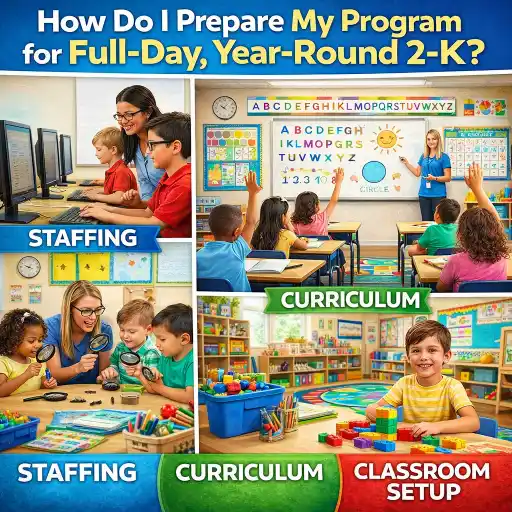
How should I staff a full-day, year-round 2-K program?
Keep these practical steps in mind:
- 😊 Plan roles: 1 lead teacher, 1 assistant for every group size you need. Add a floating staff member for transitions.
- 📋 Make a daily staffing map: mark who covers arrival, meals, nap, outdoor play, and bathroom times so no one is left alone with too many kids.
- 🧑💼 Hire for stability: look for staff who like routines and warm, calm voices. Offer steady hours or predictable rotating shifts to keep staff year-round.
- 🔁 Schedule breaks with coverage: create a written break plan so ratios stay correct during lunch and staff planning time. Train substitutes and student helpers on your scripts and supervision expectations.
- 📚 Plan training and coaching: use short, regular staff training (for example, circle-time techniques and active supervision) and practice the plan together. ChildCareEd offers training and resources for classroom management and supervision that you can use to train staff.
- ⏰ Schedules and transitions: To help staff build the smooth, predictable daily routines that keep 2-year-olds calm and engaged, ChildCareEd's Every Moment Matters: Schedules and Transitions
 Buy Now $55.00 is a 6-hour online course covering how to design effective daily schedules, use transition warnings, and reduce upset during activity changes — a direct match for the daily pattern, 2-minute warning, and anchor time steps outlined in this guide.
Why this matters: steady staff and clear roles protect children and lower burnout. When adults know exactly who watches what, the day runs more smoothly, and children feel safe.
What curriculum and daily schedule work best for 2-year-olds in a full-day, year-round program?
Try this simple daily pattern you can adapt. Keep blocks short and predictable:
- 😊 Morning arrival & greetings (15–30 min): warm hello, photo/picture sign-in.
- 📚 Small group/teacher-led time (10–15 min): short book, song, or language game focused on a single skill.
- 🧩 Choice play/centers (30–45 min): rotated options to match skills (sensory for youngest; table activity for older 2s).
- 🍽️ Snack/meals with social routines (20–30 min): teach self-help skills and social words.
- 🛌 Nap/rest (variable): provide quiet, consistent rest with a supervision plan for wake-ups.
- 🌳 Outdoor active play (30–45 min): gross motor time every day, weather permitting.
- 🎵 Closing small group (5–10 min): goodbye song, quick reflection.
Tips for success:
- Give 2-minute and 30-second warnings for transitions. Research and briefs like CSEFEL's What Works Briefs show that predictable routines reduce upset.
- Use short teacher-led bursts (5–15 minutes). Long circle times lose toddlers’ attention.
- Plan small-group blocks to meet different ages if you mix groups; see mixed-age scheduling tips at ChildCareEd Mixed-Age Grouping.
Why this matters: a steady schedule helps children feel safe and learn. It also makes staffing predictable and reduces conflicts.
How should classrooms be set up for learning, safety, and inclusion year-round?
Set up your room this way:
- 📏 Clear zones: blocks, art, reading, sensory, and a quiet, calm corner. Keep paths open for adults to scan the room.
- 🧩 Inclusive learning environments: For staff who want to set up 2-K classrooms that support every child's independence and participation, ChildCareEd's Environments That Inspire Independence and Exploration Buy Now $55.00 is a 6-hour online course covering how to design inclusive, stimulating spaces with clear zones, child-sized furnishings, and sensory supports — directly supporting the room layout, material rotation, and inclusion steps described in this article.
- 🧸 Safe zone for youngest children: low shelves, soft rugs, and no small parts nearby. Put small manipulatives away where toddlers can’t reach.
- 🪑 Child-sized furnishings: chairs, tables, and mirrors at child height so kids can practice self-help skills.
- 🔄 Rotate materials weekly: fresh toys keep interest and support learning. Label shelves with pictures so children put things back independently.
- 🤝 Inclusion supports: visual schedules, simple choices, and sensory options. For more ideas, see ChildCareEd on Inclusion.
Safety and space rules: follow your licensing guidance about square feet, toilets, and fire safety. For facility standards,s see state rules like the e Massachusetts program standards at 603 CMR 18.04. State space and equipment rules vary—state requirements vary - check your state licensing agency.
If your program operates in Massachusetts, you may also find our state-focused celebration and resource page on Massachusetts Day useful for links to local trainings and course highlights relevant to Massachusetts providers.
Why this matters: A well-planned room lowers stress, supports learning, and makes supervision easier for staff.
How do I support staff, families, and specialists so the 2-K program runs all year round smoothly?
Year-round programs work best when families, staff, and specialists share the same plan. Use short, kind notes and simple data to keep everyone on the same page. The CDC and ChildCareEd stress early action and teaming with families and specialists; see CDC Early Intervention and ChildCareEd articles on family partnership.
Follow these steps:
- 📞 Communicate early and often: send one positive note and one short update each week at pick-up.
- 📝 Track basics: document simple facts—when, what, and who present. Use brief observation notes tied to milestones (ChildCareEd milestones).
- 🤝 Plan team meetings: meet monthly with staff and families to adjust the schedule, share wins, and update behavior supports.
- 👩⚕️ Link to specialists early: if a child needs speech, OT, or behavior help, use your notes to refer families to early intervention or school-based services (CDC Early Intervention).
- 🎓 Invest in staff support: coaching, short refresher trainings, and mentoring help staff use the same language and routines. ChildCareEd has courses on management and behavior to support teams.
Why this matters: teamwork speeds help for children who need it and keeps staff less stressed. Good notes and family trust make referrals and support easier.
Summary: Quick checklist to start this week
- ✅ Post a simple picture schedule and teach it to children every morning.
- ✅ Make a one-page staffing map for each shift showing coverage for arrival, meals, nap, outside, and bathroom.
- ✅ Set 3 daily anchor times (meals, nap, outdoor play) so children know what happens each day.
- ✅ Create a calm corner with 2–3 items (soft toy, breathing card, sensory bottle).
- ✅ Rotate materials weekly and label shelves with pictures so children can put things away.
- ✅ Start a weekly family note: 1 positive and 1 small goal or update.
- ✅ Document simple observations and act early if you see delays—refer to early intervention if needed.
Common mistakes and how to avoid them:
- 😵 Relying on long circle times — use short, active mini-sessions instead.
- ⚠️ Staffing to older children in mixed groups — always staff to the youngest present.
- 😬 Inconsistent language from staff — choose short scripts and practice them in team meetings.
You are doing important work. Small, steady changes to staffing, the schedule, the room, and family teaming make a big difference for children and staff. For more practical guides and trainings, start with ChildCareEd resources on mixed-age planning, classroom management, and inclusion.
- 45 Hour Child Growth and Development
- 45 Hour Preschool Methods and Materials
- 45 Hour Infant and Toddler Methods and Materials
- Pediatric RSV First Aid & CPR/AED
- 45 Hour School Age Methods and Materials
- 45-Hour Infant and Toddler Curriculum
- Texas Director Credential Renewal
- Texas Director Credential
- 45 hour Growth and Development Birth-age 12 ONLINE
- ¿Cuáles son las mejores actividades del Día de la Tierra para niños en casa o en el aula?
- Capacitación en Salud y Seguridad Preventiva en Línea para Proveedores de Cuidado Infantil
- What bundles are available now in New York and how can they help my program?
- Lista para Guardería en Casa en Illinois: Cómo Iniciar una Guardería en el Hogar
- Lista para Guardería en Casa en Texas: Cómo Iniciar una Guardería en el Hogar
- What do I need to know to provide child care in New York?
- How can New York early childhood programs use garden-based learning?
- How do I get a New York childcare provider license, and what will it cost?
- How can New York childcare workers finish online trauma-informed care training to better serve vulnerable children?
- How Many Annual Training Hours Do Child Care Providers Need in New York?
- How can providers offer free child care for 2‑year‑olds in New York?
- What Does New York’s Free 2-K Rollout Mean for Child Care Providers and How Can You Prepare?
- Celebrando la amistad en el cuidado infantil durante el Día de los Mejores Amigos
- How do I prepare my program for full-day, year-round 2-K: staffing, curriculum, and classroom setup? A guide for New York providers
- How can we help Two-Year-Olds and Families Adjust to Year-Round 2-K in New York?
- How can New York CCAP providers keep records audit-ready?
- How can I renew my New York child care license without a gap?
- How can my program find its niche as 2‑K and 3‑K grow in New York?
- What are New York child care ratios and group sizes by age for centers and homes?
- Do You Need a Family Day Care Registration or Group Family Day Care License in New York?
