You can build a small, simple space that helps children calm their bodies, name feelings, and return to learning. This short guide is for directors and child care providers in #NorthDakota who want a practical plan for a calming spot in their #classroom. The calm corner supports #preschoolers to learn #regulation and feel safe. State requirements vary - check your state licensing agency.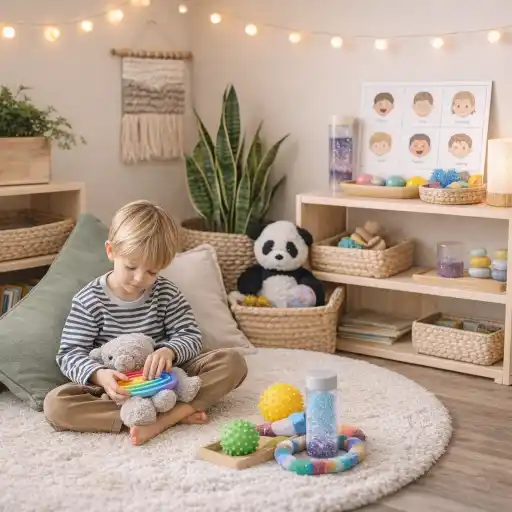
What is a calm-down corner and why does it matter?
1) Why it matters (short):
- It helps children learn to calm themselves so they can be safe and ready to learn.
- It reduces repeated meltdowns and keeps the group routine moving.
- It teaches choice and independence—skills that last.
2) Evidence and practice: Use short, repeatable tools (breathing, sensory bottles, squeeze toys). For teaching language and simple visuals, the CSEFEL briefs and ChildCareEd de-escalation guides give good ideas (see CSEFEL and How can child care teams de-escalate).
What should I put in a calm-down corner in a North Dakota classroom?
1) Suggested items (numbered for quick shopping):
- 🧸 Soft seat, rug, or pillow.
- 🔮 Sensory bottle or glitter jar for visual focus.
- 😮💨 Breathing visual poster and a stuffed breathing buddy.
- ✊ One small squeeze ball or safe fidget.
- 📘 One short feelings book or picture feeling cards (use visual cue cards from ChildCareEd Buy Now $0.00).
2) Safety and rules: follow national safety guidance like Caring for Our Children and your state rules. In North Dakota, keep licensing and ratio rules in mind—see the ND ratios overview at What Child-to-Staff Ratios.... State requirements vary - check your state licensing agency.
How do I teach children and staff to use the corner so it really helps?
1) A short teaching plan (numbered steps):
- 🧑🤝🧑 Introduce: Show the corner during circle time and name the tools.
- 😮💨 Model: Practice one breathing tool with the whole group (1–2 minutes).
- 🎲 Practice: Play quick games (Freeze Dance, Red Light/Green Light) that build stopping skills.
- 💬 Coach: Use one small question after calm: “What helped?” Praise the child’s choice.
2) Staff habits: use the same short language, stay nearby when a child uses the corner, and log visits so you can see patterns. For printable strategy cards and lesson supports, check Calm Down Strategy Cards Buy Now $0.00 and related resources on ChildCareEd.
How do we keep the corner safe, avoid common mistakes, and know when to get extra help?
1) Team rules and documentation (numbered):
- Post simple rules: voluntary use, staff nearby, visits short (2–5 minutes).
- Train all staff to use the same short scripts and to model calm.
- Log visits and triggers to find patterns and plan next steps.
- 🧠 Behavior observation and positive guidance: To help staff track calm-down corner visits and spot patterns behind meltdowns, ChildCareEd's The ABCs of Behavior: Turning Challenges into Learning Opportunities
 Buy Now
 $55.00$45.00 is a 6-hour online course teaching the Antecedent-Behavior-Consequence framework in a practical, classroom-focused way — a direct match for the visit-logging and trigger-tracking steps outlined in this guide.
2) Common mistakes & fixes (quick list):
- ❌ Mistake: Using the corner as punishment. ✅ Fix: Teach it during calm and role-play visits.
- ❌ Mistake: Too many items that overstimulate. ✅ Fix: Limit to 2–4 low-stim tools and swap them for interest.
- ❌ Mistake: Long lectures during meltdowns. ✅ Fix: One short sentence + one clear choice.
3) When to get more help: If a child hurts self/others often, has very long meltdowns many times a day, or shows no progress after consistent teaching, involve families, your director, or a mental health consultant. For local training ideas, Nebraska’s Cozy Calming Corner program is a nearby example of a training partner (Nebraska Children & Families Foundation).
- 💛 Children's mental health and calming strategies: For staff who want to deepen their skills in teaching regulation tools and knowing when a child needs more support, ChildCareEd's A Thoughtful Approach to Children's Mental Health Buy Now $24.00 is a 3-hour online course covering how to recognize emotional needs and use calming strategies — directly supporting the breathing tool teaching and "when to get more help" steps in this article.
Conclusion: What are the simple next steps?
- Pick one small corner this week and add 2–4 calm tools.
- Teach one breathing tool and practice it daily for 1–2 minutes.
- Use short scripts (Connect → Calm → Coach) and keep visits short (2–5 minutes).
- Track visits and ask for help if safety or progress is a concern.
FAQ (quick):
- Q: How long should visits be? A: 2–5 minutes to reset; staff stays nearby for longer.
- Q: What if a child refuses? A: Offer one calm choice, stay nearby, and practice later when calm.
- Q: What tools work best? A: Breath visuals, a sensory bottle, a soft toy, and a small squeeze ball.
- Q: Where to get printables? A: ChildCareEd has free posters, strategy cards, and checklists linked above.
You and your team are doing important work. Small, steady steps—one clear corner, short practice, and consistent language—help children build lasting #calmdown skills and stronger #regulation. Keep your approach simple, safe, and respectful of children’s choice.
- Building Equity: Inclusionary Practices in Preschool
- Emergency and Disaster Preparedness
- From Tantrums to Triumphs: Equipping Preschoolers with Self-Regulation Skills
- CDA Bridge Bundle: Family Child Care without Portfolio Review
- CDA Bridge Bundle: Infant/Toddler without Portfolio Review
- CDA Bridge Bundle: Preschool without Portfolio Review
- Texas Director Credential Renewal
- Texas Director Credential
- Supporting Breastfeeding Practices In Child Care
- 📋🧸 What Do You Need to Work in Childcare in North Dakota?
- ⏰📘 How Many Training Hours Do Childcare Staff in North Dakota Need Each Year?
- 👶 ¿Cuáles son las proporciones y grupos requeridos en Dakota del Norte? 🏫
- What Training Is Required to Be a Childcare Director in North Dakota?
- North Dakota Child Care Rules: A Guide for Family Child Care, Group Child Care, and Center Child Care Providers
- Lista para Abrir una Guardería en Casa en Dakota del Norte: Cómo Empezar
- Capacitación Previa al Servicio para Proveedores de Cuidado Infantil en Dakota del Norte
- How to Get an ECE Certificate in North Dakota
- How can North Dakota providers de-escalate biting, hitting & tantrums in child care?
- How Can North Dakota Childcare Providers Support Children Who Have Never Been in a Group Setting Before?
- How do I add my ND Registry ID to my ChildCareEd account so my training hours upload automatically?
- How Can North Dakota Providers Respond to Toddler Biting Without Shaming?
- How can North Dakota child care programs best support children with special needs?
- How can I prepare my North Dakota program for the July 13 CCDF rule changes?
- How Can North Dakota Child Care Providers Help Families Facing Economic Stress?
- How Can North Dakota Providers Show Quality and Attract Families?
- How can North Dakota child care programs lay reading foundations the right way?
- How do I build a calm-down corner in my North Dakota classroom?
- How can North Dakota providers best care for two-year-olds during the toddler years?
