When the class is eager to get outside, coats can turn a simple transition into a crowded, stressful bottleneck. A predictable dressing routine can instead build children’s self-help skills, language, and confidence; explore Playing with a Purpose: Infant/Toddler Lesson Planning  Buy Now $24.00 to strengthen your ability to plan age-appropriate learning through everyday experiences. You can also explore Supporting Children’s Independence Buy Now $24.00 for practical ways to scaffold children’s participation and growing autonomy.
Why is getting dressed a worthwhile learning opportunity?
Putting on a jacket is more than a task to complete before outdoor play. Children coordinate movements, attend to a sequence, solve small problems, communicate needs, and care for their belongings. When providers make room for children to participate, dressing becomes a meaningful daily practice in #independence and self-confidence.
It also shapes the transition itself. If adults dress every child quickly, children may have little opportunity to learn the steps, and educators can become caught in a cycle of rushing and repeated assistance. A routine with clear expectations and enough time can reduce waiting and create a calmer path outdoors. The CSEFEL brief on helping children make transitions recommends planning for transition time, using verbal and visual cues, and adapting assistance to individual children.
Remember, the goal is not a perfectly fast line or identical performance. Children develop at different rates and may need different levels of support. A child who finds their coat, starts a sleeve, or asks for help has made a valuable contribution to the routine. Recognizing those small steps supports a respectful, strengths-based classroom culture.
How can you set up a coat area that prevents congestion?
Start with the space, not a longer list of directions. A well-organized coat area gives children room to move and makes the next step easy to see. Position low hooks or cubbies within children’s reach, identify each space with a photo or symbol, and make sure coats and bags do not block the route to the door. Labeling belongings can also help children find and return the right items.
Consider dividing the group into small waves instead of sending everyone to the hooks at once. While a few children dress, others might look at a fall book, sing a familiar transition song, or help check the weather picture. Maintain active supervision and keep pathways clear; staff should be able to see children while offering help.
- Keep a small bench or stable seat available for children who need to sit while dressing.
- Place visual steps near the hooks, where children can refer to them while acting.
- Provide space between children so swinging sleeves, zippers, and movement do not create collisions.
- Keep spare clothing organized and follow program procedures for storing personal items.
For a ready-made child-facing support, consider ChildCareEd’s fall routines and independence visuals guide Buy Now $1.50, which includes outdoor-clothing visuals and guidance for introducing routine steps.
How do you teach a jacket routine one step at a time?
Teach the sequence when children are calm, rather than introducing it for the first time in a rush. Demonstrate slowly, using short language and a consistent order. For example: “Find your coat. Put your arms in. Pull it onto your shoulders. Find your hook.” Pause after each step so children can try before you offer more help.
Some children may enjoy practicing the coat flip: lay the jacket open with the inside facing up, position the child at the collar end, invite them to place their arms in the sleeves, and then lift the coat over their head. Demonstrate first and make sure there is enough space. This is one option, not a requirement; the best method depends on the child, the jacket, and the child’s comfort and coordination. Other children may find it easier to put on a jacket while seated or to place one arm in at a time.
- Use one brief, repeatable cue, such as “arms in, lift, pull.”
- Offer a picture sequence or show one step at a time.
- Give a child time to attempt the step before intervening.
- Help only as much as needed, and let the child complete any parts they can.
A purposeful plan can turn repetition into developmentally appropriate practice. The ChildCareEd course Playful Learning: Infant & Toddler Activities Buy Now $25.00 offers a related way to think about planning experiences around young children’s abilities and needs.
How can you use visuals, language, and play to support participation?
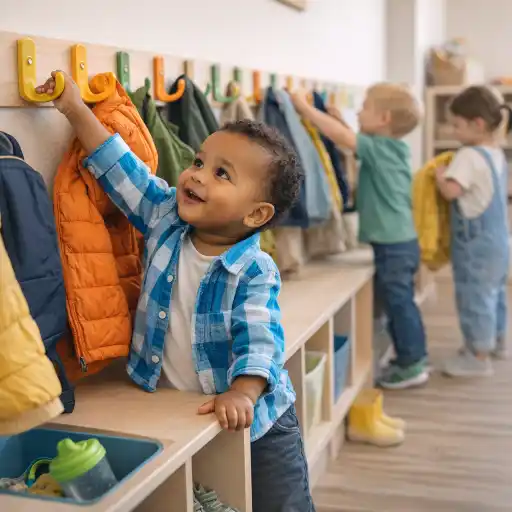
Children are more likely to follow a routine when they can see what comes next and hear the same simple cues from adults. Use three or four clear images, photographs, or drawings to show the dressing sequence. Place the visual at children’s eye level and point to it rather than repeating a long explanation. For children who communicate in more than one language or use gestures and communication tools, adapt the pictures and words to support understanding.
Keep adult language warm and specific. Instead of “Hurry up,” try “You found your sleeves; now let’s pull the coat over your shoulders.” Instead of taking over immediately, ask, “Would you like to try first, or would you like help with the zipper?” A choice between two workable options gives a child agency without overwhelming them.
Play can make practice feel less like a demand. Try a short “coat detective” game in which children match a coat to its hook symbol, or use a simple rhyme to remember the steps. The routine can include useful vocabulary—sleeve, hood, zipper, warm, inside, and outside—and conversation about what children notice in the fall weather.
Specific encouragement matters: name the effort or strategy you observed. “You kept trying to find the sleeve” gives children information about their progress and affirms persistence. Keep praise genuine, and avoid comparing children’s speed or ability.
How can you adapt the routine and avoid common pitfalls?
One routine will not work identically for every child. Some children may need extra time, a larger visual, an adaptive fastener, a different jacket style, or adult support with a particular movement. Sensory preferences, motor coordination, language, and prior experience all shape participation. Observe where a child gets stuck and adjust the support, rather than assuming unwillingness.
Partner with families to understand clothing preferences and routines that are familiar to the child. Share what the classroom is practicing and invite families to let you know about helpful strategies or accommodations. If a child becomes upset, pause and offer reassurance; the transition is not a test. Follow program policy and maintain supervision while helping each child stay safe and comfortable.
- ⚠️ Avoid expecting every child to master every step at the same pace; celebrate meaningful attempts.
- Avoid crowding the doorway; stagger the group and plan a quiet activity for children waiting.
- Avoid giving several directions at once; use short phrases, pictures, and wait time.
- Avoid turning dressing into a race; prioritize safety, dignity, and participation.
State requirements vary - check your state licensing agency, especially when changing procedures, equipment, or clothing-related safety practices. Keep the routine consistent across staff, while remaining flexible to each child’s needs.
Conclusion: What makes the jacket routine work?
The fall jacket traffic jam can become a useful learning routine when the classroom setup, adult approach, and sequence work together. Prepare an accessible coat area, teach the steps when children are calm, use consistent visual and verbal cues, and allow enough time for real participation. Offer individualized support without taking over, and notice children’s effort rather than their speed.
These small, repeated moments help children practice self-care, communication, motor coordination, and problem-solving while making transitions more manageable for the whole group. Start with one adjustment—perhaps adding picture cues or staggering the line—and observe what changes. For practical lesson-planning ideas that connect everyday moments to development, explore Playing with a Purpose: Infant/Toddler Lesson Planning Buy Now $24.00.
Which ChildCareEd courses can help strengthen related practice?
The following English-language courses connect to planning, routines, transitions, or independence:
- Playing with a Purpose: Infant/Toddler Lesson Planning Buy Now $24.00 — planning age-appropriate activities for children from birth through age three.
- Supporting Children’s Independence Buy Now $24.00 — approaches for fostering self-regulation, confidence, and everyday autonomy.
- Environments That Inspire Independence and Exploration Buy Now $55.00 — strategies for inclusive spaces that support independence and curiosity.
- Balancing Act: Schedules and Routines Buy Now $16.00 — age-appropriate routines and schedules for infants and toddlers.
- Every Moment Matters: Schedules and Transitions Buy Now $55.00 — practical strategies for planning routines and smoother transitions.
Review each course description for details about format and training information relevant to your needs.
- Moving About the Classroom: Effective Transitions for Everyday
- CDA Home Visitor Subject Area 2 Part 3 Birth to 5
- Positive Attention: Interactions and Supervision of Infants and Toddlers: For Workforce Solutions
- The ABCs of Behavior: Turning Challenges into Learning Opportunities
- Pediatric RSV First Aid & CPR/AED
- Positive Attention: Interactions & Supervision for Infants & Toddlers
- Self-Regulation & Change: Helping Children Cope
- Creating Environments that Nurture Growth and Community
- Texas Director Credential
- Everyday Safety: Creating Healthy Environments
- CDA Certification en Español: Recursos y Consejos para Educadores Bilingües
- 💛🧩 ¿Cómo puedo hacer que mi enseñanza sea inclusiva para los niños con autismo?
- ⏰ Cómo puedo facilitar las transiciones y las rutinas diarias en mi aula?
- 🤯 ¿Por qué este niño está teniendo un comportamiento difícil de repente?
- Understanding Sensory Processing in Young Children
- California Weather & Outdoor Time at Daycare
- ¿Cómo Crear Rutinas Saludables Para Niños Pequeños (sin estrés)?
- Cómo ser director de cuidado infantil en Maryland
- 10 Ejemplos de Cómo la Cultura Influye en el Desarrollo Infantil
- ¿Qué preguntas aparecen en el examen CDA para preescolar?
- Proporciones de Cuidado Infantil y Tamaños de Grupo por Edad en Nueva Jersey (Guía Rápida para Centros y Hogares)
- Proporciones de Cuidado Infantil y Tamaños de Grupo por Edad en Virginia (Guía Rápida para Centros y Hogares)
- Actividades de Otoño Fáciles para Preescolares esta Temporada
- Ejemplos de Crianza Respetuosa vs. Crianza Permisiva
- Celebrando la amistad en el cuidado infantil durante el Día de los Mejores Amigos
- Canciones, juegos y preguntas de círculo para niños
- Cómo simplificar la capacitación para sus empleados de daycare
- How Can You Fix a Supply Shelf That Creates a Classroom Traffic Jam?
- Juego Compartido y Autismo: Cómo Fomentar la Participación sin Exigir Contacto Visual
- How Can You Turn the Fall Jacket Traffic Jam Into a Learning Routine?
