When a toddler insists, “I do it!” at the coat hooks, you have a chance to turn a rushed transition into meaningful practice. Explore Every Moment Matters: Schedules and Transitions  Buy Now
$55.00$45.00 to strengthen your planning for predictable routines and calmer transitions, and consider Student Success: Expectations & Independence Buy Now $16.00 for strategies to match support to children’s emerging abilities. These courses can help you build practical professional knowledge; read on for ways to make fall dressing safer, more inclusive, and more child-led.
Why is getting dressed a powerful learning routine?
Pulling on a jacket is not merely a hurdle between the classroom and the playground. It asks toddlers to coordinate movement, attend to a sequence, solve small problems, communicate needs, and persist through effort. Repeated experiences like these support motor, language, cognitive, and social-emotional development. As Raising Children Network’s guidance on learning to get dressed explains, dressing draws on fine- and gross-motor skills, memory, concentration, and vocabulary.
Participation also communicates an important message: “You are capable, and I will help you when you need it.” A toddler may not manage a zipper or orient a coat yet, but finding a sleeve, pushing an arm through, or bringing the jacket to an adult is real progress. Those small contributions nurture #independence and #confidence without requiring children to perform beyond their developmental readiness.
There is a practical benefit for the group, too. A familiar sequence can make outdoor transitions more predictable and reduce the pressure that builds when everyone waits at the door. Predictability is not about making children move faster; it is about arranging time, space, and adult support so they can take part. The CSEFEL brief on helping children understand routines and classroom schedules describes how consistent routines and visual cues can help children anticipate what comes next.
How can you teach dressing steps without taking over?
Teach the routine when the group is calm, not for the first time during a crowded departure. Use a short, repeatable sequence and give toddlers a moment to attempt each part. A simple jacket routine might be: find your coat, locate the sleeves, put arms in, pull it onto your shoulders, then go to the waiting spot. Adjust the order and number of steps to match the garment and child.
Try the least intrusive support first. Observe, pause, offer one prompt, and help only when needed. If a child is trying safely, a few seconds of wait time can reveal what they can do without added instructions. If they seem uncertain, point to the next picture or say, “Find your sleeve.” If they ask, become distressed, or cannot proceed, help with the difficult part while leaving the child involved.
- Model one step slowly, then invite the child to try.
- Use clear, brief language: “Arms in,” “Pull up,” or “Find your hook.”
- Offer limited choices: “Do you want to sit or stand while you put on your coat?”
- Notice effort specifically: “You found the sleeve and pushed your arm through.”
Some children enjoy the coat-flip approach; others find it easier to sit or put one arm in at a time. Treat techniques as options, never requirements. Milestone ranges are general guides—not deadlines—and dressing skills vary with practice, clothing design, motor development, and individual needs. For deeper learning about supporting autonomy, explore Supporting Children’s Independence Buy Now $24.00.
How can visuals and the classroom setup make success easier?
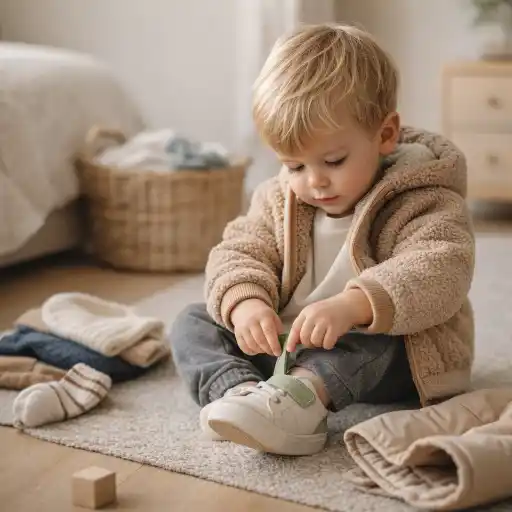
Set up the environment so the next step is visible and reachable. Low hooks or cubbies, clear spaces for belongings, and an uncluttered route to the door allow toddlers to act instead of waiting for an adult to retrieve everything. A stable seat can help children who need support with balance or prefer dressing while seated. Keep pathways open and maintain active supervision while children move through the area.
A photo sequence can make the routine easier to understand, especially for children who benefit from concrete visual information, are developing language, or find several spoken directions overwhelming. Show a few recognizable steps—coat, sleeves, shoulders, hook—and place the pictures where children dress. Teach the visuals by pointing, naming the action, and allowing time to respond. Head Start’s resource on visual supports notes that pictures and other visuals can make information more accessible across routines and settings.
The ChildCareEd Dress the Weather Cloud activity for toddlers Buy Now $1.50 offers a related way to explore weather and clothing with pictures. For the dressing sequence itself, the fall jacket routine guidance suggests arranging the coat area, using visuals, and staggering children to prevent congestion.
- Invite a few children to dress at a time; engage others in a supervised book or song.
- Use photos or familiar symbols to identify each child’s space.
- Keep visual steps simple and update them when the routine changes.
- Ask families which words, clothing preferences, and strategies are familiar to the child.
How can the routine support language, choice, and belonging?
Dressing offers natural conversation without turning self-care into a quiz. Name clothing and actions as they happen: “Your hood is down,” “You’re pulling the sleeve,” or “The air feels cool.” Follow the toddler’s attention and leave pauses for a word, gesture, look, or communication device response. If a child says “coat,” you might expand gently: “Yes, your blue coat is ready for outside.” This connects vocabulary to a meaningful, immediate experience.
Choice can give children agency while keeping decisions manageable. Offer two suitable options, such as choosing between two hats or deciding whether to sit or stand. Weather and safety decisions remain the adult’s responsibility; the child can still participate in a small, authentic way. Avoid praising only speed or comparing children with peers. Instead, describe persistence, problem-solving, or asking for help.
Inclusive practice means recognizing that children may participate differently. Sensory preferences, motor coordination, communication, culture, and prior experience can all shape dressing. A child may dislike a fabric, need an adaptive fastener, prefer a familiar phrase in their home language, or require hands-on support for one step. Collaborate with families and relevant specialists when appropriate, and focus observations on access and participation—not on diagnosing a child from a coat routine.
Some toddlers will say “I do it!” and then ask for help moments later. That is not a contradiction; it is a healthy negotiation between autonomy and support. A calm response such as “You can try, and I’m right here” protects the relationship while making room for practice. Programs seeking a wider framework for routines and transitions can explore Balancing Act: Schedules and Routines Buy Now $16.00.
What common pitfalls should providers avoid?
Fall dressing can become stressful when adults face a tight schedule, limited space, and a group eager to go outside. Those pressures are real. A thoughtful routine does not remove every challenge, but it can prevent predictable problems and help staff respond consistently.
- ⚠️ Avoid rushing in to complete every step. Pause and notice what the toddler can already do.
- Avoid giving several directions at once; offer one brief cue, then wait.
- Avoid crowding the doorway. Use small groups and plan a short, supervised activity for those waiting.
- Avoid treating one method, such as the coat flip, as the only correct way.
- Avoid interpreting reluctance as defiance before considering fatigue, discomfort, sensory preferences, or a difficult garment.
Safety and comfort come first. Check that outdoor clothing is suitable for conditions, supervise children closely, and follow program procedures for belongings and outdoor transitions. If a task remains difficult, observe which step is challenging and consider whether the environment, clothing, visual cue, or amount of assistance needs adjustment. Share factual observations with families and invite their insight. State requirements vary - check your state licensing agency, especially when changing procedures, equipment, or clothing-related safety practices.
For professional learning that connects routines, schedules, and transition planning, the English-language course Every Moment Matters: Schedules and Transitions Buy Now $55.00$45.00 explores ways to plan routines, manage transitions, and respond to different temperaments.
Conclusion: How can fall dressing become a “I do it!” moment?
Fall dressing supports toddler independence when adults make the routine predictable, accessible, and flexible. Teach a few clear steps when children are calm, use visuals and short cues, allow time for safe attempts, and give only the assistance needed. Make room for different methods and developmental paces; success means meaningful participation, not a perfectly zipped coat or a fast line.
Start with one practical adjustment: lower a hook, post a small photo sequence, stagger the group, or pause before helping. Notice what each toddler can do and build from that strength. When providers pair warmth with intentional planning, the jacket routine becomes more than preparation for outdoor play—it becomes daily practice in communication, coordination, problem-solving, and growing #selfhelp skills. The goal is a transition where children feel supported enough to try, and proud enough to say, “I do it!”
- Moving About the Classroom: Effective Transitions for Everyday
- Setting the Stage: Story Time
- Pediatric RSV First Aid & CPR/AED
- Look What I Can Do! Developmental Disabilities Overview
- CDA Bridge Bundle: Infant/Toddler without Portfolio Review
- CDA Bridge Bundle: Infant/Toddler
- Texas Director Credential Renewal
- CDA Infant/Toddler Credential with Portfolio Review
- Texas Director Credential
- Every Moment Matters: Schedules and Transitions
- CDA Certification en Español: Recursos y Consejos para Educadores Bilingües
- 👶 ¿Cuáles son las proporciones y grupos requeridos en Dakota del Norte? 🏫
- Recursos en Español sobre el Sueño Seguro del Bebé
- Capacitación en Salud y Seguridad Preventiva en Línea para Proveedores de Cuidado Infantil
- Cómo Empezar una Guardería en Casa: Requisitos y Pasos
- Proporciones de Cuidado Infantil y Tamaños de Grupo por Edad en Virginia (Guía Rápida para Centros y Hogares)
- Lista para Abrir una Guardería en Casa en Virginia: Cómo Empezar
- Lista para Abrir una Guardería en Casa en Carolina del Norte: Cómo Empezar
- Lista para Guardería en Casa en Illinois: Cómo Iniciar una Guardería en el Hogar
- Lista para Guardería en Casa en Texas: Cómo Iniciar una Guardería en el Hogar
- Cómo Trabajar en el Cuidado Infantil en Carolina del Norte: Requisitos y Pasos
- How can New York childcare providers build self-confidence in toddlers?
- Celebrando la amistad en el cuidado infantil durante el Día de los Mejores Amigos
- Canciones, juegos y preguntas de círculo para niños
- Cómo simplificar la capacitación para sus empleados de daycare
- How Can Child Care Providers Turn Everyday Routines into Learning Opportunities?
- How Can Everyday Fall Routines Support Infant and Toddler Development?
- How Can You Turn the Fall Jacket Traffic Jam Into a Learning Routine?
- How Can Preschoolers Manage Fall Layers More Independently?
- How Can Fall Dressing Routines Help Toddlers Say “I Do It!”?
