Cleanup becomes less stressful when the classroom itself helps children know what belongs where. A thoughtful layout, accessible storage, and practiced routines can increase independence while giving teachers more time for meaningful interactions; for a deeper foundation, explore Classroom Setup for Child Care  Buy Now $24.00, which can strengthen your professional knowledge of safe, inclusive learning environments.
Why does classroom design matter for cleanup?
Cleanup is not merely an end-of-play chore; it is a developmental opportunity. Preschoolers practice categorizing, planning, coordination, cooperation, language, and responsibility when they return materials to their places. The environment communicates expectations before an adult gives a direction. Head Start describes effective learning environments as responsive to children’s abilities, interests, and developmental levels, while the Texas Education Agency emphasizes accessible labels, visual schedules, and helper charts as supports for independence.
A room that is crowded, difficult to navigate, or filled with incomplete sets creates unnecessary cognitive and physical demands. Children may not know what to clean, where to put it, or whether a container belongs to one activity or another. By contrast, defined areas and consistent storage make cleanup predictable. The classroom becomes a partner rather than another problem for staff to manage.
Begin by observing the current routine. Where do children hesitate? Which materials are repeatedly misplaced? Where do adults have to step in? These observations identify the highest-impact changes.
How should you arrange centers and traffic flow?
Start with clear zones for blocks, dramatic play, art, sensory exploration, books, and table work. Place active or noisy areas away from quieter spaces. Use low shelves, rugs, or tables to define boundaries without blocking adult sight lines. The Indiana Resource Center for Autism notes that physical and visual boundaries help children anticipate expectations and move more independently; this principle benefits many preschool learners, not only children with autism.
Plan cleanup into the layout itself:
- Keep art materials near a sink or washable surface.
- Place block storage beside the block area rather than across the room.
- Provide open floor space for sorting and carrying materials safely.
- Keep pathways wide enough for children, adults, and mobility equipment.
- Position shelves so adults can supervise without standing in the center of children’s work.
Each center should have a clear beginning and end. A rug can signal where blocks are built and stored; a tray can define one tabletop invitation. These boundaries reduce wandering and help children understand what must be reset before moving on.
Which storage systems help children clean up independently?
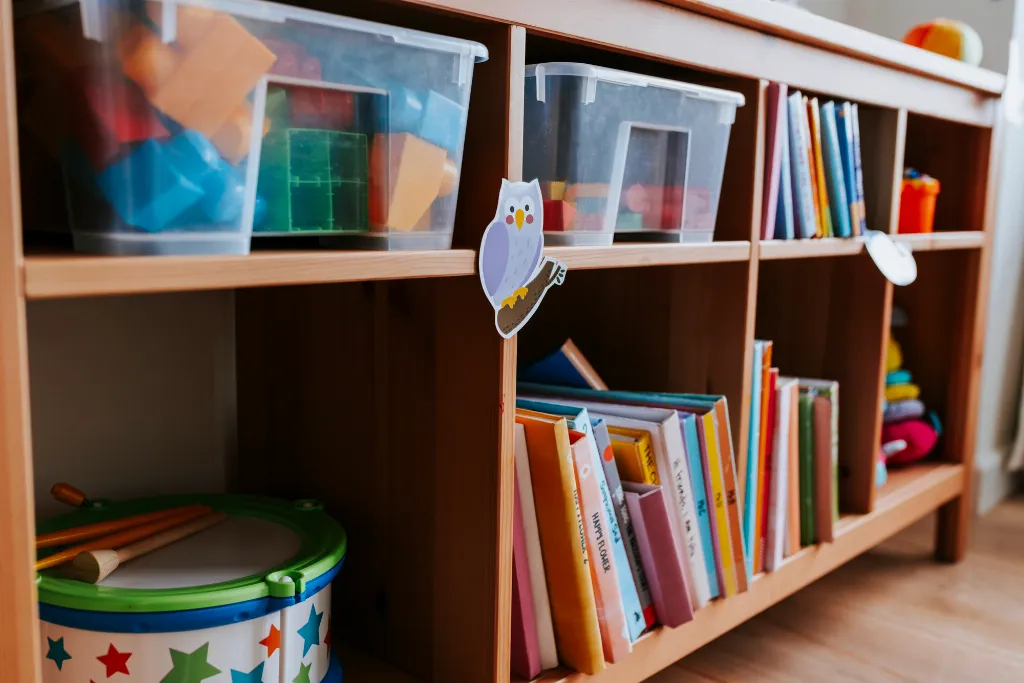
Children are more likely to return materials when storage is visible, reachable, and simple. Use one labeled home for every frequently used item. Picture-and-word labels support nonreaders, multilingual learners, and children who benefit from visual information. A photograph of the actual bin contents is often more useful than a small printed word alone.
Use a “one activity, one container” system whenever possible. Trays and baskets keep related pieces together, reduce missing parts, and allow children to carry materials with two hands. Transparent containers can help children identify contents quickly, but avoid overfilling them; a heavy or overflowing bin is difficult for small hands.
- 🧺 Keep daily materials on low, sturdy shelves.
- Store teacher-only, fragile, or hazardous items out of children’s reach.
- Limit the number of choices available in each center.
- Use color cues consistently, such as a blue label for the book area.
- Check shelves daily for broken, incomplete, or developmentally inappropriate materials.
Teach the system explicitly. Model how to carry a tray, match a picture to a shelf, and check the floor before leaving. Practice when children are calm—not only after a busy play period. Montessori-inspired approaches similarly emphasize accessible materials and orderly environments as supports for autonomy, but adapt them to your group, space, and program requirements.
How can routines make cleanup predictable and positive?
Effective cleanup routines are short, consistent, and taught like any other classroom skill. The Virtual Lab School distinguishes a schedule—the broad sequence of the day—from routines—the steps children follow within that sequence. This distinction matters because children need both to know when cleanup occurs and how to complete it.
Use the same sequence each day:
- Give a two- to five-minute warning.
- Show or name the cleanup signal, such as a song, bell, or visual card.
- Assign one or two specific tasks.
- Invite children to check the area against a picture or “finished” photograph.
- Transition to the next activity with minimal waiting.
Replace vague directions such as “Clean up everything” with concrete language: “Put the animals in the green basket” or “Place each book spine-up on the shelf.” Use helper roles—such as bin checker, book helper, or rug roller—and rotate them so responsibility is shared rather than assigned to the same children.
Specific encouragement is more effective than broad praise. Say, “You matched every puzzle piece to its tray,” or “Your table worked together to clear the floor.” If cleanup repeatedly breaks down, shorten the task, reduce materials, or reteach one step at a time.
How do you support hygiene and safety during cleanup?
An easier cleanup system must still protect children’s health and safety. The CDC recommends cleaning visibly dirty surfaces and cleaning daily after meals or activities. Surfaces that contact food or children’s mouths may require sanitizing, while diapering areas, bathrooms, and surfaces contaminated with bodily fluids require appropriate disinfection procedures. Always follow product labels, required contact times, ventilation guidance, and your program’s written health policies.
Design cleanup responsibilities so children participate without handling chemicals or unsafe waste. Children can sort blocks, return books, wipe a table with a water-dampened cloth when permitted, or place washable materials in a designated basket. Adults should handle disinfectants, bodily-fluid cleanup, broken glass, and other hazards.
- Inspect bins, shelves, rugs, and furniture for sharp edges or instability.
- Remove choking hazards from areas used by younger children or mixed-age groups.
- Keep cleaning products locked and inaccessible.
- Use washable, easily maintained surfaces for messy activities.
- Maintain clear exits and pathways throughout the process.
State requirements vary - check your state licensing agency before changing room capacity, storage, sanitation procedures, or furniture placement. Directors can support consistency by posting a brief setup-and-cleanup checklist and reviewing it during staff huddles.
What common cleanup mistakes should you avoid?
Many cleanup difficulties reflect a system problem rather than a child problem. The most common mistake is placing too many materials within reach. Excess choices create clutter, increase lost pieces, and make the task feel impossible. Rotate materials and keep only purposeful invitations available.
Another mistake is labeling containers but failing to teach the labels. Children need demonstrations, practice, and reminders. If a label is unclear, too small, or placed above eye level, revise it. A third mistake is expecting the entire group to clean every area simultaneously. Assign children to the spaces where they played, or use small teams with clearly bounded tasks.
Avoid turning cleanup into a race that rewards unsafe movement or excludes children who need more processing time. Songs and timers should provide structure, not pressure. Offer visual first-then language, additional modeling, or a quieter task for children who become overwhelmed by noise.
Finally, do not let adults silently redo the room after children leave. When possible, involve children in noticing what remains and completing the final step. This builds ownership and gives teachers information about which parts of the system need improvement.
Conclusion: How can you make cleanup easier this week?
The central question is not whether preschoolers can clean up perfectly; it is whether the environment makes participation understandable and achievable. Start with one center. Remove incomplete materials, create a child-height storage home, add a photo label, and teach a brief cleanup routine. Observe what changes, then adjust before expanding the system.
- Define centers and keep pathways open.
- Use low shelves, complete activity trays, and picture-and-word labels.
- Give warnings, specific tasks, and consistent transition cues.
- Invite children to serve as helpers and problem-solvers.
- Separate child-friendly cleanup from adult-only sanitation and hazardous-material tasks.
For additional professional learning, consider Every Moment Matters: Schedules and Transitions Buy Now $55.00, Spicing Up the Classroom: Learning Centers Buy Now $16.00, Classroom Designers ONLINE Buy Now $24.00, and The Prepared Environment: Montessori Class Design. Thoughtful #classroom design, accessible #materials, predictable #routines, visual #labels, and children’s #independence can turn cleanup from a daily struggle into a meaningful part of learning.
- Lesson Planning for Preschoolers
- Teacher-Child Interactions for Stronger CLASS® Outcomes
- Birth to Five CDA Credential with Portfolio Review
- Children at the Wheel: Emergent Curriculum
- CDA Bridge Bundle: Family Child Care without Portfolio Review
- CDA Bridge Bundle: Infant/Toddler without Portfolio Review
- CDA Bridge Bundle: Preschool without Portfolio Review
- Every Moment Matters: Schedules and Transitions
- Spicing Up the Classroom: Learning Centers
- Mindful Supervision: Balancing Safety & Independence in Montessori
- Proporciones de Cuidado Infantil y Tamaños de Grupo por Edad en Nueva Jersey (Guía Rápida para Centros y Hogares)
- Canciones, juegos y preguntas de círculo para niños
- Cómo simplificar la capacitación para sus empleados de daycare
- How can I create engaging learning centers for preschoolers?
- Preschool Classroom Schedule: A Full-Day Example from Arrival to Pick-Up
- Preschool Classroom Rules: How to Teach Expectations Without Constant Reminders
- Preschool Schedule That Works: When to Plan Centers, Circle Time, and Outdoor Play
- How to Set Up a Preschool Classroom That Makes Cleanup Easier
- Why Is My Preschool Classroom So Chaotic? 7 Classroom Management Fixes to Try
- How Can Recycled Materials Create Engaging Learning Centers?
- How Can Child Care Providers Create Classroom Rules That Children Understand and Use?
- Keep It Simple: Introducing Classroom Rules Preschoolers Can Remember
- Can Every Toddler Reach and Recognize Their Own Storage Space?
- When a Block Building and a Toy Truck Route Need the Same Space, How Can Providers Plan Shared Play?
- How Can Classroom Labels Stay Useful When Materials Move Between Centers?
- How Can Children Restore a Montessori Activity Before Choosing Another?
- How Can Preschool Teachers Build Independence Without Giving Too Much Help?
- What Are Simple Ways to Make Classroom Rules Easier for Young Children to Remember?
- How Can You Help Children Recognize and Find Classroom Supplies?
- How Can You Help Children Recognize and Find Classroom Supplies?
