When classroom expectations are easy to understand and recall, children can participate with more confidence—and educators spend less time repeating directions. A few practical changes can make rules more memorable through visuals, play, and predictable routines; for deeper professional learning, explore Staying Positive: Guidance for Preschoolers  Buy Now $24.00 or Social Foundations and Responsive Classrooms Buy Now $24.00, which offer focused learning on positive guidance and supportive classroom practice.
Why do memorable classroom rules matter?
Remembering a rule is not simply a matter of obedience. Young children are developing language, attention, working memory, impulse control, and social understanding at the same time. A long list or an abstract instruction can be difficult to retrieve in the middle of play, a busy transition, or a moment of frustration. Short, concrete expectations reduce that load and make it easier for children to know what adults mean.
Clear expectations also communicate that the classroom is a community where people can feel safe and included. Head Start describes behavior expectations as agreements that guide how people interact. When children know what to do—not only what to avoid—they have a clearer path into play and learning. Adults, in turn, can notice and encourage positive behavior rather than relying on repeated corrections.
This is not about lowering expectations. It is about teaching them in ways that fit children’s development. For example, “Be respectful” may be hard to picture; “Use kind words” gives a child something observable to practice. Consider the ChildCareEd guide on introducing preschool classroom rules without overwhelming children for additional approaches to keeping expectations manageable. State requirements vary—check your state licensing agency when developing or revising program expectations.
What makes a rule easier for children to understand?
Effective rules are brief, positive, specific, observable, and appropriate to the children’s developmental abilities. A small set—often three to five classroom-wide expectations—is easier to teach and revisit than an extensive list.
Try wording that describes an action:
- Use walking feet indoors.
- Hands are for helping.
- Use kind words.
- Care for our classroom.
- Take turns with materials.
“Don’t run” tells children what to stop, while “Walk inside” supplies the replacement action. Likewise, “Be good” or “Be respectful” may be too broad unless adults explain what those values look and sound like in a particular situation. Avoid packing several directions into one rule; teach routine steps separately.
Invite children to contribute ideas with questions such as, “What helps everyone feel safe in the block area?” Then help turn their ideas into clear, inclusive expectations. Families and staff can share language that reflects children’s cultures and home languages. A useful check is: Can a child demonstrate this rule? Is it observable? Does it tell children what to do? Does it support safety and belonging?
How can visuals and playful practice make rules stick?
Spoken explanations are only one route to learning. Pair each expectation with an appropriate photograph, drawing, symbol, object, gesture, or short phrase. Visuals can support children who are not yet reading, children learning more than one language, and children who benefit from extra processing time. The IRIS Center notes that visuals should be chosen to suit children’s needs: some respond to photos, others to simple drawings or objects they can touch.
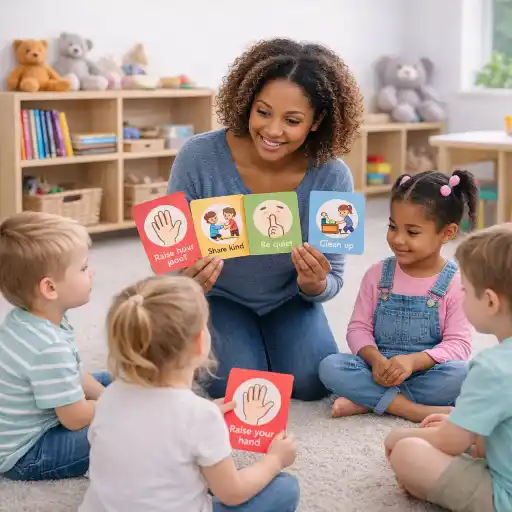
Place cues where children need them, at a height they can see. A walking-feet picture near the doorway and a cleanup sequence near the shelves can serve as timely reminders. Introduce expectations gradually instead of giving a long rules lecture. For each rule:
- Point to the image and say the short phrase.
- Model the expected action.
- Invite children to try it through role-play or a movement game.
- Practice again in the routine where the rule applies.
- Name specific efforts: “You put the blocks back gently.”
🎵 A simple chant, rhythm, or gesture can turn review into a familiar classroom ritual: “Walking feet, walking feet, safe inside our room.” Puppets and short stories can demonstrate both helpful choices and alternatives without singling out a child.
How can routines and room design reinforce expectations?
Children’s behavior is shaped by the space, schedule, materials, and relationships around them. If pathways are crowded, popular materials are scarce, or children wait for long stretches without a meaningful activity, repeating a rule may not resolve the difficulty. Prevention includes asking whether the environment makes the expected action realistic.
- Mark centers with shelves, rugs, signs, and picture labels.
- Keep materials reachable and show where they belong after play.
- Provide duplicates or alternatives for highly sought-after materials when possible.
- Balance active play, quieter choices, small groups, and outdoor time.
- Use a visual schedule and preview changes to the day.
Transitions deserve special attention because children must stop one activity, shift attention, and often follow several steps. Use a consistent signal—a song, chime, or clap pattern—and a short visual sequence. For cleanup, the pictures might show: stop playing, put materials away, check the floor, and join the group. Give children meaningful jobs, such as checking a center or carrying a transition card.
Adapt supports to individual needs. A child may benefit from a first-then card, a shorter transition, a movement opportunity, or a simpler visual. These adjustments help children access shared expectations; they are not special privileges. When the environment offers clear cues and predictable steps, rules can become prompts for independence rather than a steady stream of adult reminders.
What should educators do when a child forgets or breaks a rule?
Even well-taught rules take time to become reliable skills. Respond calmly, protect the child’s dignity, and use the moment to teach rather than shame. Address immediate safety first, then state the expectation and guide the next action in a few words. A predictable response helps children understand the boundary without turning a mistake into a public lecture.
- Describe what happened objectively: “The blocks were thrown.”
- State the expectation: “Blocks are for building.”
- Offer the next step: “You can build on the rug, or choose the cars.”
- Follow through in a related way: “We can use the blocks again when they’re safe.”
When possible, offer two acceptable choices. If a child runs indoors, return together and practice walking. If materials are dumped, involve the child in restoring the area. If someone is hurt, comfort and protect that child first, then help the other child practice a safe way to communicate or repair the interaction.
Once everyone is calm, revisit what happened briefly: “What can we try next time?” A child may need help identifying feelings, finding the words to ask for a turn, or rehearsing a replacement action. Avoid labels such as “bad” or “wild,” threats, sarcasm, and forced explanations during distress. Positive guidance combines clear limits with relationship, repetition, and support. If a pattern persists, observe what happens before and after, consider environmental or communication barriers, and collaborate respectfully with families and colleagues.
How can a teaching team keep rules consistent?
Consistency means adults share the essential expectations, safety limits, and teaching approach—not that every child receives identical support. Directors can help teams create a concise agreement listing the rules, common phrases, prevention strategies, and steps for documenting recurring concerns. Rehearse responses to familiar situations such as grabbing, running, or difficulty with cleanup so staff can respond calmly and predictably.
Choose a few shared phrases, such as “Hands are for helping,” “I’ll help you be safe,” and “Show me the next step.” Also agree to notice children using expectations successfully, not only to correct them. For example: “You waited while your friend finished with the puzzle.” Specific feedback makes the rule meaningful and reinforces children’s growing competence.
Family partnership can strengthen the connection between classroom expectations and children’s experiences at home. Share rules in accessible language and ask what words, gestures, or routines work for the child. A strengths-based conversation might begin: “Sam is deeply engaged in building. Cleanup is a hard transition, so we are trying a picture sequence and a short warning. What helps at home?” If concerns continue, objective notes about time, setting, what happened before, and what followed can help the team identify useful adjustments.
For additional professional learning, providers may explore Viewing Guidance in a Positive Light Buy Now $24.00, Classroom Management is Collaboration! Buy Now $16.00, and Every Moment Matters: Schedules and Transitions Buy Now $55.00. These English-language courses focus on positive guidance, collaborative classroom management, and the routines that support children’s participation.
Conclusion: What simple changes help children remember classroom rules?
Young children remember classroom expectations more readily when adults keep the list short, phrase rules positively, pair them with useful visuals, and teach them through modeling and playful practice. Well-planned routines and classroom spaces make the expected behavior easier to carry out. When children forget, calm and consistent responses offer another chance to practice rather than a reason for shame.
Start with one rule that would make a daily routine safer or smoother. Choose a short phrase, add a picture at children’s eye level, demonstrate the action, and rehearse it together where it is needed. Share the wording with colleagues and invite families’ insights. Small, repeated teaching moments help build a more predictable, welcoming classroom where children can participate and grow.
- 45 Hour Child Growth and Development
- CDA Home Visitor Subject Area 3 Part 3 Birth to 5
- CDA Home Visitor Subject Area 2 Part 3 Birth to 5
- Birth to Five CDA Credential with Portfolio Review
- Super Special School Agers
- 24 Hour Texas Pre-Service
- The Best Promotion is Play
- Anxiety: Signs & Strategies
- Professional Integrity in Child Care
- 🔍 ¿Qué ves cuando observas a un niño aprender?
- 💛🧩 ¿Cómo puedo hacer que mi enseñanza sea inclusiva para los niños con autismo?
- ❄️ ¿Qué actividades al aire libre funcionan bien para los niños de Illinois en cada estación? 🌷🍂
- Regulaciones de Licenciamiento de Cuidado Infantil en California para Centros y Hogares de Cuidado Infantil Familiar
- Proporciones de Cuidado Infantil y Tamaños de Grupo por Edad en Nueva Jersey (Guía Rápida para Centros y Hogares)
- Consejos de Supervisión Activa para Salones de Preescolar y el Juego al Aire Libre
- What are training bundles in Michigan and which one fits your program?
- Teaching Kids About Memorial Day Through Crafts and Activities
- Daycare Teacher Certification Requirements in Georgia
- How can child care programs teach great nutrition and healthy eating habits?
- How Do Art Activities Support Cognitive Growth in North Dakota Preschoolers?
- Online Early Childhood Courses with ChildCareEd
- Summer Field Trips for Daycares in Nevada
- How do ChildCareEd's urban childcare courses help Michigan providers in high-density communities?
- Canciones, juegos y preguntas de círculo para niños
- First Aid Lessons for Kids: Simple Skills They Can Learn
- Cómo simplificar la capacitación para sus empleados de daycare
- How Can Child Care Providers Create Classroom Rules That Children Understand and Use?
- Keep It Simple: Introducing Classroom Rules Preschoolers Can Remember
- What Are Simple Ways to Make Classroom Rules Easier for Young Children to Remember?
