Too many rules at once can be confusing for young children. In this article, we’ll explore how educators can introduce a few clear, positive expectations in ways preschoolers can understand, practice, and remember, with support from The ABCs of Behavior: Turning Challenges into Learning Opportunities  Buy Now $55.00 and the Preschool Classroom Rules Poster Buy Now $1.49.
Why does introducing fewer rules make a meaningful difference?
Preschoolers are developing language, attention, impulse control, memory, and perspective-taking at the same time. A long list of rules can exceed their working memory and leave them unsure about what adults actually expect. When expectations are limited and concrete, children can focus on learning one behavior at a time instead of experiencing correction as a constant stream of “no” messages.
Rules also communicate whether the classroom is a safe community. Head Start describes behavior expectations as agreements that guide how people interact. Clear, positively stated expectations allow adults to spend more time encouraging participation and less time reacting to behavior after a problem occurs.
This approach is not about lowering standards. It is about translating broad values such as safety, kindness, and responsibility into actions children can see and practice. For example, “Be respectful” may be meaningful to adults but is abstract for many preschoolers. “Use kind words” or “Hands are for helping” gives children a specific action.
- Choose three to five classroom-wide expectations.
- Use the same core language across classrooms and routines.
- Explain what each expectation looks and sounds like.
- Teach rules as skills, not merely as restrictions.
State requirements vary - check your state licensing agency when developing or revising program expectations.
How should you choose rules that preschoolers can understand?
Effective rules are positively stated, brief, specific, observable, and developmentally appropriate. The IRIS Center recommends no more than five rules for a setting and emphasizes that rules should tell children what to do. This makes the expectation easier to model and easier for every adult to recognize.
Consider wording such as:
- Use walking feet indoors.
- Hands are for helping.
- Use kind words.
- Care for our classroom.
- Take turns with materials.
Avoid combining several directions into one sentence. “Sit on the carpet, keep your hands to yourself, listen, and do not talk” requires children to process multiple actions and prohibitions at once. Instead, select the most important observable behavior for that context and teach the remaining steps as part of the routine.
Invite children’s contributions without placing the entire responsibility on them. Ask, “What helps everyone feel safe at the block center?” Then shape their ideas into a clear, positive expectation. Families and staff can also share language that is culturally and linguistically responsive. Head Start recommends incorporating children’s home languages and using common phrases across settings whenever possible.
Review each proposed rule with four questions:
- Can a child demonstrate it?
- Can an adult observe it?
- Does it describe what to do?
- Does it support inclusion, safety, and belonging?
How can visuals and playful practice prevent children from feeling overwhelmed?
Young children should not be expected to remember rules from spoken explanations alone. Pair each rule with a photograph, drawing, symbol, object, gesture, or brief chant. Visual supports can help children who are not yet reading, dual-language learners, and children who benefit from additional processing time. Head Start notes that visuals can clarify what will happen, what children should do, and how to participate.
Display the rules at children’s eye level and place them where the expectation is used. A walking-feet image belongs near the doorway; a cleanup image belongs near shelves or centers. Use photographs of children demonstrating the rule when appropriate, while remembering that some children may respond better to simple line drawings or less visually complex symbols.
Introduce one rule at a time rather than presenting the entire poster in a single lecture. A practical sequence might be:
- Point to the image and say the rule in five to seven words.
- Model the expected behavior.
- Invite children to demonstrate it.
- Briefly practice it in the routine where it matters.
- Notice and name successful attempts.
🎵 A short song, rhythm, or movement can make the expectation memorable: “Walking feet, walking feet, safe inside our room.” Keep the language consistent even when the activity changes. Repetition should feel like a familiar ritual, not a reprimand.
For additional learning related to classroom relationships and guidance, consider Social Foundations and Responsive Classrooms Buy Now $24.00, which addresses self-regulation, positive guidance, conflict resolution, and responsive classroom practices.
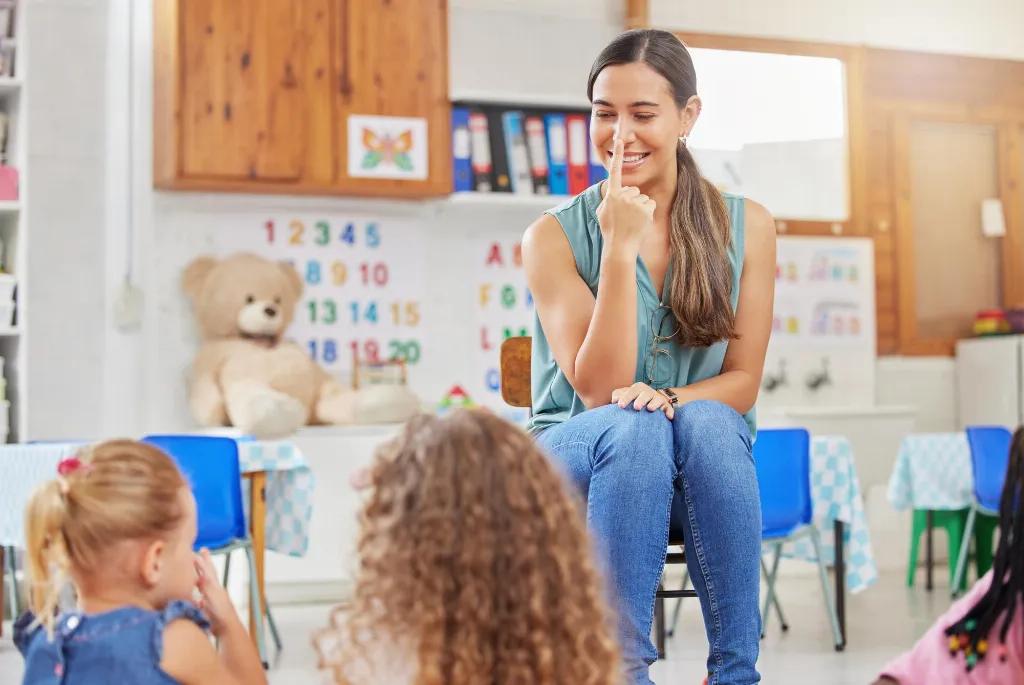
How can routines and room design make rules easier to follow?
Children’s behavior is shaped by the environment, schedule, materials, and relationships around them. If a room contains crowded pathways, too few popular materials, or long periods of waiting, repeated reminders may not address the real challenge. Prevention begins by asking whether the environment makes the desired behavior realistic.
- Define centers with shelves, rugs, signs, and picture labels.
- Keep materials accessible and provide a clear place for returning them.
- Offer duplicates or alternatives for highly desirable materials.
- Reduce open pathways that invite running indoors.
- Balance active play, quiet choices, small groups, and outdoor time.
- Post a visual schedule at children’s eye level.
Transitions deserve particular attention. Before cleanup, show a sequence such as stop, put materials away, check the floor, and join the group. Give a brief warning and use a consistent signal, such as a chime, clap pattern, or song. Classroom jobs can also build ownership: one child checks the book area while another carries the transition card.
Developmentally appropriate practice requires flexibility. Some children may need a first-then card, a shorter transition, a movement opportunity, or an individualized visual. These supports do not give a child an unfair advantage; they provide access to the same community expectations.
When the environment supports independence, rules become cues rather than constant verbal corrections. Children can look, act, and gradually monitor their own participation.
What should you do when a child does not follow a rule?
Responding calmly protects the child’s dignity and preserves the instructional purpose of the rule. A brief, predictable response is usually more effective than a public lecture. First address immediate safety, then state the expectation and teach the next action.
- Describe what you observe: “The blocks were thrown.”
- State the rule: “Blocks are for building.”
- Offer the next step: “You may build on the rug or choose the cars.”
- Follow through with a related consequence: “We can use the blocks again when they are safe.”
Whenever possible, offer two acceptable choices. “You can walk beside me or hold the rope” provides structure without creating a power struggle. If a child runs, return together and practice walking. If materials are dumped, involve the child in restoring the area. If someone is hurt, comfort and protect the injured child first, then guide repair and rehearse the replacement skill.
Positive guidance is not permissiveness. Adults remain responsible for safety and clear limits, while recognizing that preschoolers need co-regulation and repeated instruction. Avoid shame, sarcasm, threats, and labels such as “bad” or “wild.” Address the behavior without defining the child by it.
After the child is calm, use a brief repair conversation: “What happened? How did you feel? What can we try next time?” Supply vocabulary and sequence the events when needed. The purpose is learning, not forcing an apology or extracting an explanation during distress.
How can directors and teaching teams keep expectations consistent?
Consistency does not mean every child receives identical support. It means adults share the same essential expectations, language, safety standards, and process for teaching replacement skills. Directors can support this work with a one-page team agreement that includes the classroom rules, common phrases, prevention strategies, and documentation procedures.
Use staff meetings to rehearse responses to common situations such as grabbing, unsafe climbing, running, and refusing cleanup. Agree on language like “Hands are for helping,” “I will help you be safe,” and “Show me the next step.” Review whether staff are noticing expected behavior as often as they are correcting behavior.
Family partnership is equally important. Share the classroom rules in accessible language and invite families to describe routines or words that help at home. A strengths-based message might say, “Jordan is deeply engaged in block play. Cleanup is difficult after this center, so we are using a two-minute warning and a picture card. What helps at home?”
If one child continues to struggle, collect brief objective information about what happened before the behavior, the observable behavior, and what followed. Look for patterns involving fatigue, sensory input, language, crowding, task difficulty, or transitions. Collaborate with families and qualified specialists when needed, and ensure that supports are used to teach participation rather than exclude the child.
Professional learning can reinforce this team approach. Classroom Management is Collaboration! Buy Now $16.00 focuses on shared classroom-management techniques and strategies for addressing challenging behavior in preschool settings.
Conclusion: How can you introduce rules without overwhelming children?
The most effective answer is to make rules few, concrete, visible, and teachable. Choose three to five positive expectations, introduce them gradually, model them, practice them in real routines, and respond with calm consistency. Then examine the environment, schedule, and adult responses whenever a rule is difficult to follow.
- Post one clear rule with a visual at children’s eye level.
- Teach it using the sequence say, show, practice, and notice.
- Use visual schedules and predictable transition signals.
- Give brief, respectful redirection and related follow-through.
- Align staff language and invite family partnership.
Children do not learn classroom expectations because they saw a poster once. They learn through relationships, repetition, meaningful practice, and adults who believe they are capable. Small, steady changes can create a calmer, more inclusive #classroom, strengthen #routines, and help every #child develop #selfregulation and #safety skills.
- 45 Hour Child Growth and Development
- CDA Home Visitor Subject Area 3 Part 3 Birth to 5
- 45 Hour Preschool Methods and Materials
- Bienvenido! Welcoming All Families
- Children at the Wheel: Emergent Curriculum
- Teach with Respect!
- Super Special School Agers
- CDA Bridge Bundle: Preschool without Portfolio Review
- Creating Environments that Nurture Growth and Community
- Recursos en Español sobre el Sueño Seguro del Bebé
- Actividades de Motricidad Gruesa que Desarrollan el Equilibrio, la Coordinación y la Fuerza
- 10 Ejemplos de Cómo la Cultura Influye en el Desarrollo Infantil
- Cómo Empezar una Guardería en Casa: Requisitos y Pasos
- Proporciones de Cuidado Infantil y Tamaños de Grupo por Edad en Maryland (Guía Rápida para Centros y Hogares)
- Proporciones de Cuidado Infantil y Tamaños de Grupo por Edad en Wisconsin (Guía Rápida para Centros y Hogares)
- Proporciones de Cuidado Infantil y Tamaños de Grupo por Edad en Nueva Jersey (Guía Rápida para Centros y Hogares)
- Actividades de Otoño Fáciles para Preescolares esta Temporada
- Celebrando la amistad en el cuidado infantil durante el Día de los Mejores Amigos
- Canciones, juegos y preguntas de círculo para niños
- How Can I Use Fun Math Activities for Preschoolers Every Day?
- How can I use simple math activities for preschoolers every day?
- How can childcare programs meaningfully explore Japanese culture with young children?
- How can I introduce inspiring women to preschoolers?
- Attention Signals: Which Ones Work Best for Toddlers, Preschoolers, and School-Age Kids?
- How Can Sound Bingo Sharpen Listening Skills in Preschoolers?
- Keep It Simple: Introducing Classroom Rules Preschoolers Can Remember
- How Can Child Care Programs Celebrate Juneteenth Through Respectful, Child-Centered Art?
- When a Preschool Rule Expects More Self-Control Than Children Can Manage, What Should Educators Do?
- What Are Simple Ways to Make Classroom Rules Easier for Young Children to Remember?
