When materials travel between centers, labels can quickly stop matching the classroom children see—making cleanup confusing and independence harder to practice. A flexible system of portable labels and location cards can keep cues accurate as materials move; for deeper guidance on inclusive classroom design, explore Creating Environments that Nurture Growth and Community  Buy Now $55.00 and Classroom Setup for Child Care Buy Now $24.00, which can strengthen practical skills in arranging and adapting learning spaces.
Why do labels need to move with classroom materials?
A label is useful only when it describes what children can actually find in a space. If a basket of magnetic tiles moves from the construction area to a small-group table but its label remains behind, the label gives conflicting information. Children may search, ask an adult, or return materials to the wrong place—not because they are careless, but because the environment has stopped providing a reliable cue.
Consistent visual information makes classroom expectations easier to understand. The ChildCareEd guide to storage, labeling, and daily routines recommends picture-and-word labels, actual material images, and label updates when materials rotate. This is especially helpful for children who are not yet reading, children learning multiple languages, and children who benefit from visual supports.
Labels also support a shared classroom system for staff. When educators, substitutes, and children can identify both the material and its current home, transitions and resets become less dependent on individual memory.
- Children can find and return materials with fewer verbal prompts.
- Adults can restore centers more consistently after shared use.
- Clear cues can ease frustration and support a sense of belonging.
The aim is not to keep every object fixed in one location. Rather, it is to make changes visible and understandable as the classroom adapts.
What makes a portable label system practical?
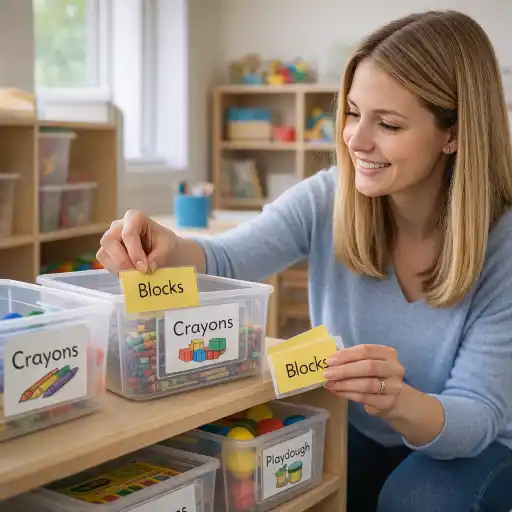
Portable labels work best when they are durable, easy to move, and connected to a clearly identified “home” for each item or kit. Choose a consistent format that children can recognize at a glance: a photograph or simple image, paired with a short word or phrase. When possible, use photographs of your own materials; children can match a familiar basket or tool more readily than an abstract symbol.
Consider two parts to the system: a label that travels with the material and a location card that identifies where it belongs when not in use. For example, a portable tray of animal figures might carry its own picture-and-word label, while a matching location card is displayed on the shelf where the tray is stored. If the tray is temporarily used elsewhere, the location card can indicate where it should return.
- Use hook-and-loop dots, removable sleeves, or clip-on tags that can be repositioned safely.
- Keep labels at children’s eye level and make images large and uncluttered.
- Use brief, consistent wording, such as “animal figures” or “painting tools.”
- Choose wipeable, sturdy materials for frequently handled cards.
- Use the same image and wording wherever the same item appears.
For more ideas on maintaining accurate picture labels, see ChildCareEd’s guidance on helping preschoolers understand what belongs in the classroom. An adaptable system reduces label-making work while keeping the room legible to children.
How can labels stay accurate when materials move?
Start by identifying which materials genuinely travel between centers and why. Some items are designed to be shared—such as clipboards, loose parts, or a thematic prop kit—while others are safer and easier to manage when they have a stable home. A quick inventory helps distinguish routine movement from materials that have simply become displaced.
For mobile materials, make their destination visible. A location card can be placed on the shelf, in a pocket chart, or beside a center sign. When a kit moves, staff can move its card as well, or use a simple “in use at” marker. Avoid complicated tracking systems: children and adults need to understand the cue quickly.
- Choose a small set of frequently moved materials to pilot.
- Photograph the contents and create a matching label for each container.
- Decide where each item belongs when it is not in use.
- Place a location card at the home shelf and teach children how to match it.
- At cleanup, return both the material and any movable cue to the agreed location.
- Review the arrangement after a few days and revise what is confusing.
A short reset check at the end of center time can catch mismatches before they become routine. The ChildCareEd article on using photos to support classroom routines emphasizes that visuals are most helpful when adults model and practice them, rather than simply posting them. Keep the system flexible enough to reflect genuine changes in play.
How should teachers teach children to use portable labels?
Portable labels do not teach themselves. Introduce them during a calm moment, model the process, and let children practice with a few familiar materials. Use simple, concrete language: “The blocks are visiting the rug. When we finish, we check the picture and bring them back to this shelf.” That explanation makes movement part of the routine instead of an exception children must guess about.
Invite children to participate in moving the materials and matching the cards. They might carry a location card to the new center, compare the image with the basket contents, or help check whether pieces are complete. Specific feedback reinforces the thinking involved: “You looked at the card and found the basket’s home.”
- Model how to remove and reattach a label or card without damaging materials.
- Practice returning one item at a time before expecting a full-center cleanup.
- Use photographs, words, or home-language labels that make sense to the group.
- Offer extra processing time or a simpler visual cue when a child needs it.
- Keep adult support available; independence develops through supported practice.
Some children may benefit from a portable card ring or a first-then cue, while others may use shelf labels independently. Observe how children respond and adjust the visual format instead of assuming that one design fits everyone. Head Start’s resource on designing learning environments likewise highlights accessibility, visual supports, and meaningful materials as considerations in an engaging space.
What common label problems can providers prevent?
One common pitfall is leaving a label in place after its contents have changed. Another is creating a different image or naming system for the same material in each center. Both make matching harder. Keep a small master list of images and words, and update it whenever a center’s materials are reorganized or rotated.
A second issue is over-labeling. If every small component has a separate card, the room can become visually busy and the system difficult to maintain. Focus first on high-use containers, shared kits, and items that are often misplaced. A few accurate labels are more useful than a comprehensive set that staff cannot keep current.
- Mismatch: Check that the label reflects current contents, not an old setup.
- Too much text: Use a short name and a clear image; add another language when useful.
- Unclear destination: Make the storage home obvious with a matching location card.
- Labels that fall off: Test fasteners and choose durable, safe materials.
- Expecting instant independence: Model, practice, and revisit the routine as needed.
Directors can support consistency by agreeing on a shared label format and a quick review routine across classrooms. Pay attention to access, supervision, and safe pathways when moving shelving or materials. State requirements vary—check your state licensing agency before making changes that affect room layout, exits, equipment, or access.
Conclusion: How can providers keep labels useful as centers change?
Classroom labels remain useful when they reflect the room children encounter—not a former arrangement. Pair clear picture-and-word labels with portable location cards, identify a dependable home for mobile materials, and keep cues consistent as kits travel between centers. These small design decisions support #independence, smoother cleanup, and more confident participation.
Begin with one frequently moved kit. Show children how its label connects to its storage location, practice returning it together, and observe what works. Revise cues that cause hesitation, and invite colleagues to use the same approach. A responsive system does not prevent materials from moving; it helps children and adults navigate those changes together.
- 🧩 Keep images, names, and storage locations consistent.
- Teach children to consult and move the cues as part of cleanup.
- Review labels when materials rotate, centers shift, or children’s needs change.
For a broader professional learning experience on arranging centers and creating inclusive, engaging spaces, explore Creating Environments that Nurture Growth and Community Buy Now $55.00. Additional learning related to center planning and daily flow is available through Spicing Up the Classroom: Learning Centers Buy Now $16.00, CDA: Curriculum Alignment & Materials Buy Now $16.00, and Every Moment Matters: Schedules and Transitions Buy Now $55.00.
- Bienvenido! Welcoming All Families
- 45 Hour School Age Methods and Materials
- 24 Hour Texas Pre-Service
- Art from the Heart for Preschoolers: Open Ended Art Projects that Build Self-Esteem
- 45-Hour Infant and Toddler Curriculum
- Classroom Tools for Emergent Literacy
- Classroom Tools for Emergent Literacy
- Staying Positive: Guidance for Preschoolers
- CDA: Curriculum Alignment & Materials
- Moving About the Classroom: Effective Transitions for Everyday
- Recursos en Español sobre el Sueño Seguro del Bebé
- 10 Ejemplos de Cómo la Cultura Influye en el Desarrollo Infantil
- Proporciones de Cuidado Infantil y Tamaños de Grupo por Edad en Maryland (Guía Rápida para Centros y Hogares)
- Proporciones de Cuidado Infantil y Tamaños de Grupo por Edad en Nueva Jersey (Guía Rápida para Centros y Hogares)
- Retraso del Habla en la Guardería: Cómo Pueden Ayudar los Proveedores
- Canciones, juegos y preguntas de círculo para niños
- Cómo simplificar la capacitación para sus empleados de daycare
- Why Is My Preschool Classroom So Chaotic? 7 Classroom Management Fixes to Try
- Which Low-Cost Printables Make the Biggest Classroom Impact?
- How Can Classroom Environment and Arrangement Support Young Children’s Learning?
- How Can Child Care Providers Create Effective Learning Centers in Small Spaces?
- What Printables Should Every Preschool Classroom Have on Hand?
- Why Are Reusable Printables a Smart Investment for Child Care Providers?
- Which Printable Activities Belong in Every Preschool Classroom?
- When Do Too Many Materials Make a Learning Center Harder to Use?
- How Can Classroom Labels Stay Useful When Materials Move Between Centers?
- Does an Empty Classroom Space Need to Stay Empty?
- How Do You Set Up a Developmentally Appropriate Preschool Classroom?
- How Can Classroom Labels Help Children Understand Print?
- ¿Faltan Materiales o Falta una Nueva Estrategia? Cómo Revisar los Rincones del Aula
