A pumpkin rolling off a ramp is not a failed activity—it may be the moment a child begins to plan, test, and try again. Strengthen your ability to notice and document these meaningful learning moments with ChildCareEd’s Preschool Assessments & Observations  Buy Now $24.00 course, which explores objective observation and developmentally appropriate assessment. Read on for practical ways to set up a fall ramp challenge, recognize persistence, and turn what you see into responsive teaching.
Why is persistence worth observing during ramp play?
When children build a pumpkin ramp, their attention may move between choosing materials, adjusting the slope, stabilizing the structure, and figuring out why the pumpkin veers off course. Each attempt offers a glimpse of how a child approaches a challenge. Persistence is not simply staying at an activity for a long time; it can appear in small, purposeful actions, such as returning after a brief pause, making a design change, asking a peer for an idea, or testing the same ramp again.
These moments matter because they show how children engage with problems, use feedback, and direct their own learning. Ramp exploration also brings together science, engineering, early mathematics, language, and social interaction. Children may compare slopes, notice that a round pumpkin rolls, or negotiate how to keep it on the track. A broad overview of ramps and movement from PEEP’s Ramps curriculum describes children observing, predicting, comparing, measuring, and discussing how objects move.
For providers and directors, watching closely helps distinguish persistence from a need for support. A child may be deeply engaged, or may be stuck and ready for a small scaffold. Documenting the process—not just the finished ramp—helps your team plan an invitation that builds on each child’s strengths and interests.
How can you set up a pumpkin ramp challenge that invites repeated attempts?
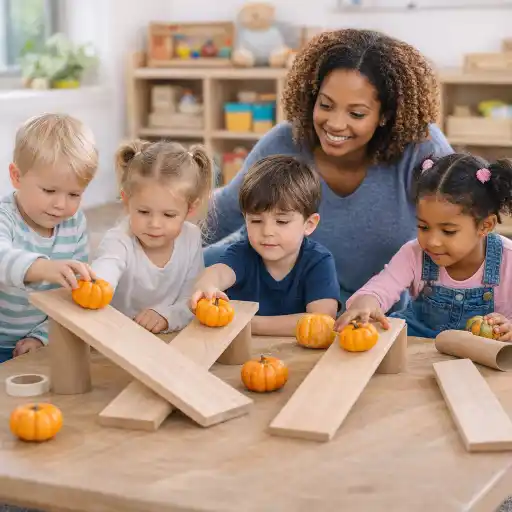
Keep the invitation simple and open-ended. Provide small pumpkins or other appropriately sized rolling objects, stable cardboard or gutter-style ramps, and blocks or boxes to adjust the height. Offer a clear prompt: “Can you build a path that helps the pumpkin reach the basket?” Children can begin with a pre-set ramp and later redesign it themselves. A rolling-pumpkin activity from Little Bins for Little Hands suggests varying the ramp’s height and noticing how the pumpkin moves.
Make room for children’s own goals. One child may want the pumpkin to travel farther; another may focus on keeping it on the track; a small group may build a winding route. Avoid showing one “correct” design. Give children uninterrupted time to explore and revisit the materials, while remaining close enough to supervise and offer support when needed.
- Use a stable base and secure the ramp so it cannot slide or tip.
- Offer a small set of materials first; add options when children’s questions call for them.
- Invite predictions without requiring a single expected answer: “What do you think will happen?”
- Keep the setup accessible with different roles—builder, tester, observer, or materials helper.
- 🍂 Treat an unexpected roll or a collapsed structure as useful information for the next attempt.
Children’s building, testing, and revising are central to Ramps and Pathways, an approach that values both successful designs and learning from mistakes.
What does persistence look like as children design and test ramps?
Persistence is easier to recognize when you look for observable actions rather than an adult’s impression that a child is “trying hard.” Watch for specific evidence: a child repeats a test, changes the ramp’s height, braces a wobbly support, retrieves the pumpkin and starts again, or studies a peer’s solution before adapting it. A child may also pause to think, watch quietly, or communicate through gestures before re-entering the task. These can be meaningful parts of problem-solving, not signs of disengagement.
Notice how children respond to results. Does the child change one part of the design, try a different material, or ask a question? Do they invite a friend to help, explain a plan, or show frustration and then return? The aim is not to rank children by stamina or compare them with one another. Rather, observe how each child approaches a challenge in that moment and what conditions support participation.
Use open prompts that keep the child in charge: “What do you notice?” “What could you change?” or “What might you try next?” Resist the understandable urge to fix the ramp immediately. Guidance on early STEM with ramps from Community Playthings emphasizes giving children time to figure out problems and avoiding solving those problems for them.
Remember that engagement is individual and context-dependent. Some children may persist through repeated physical tests; others may plan, observe, collaborate, or communicate their ideas. Recognizing varied approaches helps make #persistence visible without narrowing it to one behavior.
How can you document children’s efforts objectively?
Objective documentation captures what you saw and heard, not a judgment about a child’s character or motivation. Record the date, context, materials, the child’s actions, and exact words when possible. For example: “During ramp play, Amara placed two blocks beneath the cardboard, released the pumpkin, watched it roll off the left edge, then added a side barrier and tested again.” This note gives a clearer account than “Amara was determined.”
Choose a manageable method. A brief anecdotal note can capture a key moment; a photograph with a factual caption can show changes in the structure; a child’s drawing or dictated explanation can preserve their perspective. If you take photos or recordings, follow your program’s consent, privacy, and storage procedures. Do not let documentation interfere with active supervision.
- Write observable verbs: placed, released, watched, adjusted, tested, asked, or described.
- Include relevant context, such as a peer’s suggestion or an adult prompt.
- Capture strengths and strategies, not only difficulty or the final outcome.
- Record more than one moment before drawing conclusions about a skill.
NAEYC describes observation, documentation, and assessment as ongoing and purposeful processes that should be responsive to children’s development, cultures, and languages. Its guidance on observing, documenting, and assessing children’s development and learning also stresses using information to inform curriculum and interactions. For a practical overview of assessment through everyday activities, see ChildCareEd’s guidance on assessing through observation.
How can observations guide inclusive teaching and next steps?
After the activity, review the evidence and ask what the child may be exploring. Is the child investigating speed, slope, balance, distance, or how to keep an object on the track? What materials or social supports seemed to help? These questions turn observation into a useful planning decision rather than a label.
For instance, if a child repeatedly adjusts a ramp but the pumpkin still rolls off, you might add wider cardboard, a shallow channel, or a few blocks that can serve as side rails. If a child watches peers before joining, provide time to observe and offer a role such as choosing the starting point or placing a marker. If a child communicates mainly through gesture or home language, accept those forms of expression and invite family insight when useful. An accessible ramp investigation can offer multiple ways to participate and show understanding.
Use a simple cycle: observe, document, reflect, plan, and observe again. Set one realistic next step—perhaps offering a new material, leaving the ramp available for later play, or asking a question that extends the child’s idea. Share a specific example with families, such as, “Today, Jordan tested two ramp heights and added a barrier after noticing the pumpkin rolled off.” State requirements vary - check your state licensing agency.
Teams seeking a fuller foundation in assessment, objective observation, and individualized planning may explore ChildCareEd’s Tracking Progress, Shaping Futures: Observation & Assessment Skills Buy Now $55.00 or Observations and Goal Setting in Childcare Buy Now $24.00. These courses complement the focused preschool learning offered in the introduction.
What common pitfalls should educators avoid?
Even a playful investigation can lose meaning if adults focus only on the finished product or rush to rescue children from every difficulty. A pumpkin that rolls off the ramp is not proof that the activity failed, and a child who changes the design repeatedly is not necessarily “off task.” Look at the child’s actions and the context before interpreting what happened.
- Labeling instead of observing: Replace “gave up” with a factual note about what the child did and said.
- Fixing the design too quickly: Offer a question or a small material adjustment, then let the child decide what to try.
- Expecting every child to participate in the same way: Welcome watching, planning, communicating, testing, and collaborative roles.
- Recording only the result: Document the process, including revisions, peer ideas, and moments of reflection.
- Leaving access or safety to chance: Select age-appropriate materials, stabilize ramps, and maintain active supervision.
Keep the experience low-pressure. Children do not need to use formal science terms or produce a successful ramp to demonstrate learning. A thoughtful question, a revised support, or a return to the challenge later can all reveal emerging strategies. Your role is to notice those moments and respond with respect and curiosity.
Conclusion: How can you make persistence visible in pumpkin ramp play?
To observe persistence while children build pumpkin ramps, focus on the process: what they try, what they notice, how they respond to a result, and what support helps them continue. Offer an open-ended, safe setup; give children time; document factual actions and words; then use the evidence to plan meaningful next steps. Persistence may look like redesigning a track, watching before joining, seeking a peer’s idea, or returning after a pause.
Most of all, treat children as capable investigators. When educators honor the many ways young learners explore and revise their ideas, a seasonal ramp challenge becomes an opportunity to make their thinking visible and strengthen responsive practice.
Related ChildCareEd courses for further learning:
- CDA Certification en Español: Recursos y Consejos para Educadores Bilingües
- 🔍 ¿Qué ves cuando observas a un niño aprender?
- 💛🧩 ¿Cómo puedo hacer que mi enseñanza sea inclusiva para los niños con autismo?
- 👶 ¿Cuáles son las proporciones y grupos requeridos en Dakota del Norte? 🏫
- Curso de Comunicación de 9 Horas de Maryland
- 10 Ejemplos de Cómo la Cultura Influye en el Desarrollo Infantil
- Proporciones de Cuidado Infantil y Tamaños de Grupo por Edad en Maryland (Guía Rápida para Centros y Hogares)
- Proporciones de Cuidado Infantil y Tamaños de Grupo por Edad en Nueva Jersey (Guía Rápida para Centros y Hogares)
- Proporciones de Cuidado Infantil y Tamaños de Grupo por Edad en Virginia (Guía Rápida para Centros y Hogares)
- Actividades de Otoño Fáciles para Preescolares esta Temporada
- Apoyo en Preescolar para Retrasos del Habla: Estrategias Simples que Ayudan
- Cómo Trabajar en el Cuidado Infantil en Carolina del Norte: Requisitos y Pasos
- Calabazas, hojas y manzanas: actividades de otoño para preescolares
- Celebrando la amistad en el cuidado infantil durante el Día de los Mejores Amigos
- Canciones, juegos y preguntas de círculo para niños
- Cómo simplificar la capacitación para sus empleados de daycare
- Fall Detectives: 10 Questions Pre-K Kids Can Investigate This Season
- Fall Challenge Accepted! Hands-On Learning Games for Pre-K
- Why Do Children Repeat the Same Play—and Why Should Educators Let Them?
- How Can You Observe Persistence While Children Build Pumpkin Ramps?
