When children become the sound detectives, a quick guessing game can turn early literacy into lively, meaningful play. Use Task Cards – Beginning Sounds Buy Now $2.49 as picture prompts, inviting children to choose a card, offer a beginning-sound clue, and take turns guiding their peers’ guesses. Explore Language and Literacy Foundations in Pre-K  Buy Now $16.00 to build practical strategies for strengthening listening, speaking, and early literacy through everyday classroom experiences. Read on for ways to give children meaningful choices while you observe, encourage participation, and extend their thinking.
Why let children lead a beginning-sound game?
Beginning-sound guessing invites children to listen closely to words, notice how they start, and use language to share an idea. When children take turns choosing a secret object or giving a sound clue, they are not simply responding to a teacher’s prompt: they are making decisions, communicating with peers, and shaping the direction of play. That agency can strengthen engagement and confidence, especially for children who are more comfortable participating through gestures, object choices, or short phrases.
The skill itself is one element of phonological awareness: attending to the sound structure of spoken language. It is related to phonics, but it does not require children to identify letters. A child may hear that “moon” and “milk” begin alike before knowing which printed letter represents that sound. Keep the initial goal oral and playful; letter connections can come later when they support the children’s learning.
Letting children lead also gives educators useful information. You can notice which words children know, whether they attend to the first sound, and what kinds of clues or supports help them participate. Treat responses as evidence for planning, not as a judgment of ability.
- Children practice careful listening and comparing spoken words.
- They use vocabulary, turn-taking, and explanation in an authentic context.
- Educators see where to add modeling, a visual cue, or a new challenge.
How do you set up the game so children can take charge?
Choose a familiar, concrete setting: a basket of classroom objects, a pretend grocery store, or a small group of picture cards. Begin with a manageable set of words that children can name. If you use objects, select safe, appropriately sized materials and avoid items that could pose a choking risk. Before play, introduce the words naturally so the task is about listening—not guessing what an unfamiliar picture represents.
Model one round with a sound that can be sustained, such as /m/ or /s/. Say, “I’m thinking of something that starts with /m/. What could it be?” Once children understand the routine, invite a child to choose the object and offer the clue. They can say the sound, describe the object, point to a sound card, or ask an adult to help phrase the clue.
- Place three to five familiar objects or pictures where everyone can see them.
- Name each one together and confirm that the words are understood.
- Demonstrate how to give a clue: “It starts with /b/.”
- Invite the child leader to choose a target and offer a clue.
- Give peers time to consider, answer, and explain their thinking.
For example, a child may choose a block and say, “It starts like book.” That clue compares two familiar words and makes the sound relationship meaningful. Keep the group small enough that each child has a chance to lead, and let children pass or participate in another way when they prefer.
What prompts help children listen, reason, and explain?
Good prompts make the sound noticeable without taking over the game. Say the whole word clearly, then briefly emphasize its beginning sound: “/b/—ball.” Avoid adding a vowel after a consonant (for example, saying “buh” for /b/), because this can make the sound harder to isolate. Continuous sounds such as /m/, /s/, and /f/ are often easier to stretch than brief stop sounds such as /b/ or /t/.
Use open invitations that encourage children to compare and explain. Questions such as “What do you hear first in ‘sun’?” and “What else starts the way ‘sock’ does?” leave room for children to generate ideas. The NAEYC guidance on open-ended questions also emphasizes wait time and listening to children’s responses. Pause several seconds before repeating a prompt; children may need time to process the words, search the objects, and formulate a response.
- “Which two words sound alike at the beginning?”
- “How did you decide that this one belongs?”
- “Can you think of another classroom object that starts that way?”
- “Would you like to say the clue, point, or choose a picture?”
When a guess is off target, keep the tone curious: “Let’s say both words together. What do you notice?” Model the sound and invite another try without making the child perform for approval. Specific encouragement—“You listened to the first part of the word”—recognizes the thinking process, not just a correct answer.
How can the game welcome different languages and communication styles?
Children bring varied language experiences, speech patterns, and ways of communicating. A beginning sound may be familiar in one language but less familiar in another, and letter-sound relationships do not match perfectly across languages. Treat home-language knowledge as a resource: invite families to share words, songs, or objects that children recognize, and allow a child to offer a clue in the language that feels comfortable. When appropriate, compare how the words begin in each language without presenting one language or accent as more correct.
Offer more than one way to participate. A child might point to an object, place it beside a matching picture, gesture, use an augmentative and alternative communication system, or tell a peer the clue privately. A child who is still developing spoken language can lead by selecting the secret item while an adult helps voice the clue. These options preserve the game’s purpose—attending to sounds—while reducing unnecessary barriers.
Adapt the challenge to what children show you. Start with two contrasting choices and a familiar sound; increase the number of objects or ask children to generate examples when they are ready. Some words are easier to hear than others, and children may pronounce sounds differently. Do not mistake a language difference or speech variation for a lack of understanding. If concerns persist, document observations and follow your program’s process for collaborating with families and relevant specialists.
- Use familiar objects and ask families about meaningful vocabulary.
- Accept pointing, matching, gesture, and other communication methods.
- Allow generous wait time, repetition, and a smaller choice set as needed.
- Celebrate ideas and effort without requiring every child to speak aloud.
How can you extend the game without turning it into a drill?
Keep the central routine familiar, but let children change the theme, materials, and roles. The same guessing game can happen during block play, at snack, outdoors, or after a story. Everyday settings make sound play feel relevant and allow children to encounter target words repeatedly in context. This reflects the playful, embedded approach to early literacy described by NAEYC’s discussion of literacy-rich preschool environments.
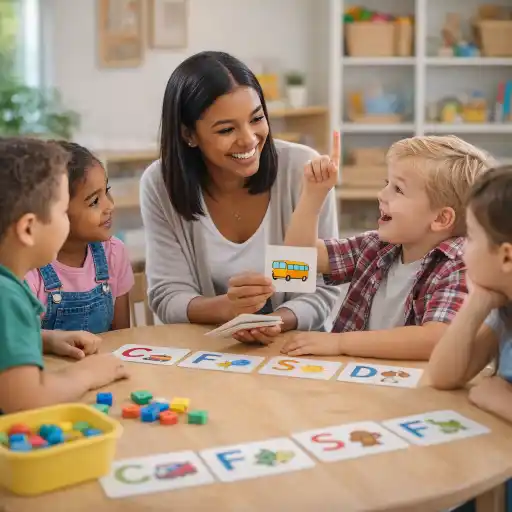
Children can lead a sound hunt by choosing a target and searching for objects that match it, or create a class collection of drawings and dictated words. Use a brief song or movement cue to keep transitions lively. You might also connect the game to an interactive read-aloud by inviting children to listen for a repeated sound in a character’s name or in objects shown in the illustrations.
- 🎵 Sing a short “What starts with /s/?” refrain as children search the room.
- Invite a child to select two objects and ask peers which begin alike.
- Make a shared book of children’s sound clues, drawings, and dictated words.
- Use familiar names, story characters, or dramatic-play props as clues.
- Revisit the same sound later in the week with different materials.
Short rounds—often just a few minutes—can be enough. If children begin to lose interest, change the role, simplify the choices, or return to play. Repetition is valuable when it brings a fresh opportunity to listen, rather than requiring children to repeat a worksheet or a fixed sequence of answers.
How can educators observe progress and respond to common pitfalls?
Observe what children do during ordinary play. Note whether a child can name the object, attend to its initial sound, compare it with another word, generate a clue, or benefit from a model or a smaller set of choices. Write brief, descriptive notes: “Chose ‘moon’ for /m/ after hearing the word twice,” for example. Revisit the activity over time before drawing conclusions from a single response.
Common pitfalls are manageable. Too many objects can make the game visually and verbally demanding, while unfamiliar vocabulary can obscure the sound-awareness goal. Overcorrecting pronunciation may discourage participation; instead, model the word clearly and invite another listen. Also avoid making speed or winning the focus. The aim is thoughtful sound play and communication, not a competition.
- Start with a few familiar items and one clear sound contrast.
- Check that children know the object names before interpreting responses.
- Model without harsh correction; acknowledge effort and offer another try.
- Adapt the response mode and level of support to the individual child.
Use observations to plan the next step: offer a fresh set of objects, model a sound again, or invite a child to lead with less support. Share what you notice with families in strengths-based language. If you are connecting this activity to required professional learning, state requirements vary - check your state licensing agency.
Conclusion: How can children lead a beginning-sound guessing game?
Children can lead by choosing a familiar target, offering a beginning-sound clue, and inviting peers to listen, compare, and explain. Providers make the experience successful through clear modeling, manageable materials, open prompts, generous wait time, and flexible ways to participate. The game is most powerful when it remains joyful and responsive—not a test of speed or perfect pronunciation.
Watch how children use words and clues, then adjust the next round to build on their interests and emerging skills. For broader professional learning about phonological awareness and related early literacy foundations, explore Science of Reading Foundations in the Pre-K Classroom Buy Now $16.00. This course covers phonological awareness alongside vocabulary, alphabet knowledge, emergent writing, read-alouds, and storytelling.
Explore five related ChildCareEd courses
- Moving About the Classroom: Effective Transitions for Everyday
- Creating the Natural Outdoor Classroom
- CDA Home Visitor Subject Area 3 Part 3 Birth to 5
- CDA Home Visitor Subject Area 2 Part 3 Birth to 5
- Safe and Sound: Creating Healthy Environments for Every Child
- Emergent Learning & Development
- Creating Environments that Nurture Growth and Community
- Texas Director Credential
- The Right Kind of Influence for Young Children
- 💛🧩 ¿Cómo puedo hacer que mi enseñanza sea inclusiva para los niños con autismo?
- Proporciones de Cuidado Infantil y Tamaños de Grupo por Edad en Nueva Jersey (Guía Rápida para Centros y Hogares)
- Proporciones de Cuidado Infantil y Tamaños de Grupo por Edad en Virginia (Guía Rápida para Centros y Hogares)
- Cómo Trabajar en el Cuidado Infantil en Carolina del Norte: Requisitos y Pasos
- Celebrando la amistad en el cuidado infantil durante el Día de los Mejores Amigos
- Canciones, juegos y preguntas de círculo para niños
- Can You Guess the Feeling? Emotion Games for Pre-K Kids
- How Can Sound Bingo Sharpen Listening Skills in Preschoolers?
- Why Are Self-Checking Clip Cards Great for Independent Practice?
- Why Is Beginning-Sound Bingo a Smart Step Toward Reading?
- How Can Bingo Games Make Learning Feel Like Play?
- How Can Seasonal Picture Sorting Build Phonemic Awareness in Early Childhood?
- What Should Effective Beginning-Sound Practice Include?
- How Can Providers Connect Letter Formation, Sound, and Vocabulary in Phonics Instruction?
- How Can Animal Words Strengthen CVC Decoding?
- How Can Picture Task Cards Help You Assess Beginning Sounds?
- Is a Beginning Reader Decoding or Guessing from Pictures?
- Is a Beginning Reader Decoding or Guessing from Pictures?
- How Can You Let Children Lead a Beginning-Sound Guessing Game?
- How Can You Choose CVC Word Activities That Match a Beginning Reader’s Skill Level?
