Want a simple, respectful way to help young children notice the contributions of women while strengthening your classroom practice? Introducing stories, play invitations, and low-prep STEM prompts builds empathy, vocabulary, and confidence in your learners—and it can be done in short, repeated moments during the day. If you’d like ready-to-use strategies and CEU-friendly guidance, start with ChildCareEd’s Montessori Cultural Activities: Exploring the World Through Play and Learning  Buy Now $24.00 to add culturally rich materials and routines, and pair it with Building Early Science Foundations Buy Now $16.00 to highlight women in STEM. These courses help you deepen practice, earn training hours, and expand your activity ideas without adding heavy prep.
Why does this matter for my classroom?
Young children form ideas about who can be a leader, helper, scientist, or artist before they enter formal school. Introducing stories and play about real women and diverse roles helps break narrow stereotypes early. When you intentionally include images, books, and play props that show women at work and in leadership, you support equitable identity development and stronger language growth. Practical wins include better social-emotional skills, richer vocabulary, and increased curiosity. If you use a Montessori approach, this overview of whether Montessori can be inclusive for every child explores ways to embrace diversity and support individual learning needs.
Quick note: state requirements vary - check your state licensing agency.
Use simple goals: teach #preschoolers that #women do many jobs, show women in #STEM through play, use #books that reflect diversity, and center #inclusion in conversations.
How can I pick age-appropriate stories and materials?
Choose books and images with clear, simple narratives and strong visuals. For preschoolers, biographies should be short, picture-focused, and emphasize an action or value (e.g., “She solved problems” or “She helped her community”). Use board books, picture-book biographies, and simple STEM role-model stories. Good sources include picture-book bios of Amelia Earhart, Harriet Tubman, and contemporary role models; curated lists like the ChildCareEd article Women’s History Month in Childcare offer classroom-ready suggestions.
- Look for diversity in race, culture, ability, and family types.
- Prefer action-focused stories: what she did, not long historical detail.
- Keep reading short (2–5 minutes) and repeat the same book across days.
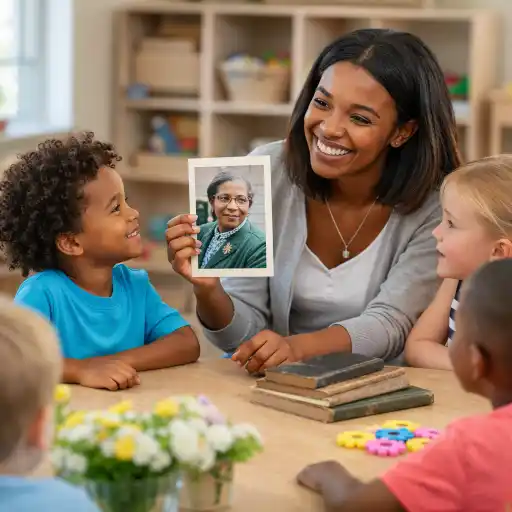
Practical classroom step: create a small display titled “Women Who Help” with 4–6 images and one sentence per image that children can point to during circle time.
What play invitations and activities work best for preschoolers?
Play is the primary vehicle for learning at this age. Design open-ended invitations that let children explore roles and tools while you weave in language about women’s work.
- 🎨 Dramatic play: add props (hard hats, lab coats, chef hats) and picture cards of women in each role so children can pretend and name the job.
- 🔬 STEM prompt: a simple building challenge—"Can you build a bridge like an engineer?"—and place a photo of a woman engineer as inspiration.
- 📚 Book-based provocation: after a short biography, offer a related art or block challenge tied to the story’s theme.
Keep materials accessible. Rotate one new figure or story each week so the classroom feels fresh and manageable. Use visual labels and single-sentence captions so children can connect images with words.
How do I include families and culture without making assumptions?
Family partnerships enrich learning and make representation authentic. Invite families to share photos and short stories (with permission) about women who matter to their children—grandmothers, aunts, neighbors, coaches, or community helpers. Provide options for sharing (photo, recorded message, or a sentence) and translate requests where needed. Use the language “someone who cares for you” or “someone who helps in your family” to be inclusive of diverse family structures.
- Send home a brief prompt: “Tell us about a woman your child looks up to—photo or sentence is fine.”
- Display family contributions in a respectful, rotating gallery.
- Offer take-home activity ideas families can do together.
For staff training in family engagement and cultural responsiveness, consider ChildCareEd’s Bienvenido! Welcoming All Families Buy Now $16.00 or the Montessori cultural activities course linked above to strengthen outreach and communication practices.
How can I avoid common mistakes and assess impact?
Common mistakes include: using tokenistic images without context, presenting overly complex history, and assuming every family celebrates the same way. Avoid these by keeping content simple, respectful, and permission-based. Focus on one clear message per activity (e.g., women can be scientists) and avoid comparisons like "girls are better than boys."
Quick assessment strategies:
- Observe play: do children name roles, imitate actions, or choose diverse props?
- Listen for language: are children using words like "inventor," "leader," or "helps"?
- Collect child work: simple drawings with a child’s comment or a teacher note showing understanding.
Small data points guide planning—if few children engage, try a new provocation or shorter circle time read-aloud. For professional growth, note that courses like the CDA: Curriculum Alignment & Materials Buy Now $16.00 and the CDA Bridge Bundle: Preschool Buy Now $300.00$249.00 can support stronger lesson design and meet training hour needs.
Conclusion: What should I take away?
Introduce inspiring women to preschoolers through short, repeated moments: picture-book biographies, targeted play invitations, and family connections. Keep activities concrete, visual, and culturally respectful. Small, daily efforts—one short story, one prop rotation, one family photo—build children’s understanding that #women can be leaders, helpers, and innovators. When you pair classroom practice with a focused course (see Montessori Cultural Activities Buy Now $24.00 and Building Early Science Foundations Buy Now $16.00), you’ll gain practical tools, activity ideas, and training hours to support stronger, more inclusive programming.
Next step: try a one-week mini-project—pick one woman, read a short book each day, set a related play invitation, and invite families to contribute a photo. Small habits create big change for children’s ideas about who belongs in every role.
FAQ
- Q: How long should each activity be? A: 2–10 minutes for circle time reads and short provocations; longer for child-led play.
- Q: What if families don’t want to participate? A: Make family contributions optional and provide classroom-centered alternatives like community guest photos.
- Q: Can I cover sensitive historical topics? A: Keep details age-appropriate; focus on the person’s action and values rather than violence or trauma.
- Q: How do I find diverse books? A: Use curated lists from trusted sites and preview books for age-appropriateness before reading. Scholastic and ChildCareEd lists are good starting points.
- Q: Will this help with professional development requirements? A: Yes—courses mentioned above can provide CEUs and clock hours; check course listings and state licensing rules.
- 45 Hour Child Growth and Development
- CDA Home Visitor Subject Area 3 Part 3 Birth to 5
- 45 Hour Preschool Methods and Materials
- Setting the Stage: Story Time
- Pediatric RSV First Aid & CPR/AED
- CDA Bridge Bundle: Preschool without Portfolio Review
- 45-Hour Preschool Curriculum
- Creating Environments that Nurture Growth and Community
- Texas Director Credential
- CDA Certification en Español: Recursos y Consejos para Educadores Bilingües
- 👶 ¿Cuáles son las proporciones y grupos requeridos en Dakota del Norte? 🏫
- Recursos en Español sobre el Sueño Seguro del Bebé
- Curso de Comunicación de 9 Horas de Maryland
- 10 Ejemplos de Cómo la Cultura Influye en el Desarrollo Infantil
- Capacitación en Salud y Seguridad Preventiva en Línea para Proveedores de Cuidado Infantil
- Cómo Empezar una Guardería en Casa: Requisitos y Pasos
- Proporciones de Cuidado Infantil y Tamaños de Grupo por Edad en Maryland (Guía Rápida para Centros y Hogares)
- Proporciones de Cuidado Infantil y Tamaños de Grupo por Edad en Nueva Jersey (Guía Rápida para Centros y Hogares)
- Proporciones de Cuidado Infantil y Tamaños de Grupo por Edad en Virginia (Guía Rápida para Centros y Hogares)
- Lista para Guardería en Casa en Illinois: Cómo Iniciar una Guardería en el Hogar
- Lista para Guardería en Casa en Texas: Cómo Iniciar una Guardería en el Hogar
- Cómo Trabajar en el Cuidado Infantil en Carolina del Norte: Requisitos y Pasos
- Cómo Ser Maestra de Preescolar en Virginia
- Calabazas, hojas y manzanas: actividades de otoño para preescolares
- Celebrando la amistad en el cuidado infantil durante el Día de los Mejores Amigos
- Canciones, juegos y preguntas de círculo para niños
- Cómo simplificar la capacitación para sus empleados de daycare
- How can I introduce inspiring women to preschoolers?
- ¿Qué habilidades preceden al recorte y cuándo deben aprender los niños a usar tijeras?
