Every day in your program gives small clues about how each child is growing. This article helps Texas child care providers and directors use short, real moments — snack, block play, pick-up time — to learn about each child. Use simple steps so observation fits your day and helps you plan. Remember: state requirements vary - check your state licensing agency.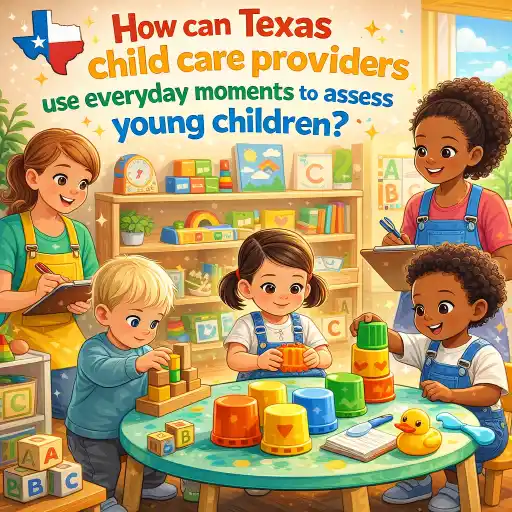
Why does this matter for your #Texas program?
1) Everyday moments show what a child can already do. 2) They help you spot what the child needs next. 3) They build trust with families when you share clear examples. Watching with purpose turns tiny events into useful #assessment and better teaching.
Want tools? ChildCareEd has several helpful guides, like How can observation guide daily activities and the resource page, Observing and Recording Children’s Development Buy Now $0.00, to get you started.
What can everyday moments tell us about a child?
- Social play: Does the child share or wait for their turn?
- Language: Does the child use words or point to ask?
- Cognitive: Can the child solve a small problem like fitting shapes?
- Motor: Can the child use a fork, run, or write a mark?
- Emotional: How does the child handle frustration?
How to watch in one quick step:
- 🔎 Pick one focus (for example: saying new words).
- 🕒 Watch for 5–10 minutes during a routine (snack, centers).
- ✍️ Write one short note: who, what, when, where, and the child’s exact action or quote.
For examples and short forms, see ChildCareEd’s post What Do You See When You Watch a Child Learn? and training like Tracking Progress, Shaping Futures.
How can Texas providers collect quick, fair observations during routines?
- 📝 Anecdotal note: One sentence with date, setting, and exact actions.
- ⏱ Time sampling: Check if a behavior happens during set times.
- 🎯 Event sampling: Write down every time a specific event occurs.
- 🧩 Work samples or a photo (with permission) saved in the child file.
Common mistakes and how to avoid them:
- ❗ Writing opinions (avoid): Record facts, not feelings. Write "stacked 6 blocks," not "good at blocks."
- ❗ Watching only hard moments (avoid): Watch play and routines to see strengths.
- ❗ Using only one tool (avoid): Mix notes, photos, and checklists.
Practice with your team: watch the same short moment and compare notes. ChildCareEd explains calibration steps in How do we observe with purpose.
How do we turn quick notes into simple goals and share them with families?
Turn what you see into 1–3 small, clear steps. A helpful routine:
- 📑 Summarize the observation in one short paragraph with date and setting.
- 🎯 Make 1–3 measurable goals tied to routines (example: "Will use a fork for 3 bites with teacher help during lunch 3 times this week").
- 🛠 List 2–3 teacher supports that fit the day (modeling, cue cards, small group).
- 🔁 Re-observe in 2–4 weeks and update the plan.
Invite families into the plan. Start conversations with strengths, show one short note or photo, and ask, "What do you see at home?" For help on talking with families about development, see the CDC training Watch Me! Module 4 and ChildCareEd’s article How can we document child progress effectively?
What systems and training help Texas providers stay safe and compliant?
Systems that save time and meet Texas rules include clear files, short daily notes, and staff training. Try this simple system:
- 🗂 One child file for samples and notes.
- 📘 One classroom binder with quick checklists.
- 💻 One secure digital folder for photos (if center policy allows).
Texas rules and training: Know Texas Health and Human Services requirements and training hours. ChildCareEd explains Texas training and licensing details in Texas Child Care Training Requirements and licensing tips in Child Care Licensing in Texas. Also, review official HHSC pages like the HCSSA guidance (HCSSA Module 2).
Use screening tools when you are worried. ASQ Online is a common tool — learn more at ASQ Online Developmental Screening. If a child is not making progress, document supports and follow referral steps. Remember: state requirements vary - check your state licensing agency.
Conclusion
Everyday moments are powerful. Use short, factual notes, pick one small goal, and make supports part of routines. Keep one child file, invite #families into the plan, and get Texas-specific training so your team stays confident and compliant. ChildCareEd has many templates and courses to help you start today — see links above.
FAQ
- Q: How often should we observe? A: Short notes daily and one deeper observation each month works well.
- Q: Who should write observations? A: Staff who know the child best; add a second observer sometimes.
- Q: What if a family disagrees? A: Listen, share examples, and invite their observations to make a shared plan.
- Q: When should we refer? A: If progress is slow despite good support, document carefully and follow referral steps.
Use observation to celebrate progress and plan next steps. Your careful watching helps each #children grow and helps build stronger partnerships with #families through honest, simple #observation and clear #assessment.
Short, natural moments give clues about learning in these areas: Why it matters: Use short, fair methods so notes are useful and trusted by #families and colleagues. Try these easy tools:- 45 Hour Child Growth and Development
- Planning for Every Child: Responsive Strategies in Action
- Tracking Progress, Shaping Futures: Observation & Assessment Skills
- 45 Hour Infant and Toddler Methods and Materials
- 45 Hour School Age Methods and Materials
- Texas Director Credential Renewal
- Texas Director Credential
- Pediatric First Aid and CPR Training with ChildCareEd - Empower Yourself!!
- 🔍 ¿Qué ves cuando observas a un niño aprender?
- Capacitación en Salud y Seguridad Preventiva en Línea para Proveedores de Cuidado Infantil
- Cómo Solicitar una Licencia de Guardería en Texas
- Proporciones de Cuidado Infantil y Tamaños de Grupo por Edad en Maryland (Guía Rápida para Centros y Hogares)
- Proporciones de Cuidado Infantil y Tamaños de Grupo por Edad en Nueva Jersey (Guía Rápida para Centros y Hogares)
- Proporciones de Cuidado Infantil y Tamaños de Grupo por Edad en Virginia (Guía Rápida para Centros y Hogares)
- Lista para Guardería en Casa en Texas: Cómo Iniciar una Guardería en el Hogar
- How can Texas infant and toddler caregivers ensure safe sleep, support brain development, and use responsive routines?
- How can Texas child care providers use simple language and visual supports with children?
- How can Florida preschool staff assess children during everyday activities?
- How can Texas child care providers use everyday moments to assess young children?
- How can Texas child care programs support inclusion every day?
- How Can Child Care Centers Join Texas' Growing Pre-K Partnership Movement?
- Canciones, juegos y preguntas de círculo para niños
- Cómo simplificar la capacitación para sus empleados de daycare
- How Can Texas Providers Learn from San Antonio’s Infant-Toddler Expansion About Six-Week Learning?
- How can early childhood educators effectively teach digital citizenship to young children?
- What Does Compassion Look Like in Child Care? 10 Everyday Moments That Matter
- How Can Child Care Providers Assess Children Through Everyday Activities?
