When a preschooler says they “need” the toy they just spotted, they are offering a meaningful chance to practice language, emotional awareness, and decision-making. Explore practical, play-based ways to nurture that learning—and consider Social Foundations and Responsive Classrooms Buy Now $24.00 for strategies that support self-regulation, positive guidance, and thoughtful classroom conversations.
Why does this distinction matter in preschool?
For young children, a strong desire can feel urgent and real. A preschooler may sincerely believe a special snack or toy is something they “need.” That response is not a failure to understand; it reflects developing language, impulse control, and perspective-taking. Teachers can help children make sense of these feelings without dismissing them.
The lesson is broader than money. Children practice naming what matters, considering what keeps people healthy and safe, and accepting that resources may be limited. These discussions can also build empathy: families and people may meet needs in different ways, and a classroom conversation should never invite children to compare or disclose their family’s finances.
Keep the distinction simple and flexible. Needs are essentials for health, safety, and basic well-being—such as water, nourishing food, shelter, appropriate clothing, rest, care, and supportive relationships. Wants are things people enjoy or prefer but can live without. Context matters: a coat may be a need in cold weather, while a particular brand or decorative detail is a preference.
How can teachers explain wants and needs in child-friendly language?
Use short, concrete definitions and familiar examples. Rather than presenting a long list for children to memorize, connect the words to classroom routines and children’s observations. A plant needs water to grow; a child needs water to stay healthy. A child may want a certain cup, but another clean cup can still meet the need to drink.
Try asking open-ended questions that invite reasoning instead of announcing a verdict:
- “What does our classroom pet need so it can stay healthy?”
- “What do our bodies need after running outside?”
- “Would this help us stay safe or healthy, or is it something we would enjoy?”
- “Could there be another way to meet that need?”
Emphasize that a want is not bad or silly. Children can want something very much even when it is not essential. Naming the feeling—“You really want the red truck; waiting is hard”—helps them learn that a desire can be real without becoming a need. This respectful approach supports #empathy and keeps the conversation from turning into a judgment about what children should like.
Which play-based activities make the idea tangible?
Preschoolers learn through doing, talking, and revisiting ideas. Use photographs, drawings, classroom objects, pretend scenarios, and movement rather than relying on abstract explanations. A sorting game can start the conversation, but the discussion matters more than getting every card “right.” Some items depend on the situation, and that complexity is useful when introduced gently.
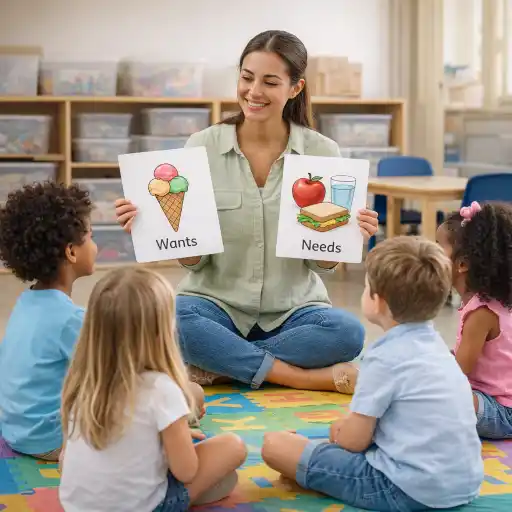
- Picture sort: Invite children to place pictures under “helps us stay healthy and safe” or “something we enjoy.” Include food, water, a blanket, a toy, and a family activity. Ask children to explain their thinking.
- Care-for-a-plant investigation: Talk about what a plant needs, then observe how water, light, and care support its growth. The Illinois Early Learning Project offers teacher-tested ways to introduce needs and resources through investigations and play.
- Pretend classroom store: Use play money and a small selection of classroom items. Ask children what a character might need for a picnic and what the character might also want to bring for fun.
- Enough-for-everyone game: Use a game with a set number of pieces and talk about what is needed to play. For example, “We need four cards of one color; we have three, so what could we do?”
- 🎨 Draw and explain: Children draw one thing people need and one thing they want, then dictate or share a reason with the group.
Adapt materials and questions to children’s abilities and lived experiences. ChildCareEd’s guidance on developmentally appropriate lesson planning emphasizes matching activities to age, individual development, and social and cultural context.
How can teachers respond when a child says, “I need it”?
Begin by recognizing the child’s feeling, then guide reflection. A quick correction—“You don’t need that”—may end the exchange but can also sound dismissive. Instead, try: “You really want the dinosaur. It looks exciting. What do people need to stay healthy? Where might the dinosaur fit?” This keeps the boundary clear while respecting the child’s perspective.
If the answer must be no, explain briefly and consistently: “We are choosing the supplies for our activity today. We can put the dinosaur on our classroom wish list.” Avoid promising a future purchase or using the idea of needs to shame children. A want can be acknowledged even when it cannot be met right now.
Offer small, meaningful choices when possible. A child who cannot choose a new toy might choose which book to read or which color bowl to use in dramatic play. This provides agency without confusing preference with necessity. Sesame Workshop also recommends validating children’s wants, explaining that basic needs are prioritized, and using simple sorting activities to practice the distinction.
- Pause and get down to the child’s eye level.
- Name the want and the feeling without judgment.
- State the need or limit in clear, calm words.
- Offer a realistic alternative, choice, or way to wait.
How can lessons honor family differences and avoid common pitfalls?
There is no single universal list that captures every family’s circumstances. An item may be essential for one person because of health, disability, weather, culture, or access, while optional for another. Glasses, for example, are a need for someone who relies on them to see. A device might be essential for a particular learning task, while a newer model is a preference.
Use examples that do not assume every child has the same home, food, clothing, or resources. Avoid asking children to report what their family can afford, ranking family choices, or describing wants as selfish. Focus instead on a fictional character, a classroom project, or shared care for plants and pets. Invite families to share perspectives only in ways that are comfortable and voluntary.
Common pitfalls include treating every example as absolute, making the lesson a lecture about spending, and expecting children to regulate disappointment immediately. Preschoolers need repeated practice and adult support. Teachers can model flexible thinking: “We need something to keep us warm outside. This sweater works, even if the child wanted the blue one.” Keep the emphasis on understanding, not on judging household decisions.
How can teachers reinforce learning over time?
Return to the vocabulary during routines and play so the concept becomes useful rather than a one-day topic. At snack, discuss what helps bodies feel well. During outdoor play, notice what supports comfort and safety. When a classroom material runs short, talk about resources and alternatives. The Illinois Early Learning Project suggests connecting needs and resources to familiar investigations, such as asking what plants, animals, or classroom tasks require.
Use observations to plan next steps. Notice whether children can name examples, offer a reason, recognize a different perspective, or tolerate a brief wait with support. Some children may show understanding through gestures, pictures, home-language words, or pretend play rather than a verbal explanation. Provide visuals, accessible choices, and additional time as needed.
Partner with families by sharing the classroom language and inviting simple, optional conversations at home. Sesame Workshop’s wants-and-needs resource uses a grocery-store story to make the idea relatable. Keep communication strengths-based: the purpose is to build concepts and language, not assess a family’s spending or circumstances.
Conclusion: What should preschool teachers remember?
Preschool teachers can help children understand wants and needs by offering clear examples, playful practice, thoughtful questions, and compassionate responses. Explain that needs support health, safety, and well-being, while wants are meaningful preferences or enjoyable extras; also show that context can change how an item is understood.
Most of all, acknowledge children’s feelings while helping them think beyond the immediate moment. Short conversations, sorting games, pretend play, and everyday routines build vocabulary and early decision-making without shame. When teachers treat each child and family with respect, the distinction becomes a foundation for curiosity, flexibility, and care for others.
Explore relevant ChildCareEd courses
These English-language courses offer further professional learning connected to developmentally appropriate practice, preschool planning, social-emotional support, and inclusive relationships:
- Social Foundations and Responsive Classrooms Buy Now $24.00 — positive guidance and social-emotional learning.
- DAP for Preschool
 Buy Now $24.00 — applying developmentally appropriate practice in preschool settings.
- Lesson Planning for Preschoolers Buy Now $24.00 — planning intentional, age-appropriate learning experiences.
- Brighter Futures: Social Emotional Development Buy Now $16.00 — understanding children’s emotional development and supportive interactions.
- Family Connections: Creating Inclusive Relationships Buy Now $55.00 — strengthening respectful, culturally responsive family partnerships.
State requirements vary - check your state licensing agency.
- CDA Home Visitor Subject Area 3 Part 3 Birth to 5
- Money Matters in Medicine
- Working Together: Teachers & Preschoolers
- CDA Bridge Bundle: Family Child Care without Portfolio Review
- CDA Bridge Bundle: Infant/Toddler without Portfolio Review
- The Best Promotion is Play
- CDA Bridge Bundle: Preschool without Portfolio Review
- Play, Learn, Grow
- Texas Director Credential
- Every Moment Matters: Schedules and Transitions
- Child Care Professionals
- CDA Certification en Español: Recursos y Consejos para Educadores Bilingües
- Cómo usar tu certificación de 90 horas en Maryland para completar tu CDA
- 10 Ejemplos de Cómo la Cultura Influye en el Desarrollo Infantil
- Child Care Business Broker vs. General Business Broker
- Celebrando la amistad en el cuidado infantil durante el Día de los Mejores Amigos
- Canciones, juegos y preguntas de círculo para niños
- What are the benefits of earning a CDA credential?
- Preschool Curriculum Types: Play-Based, Montessori, Reggio, and More
- Are online CDA classes a good choice for preschool teachers?
- How Do I Become a Pre-K Teacher?
- Training for Preschool Teachers: What Should You Take After You Meet the Minimum Requirements?
- Teacher-Directed or Child-Directed? Finding the Right Classroom Balance
- Teacher-Led vs. Child-Led Activities: What Is the Difference?
- How Can You Spot Leadership Potential in Quiet Preschool Teachers?
- How Can AI Support a Teacher’s Professional Development Plan?
- How Can Preschool Teachers Help Children Recognize When a Friend Needs Help?
- How Can Teachers Help Young Children Understand Similarities and Differences?
- How Can Child Care Providers Tell When a Child Wants Company—but Not Help?
- How Can Preschool Teachers Help Children Understand the Difference Between Wants and Needs?
