When a preschooler can notice “my body needs a pause” and ask for help, a difficult moment can become a chance to build confidence and connection. Teachers can teach this skill through everyday observation, simple language, predictable choices, and calm practice; From Tantrums to Triumphs: Equipping Preschoolers with Self-Regulation Skills Buy Now $25.00 offers a deeper learning experience in supporting coping and self-control. If you want to strengthen your team’s understanding of emotional development as well, explore CDA Subject Area 3  Buy Now $80.00, a 10-hour course focused on children’s social-emotional growth and self-regulation.
Why does recognizing the need for a break matter?
Preschoolers are still developing the language, attention, and emotional skills needed to identify what is happening inside their bodies. A child may not yet say, “I’m overwhelmed,” but may show the need for a pause by withdrawing, becoming unusually restless, covering their ears, or struggling to stay with an activity. These behaviors are useful information—not proof of a diagnosis or deliberate misbehavior.
Helping children notice early signals can make a break more preventive than reactive. A short pause may help a child return to play, participate in a group, or communicate a need before frustration grows. It also respects the child’s agency: rather than expecting young children to keep going until they become distressed, adults show them that noticing and asking for support are worthwhile skills.
Self-regulation develops over time and with adult scaffolding. The Administration for Children and Families recommends warm relationships, calm environments, responsive support, and partnership with parents as ways practitioners can foster these emerging abilities (practitioner tips on supporting self-regulation). In practice, teaching children to ask for a break is part of teaching them how to recognize needs, accept help, and gradually make safe choices. It can also make the #classroom feel more inclusive and predictable for the whole group.
What signals might tell a child that a break would help?
There is no single sign that means every child needs a break. Look for a change from that child’s usual behavior, and consider what is happening around them. Noise, crowding, transitions, a challenging task, fatigue, hunger, or an unexpected change can all affect a child’s capacity to participate. Pay attention to both high-energy and quiet responses.
- Becoming more fidgety, pacing, repeatedly leaving an activity, or having difficulty waiting.
- Turning away, hiding, becoming unusually quiet, or losing interest in an activity they usually enjoy.
- Showing tension through a tight jaw or fists, a raised voice, tears, or a quick increase in frustration.
- Covering ears, squinting, moving away from a busy area, or reacting strongly to ordinary classroom input.
- Using fewer words, repeating requests, or having difficulty following familiar directions.
Use these cues as an invitation to connect and observe, not as a checklist for labeling children. Ask yourself: What happened just before the change? Is the environment demanding? Does the child seem tired, uncomfortable, or unsure what comes next? Could the activity or transition be adjusted?
Record what you see objectively: “After the room became louder, Maya moved away from the group and stopped responding to questions.” Avoid interpretations such as “Maya was being difficult.” Concrete notes help staff and families recognize patterns and identify helpful supports. If a child’s presentation changes suddenly or includes signs of illness, pain, or a safety concern, follow your program’s health and safety procedures rather than assuming a break is all that is needed.
How can teachers teach children to notice and name their signals?
Teach the skill during calm moments, when children can listen, imitate, and try different words or gestures. Start by modeling your own signals in a simple, non-alarming way: “My shoulders feel tight, so I’m going to stretch,” or “The room is noisy; I’m taking a quiet moment.” This shows children that noticing a need is ordinary and that adults use supportive strategies too.
Help children build a small vocabulary for body sensations, feelings, and needs. Use a mirror, picture cards, books, puppets, or a simple feelings chart. Ask concrete questions such as, “Is your body feeling wiggly or still?” or “Would you like help, movement, or quiet?” Accept pointing, gestures, signs, home-language words, or communication devices. A child does not need to explain a complex feeling in order to receive care.
Practice through play and familiar routines. A puppet can show signs of being tired of a noisy game and ask for a quieter choice. After a short movement activity, invite children to notice how their bodies feel. Pair signals with a brief cue children can remember, such as “Notice, name, choose.” Research and professional guidance describe self-regulation as a developing set of skills supported through practice, meaningful choices, and responsive adults.
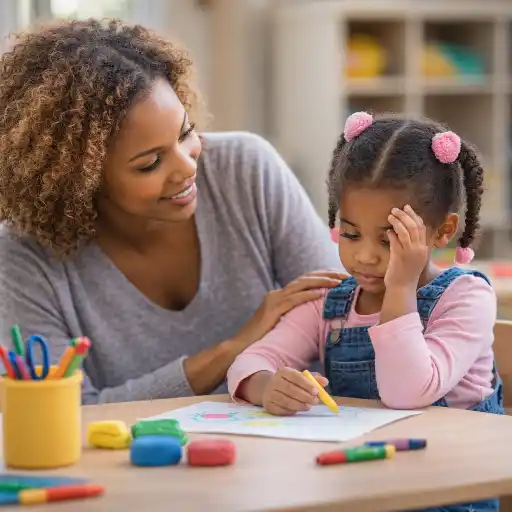 Keep the goal flexible: children are learning to recognize clues, not to match every sensation to one “correct” emotion. Praise the attempt: “You noticed the room felt too loud and showed me you wanted a pause.”
How can a child ask for a break in an age-appropriate way?
Make asking for a break easy and accessible. Preschoolers may use words, point to a picture, hand over a card, make a gesture, or move toward an agreed-upon space. Teach one or two phrases—“I need a break,” “Help, please,” or “Can I have quiet?”—and practice them as part of the daily routine. A small visual card near the meeting area or learning centers can serve as a reminder without requiring a child to speak during stress.
Offer genuine, limited choices when you notice early signs: “Would you like to sit with me or take a quiet pause?” or “Would you like to stretch or look at a book?” Children may need adult help choosing; the purpose is not to make them manage distress independently, but to give them a meaningful role in the next step.
A break can include quiet reading, a few slow breaths, a brief stretch, carrying a light classroom item with supervision, or taking a moment in a supervised calm area. The option should fit the child and the situation. Sensory input that helps one child may be uncomfortable or distracting for another, so observe individual responses rather than assuming a particular tool will work for everyone. For practical professional learning about supportive self-regulation strategies, teachers can explore Self-Regulation & Change: Helping Children Cope Buy Now $16.00.
Explain that a break is a supportive pause, not a punishment and not a way to remove a child from the group for having feelings. Stay within supervision requirements, honor reasonable requests, and help the child return when ready to participate safely. State requirements vary - check your state licensing agency when adjusting spaces, supervision practices, or classroom routines.
How can routines and staff responses make break-taking successful?
Children are more likely to use a break appropriately when adults teach the routine before anyone is upset. Introduce the break choices during group time, model how to use them, and let children practice without pressure. Keep the available options simple and predictable. A visual schedule, transition warning, or consistent signal can also reduce the uncertainty that sometimes makes a pause necessary.
Staff consistency matters. Agree on shared language and response steps so children receive a dependable message from every adult. A useful sequence is:
- 👀 Notice: Describe the observable cue calmly: “Your body is moving a lot, and it looks hard to stay with the puzzle.”
- Connect: Reassure the child: “I’m here. You can ask for a pause.”
- Offer a choice: Present two safe, manageable options without insisting that the child explain.
- Support return: When the child is ready, help them rejoin or choose an appropriate next activity.
Afterward, keep reflection brief and strengths-based: “You asked for quiet, and that helped. What would you like to try next time?” Directors can use staff huddles to practice the script, review what supports children, and make sure a calm area remains voluntary, visible to staff, and safe. Keep the surroundings uncluttered and the choices manageable; a break space should not become another busy center.
Track patterns without turning observation into a judgment. A brief note about the time, routine, cue, offered choice, and outcome can help the team notice whether a certain transition, noise level, or activity needs adjustment. Share observations respectfully with families and invite their insight into what helps at home.
Conclusion: How can teachers help preschoolers recognize when they need a break?
Teachers help preschoolers recognize a need for a break by noticing individual cues, naming body signals and feelings, teaching simple ways to ask, and responding with predictable, respectful choices. Practice the routine when children are calm; keep breaks supportive, safe, and supervised; and coordinate staff responses so children hear the same reassuring message.
- Observe changes in each child’s behavior and the context around them.
- Model and practice words, gestures, or picture cues for requesting a pause.
- Offer a few individualized options and help the child return when ready.
- Use objective notes and partner with families and specialists when concerns persist.
The aim is not to prevent every strong feeling. It is to help children notice what they need, communicate that need, and build self-regulation with caring adult support—one small, practiced pause at a time.
Explore five relevant ChildCareEd courses:
- From Tantrums to Triumphs: Equipping Preschoolers with Self-Regulation Skills Buy Now $25.00
- CDA Subject Area 3 Buy Now $80.00
- Self-Regulation & Change: Helping Children Cope Buy Now $16.00
- The ABCs of Behavior: Turning Challenges into Learning Opportunities Buy Now $55.00
- Every Moment Matters: Schedules and Transitions Buy Now $55.00
- Teacher-Child Interactions for Stronger CLASS® Outcomes
- From Tantrums to Triumphs: Equipping Preschoolers with Self-Regulation Skills
- Moving About the Classroom: Effective Transitions for Everyday
- Pediatric RSV First Aid & CPR/AED
- Working Together: Teachers & Preschoolers
- CDA Bridge Bundle: Family Child Care without Portfolio Review
- CDA Bridge Bundle: Infant/Toddler without Portfolio Review
- CDA Bridge Bundle: Preschool without Portfolio Review
- Texas Director Credential
- Preschool Assessments & Observations
- Confidence Boosters for Preschoolers
- CDA Certification en Español: Recursos y Consejos para Educadores Bilingües
- 🎉STEM-sational Fun: How Can You Spark Preschoolers’ Curiosity with Engaging STEM Activities? 🔬🧪🔢
- Cómo Trabajar en el Cuidado Infantil en Carolina del Norte: Requisitos y Pasos
- How Can DC Child Care Programs Keep Staff During Workforce Shortages?
- How can visuals, routines, and gentle words support Georgia preschoolers with special needs?
- Celebrando la amistad en el cuidado infantil durante el Día de los Mejores Amigos
- Why Do Classroom Management Strategies Fail With 3-Year-Olds—and What Works Instead?
- When Learning Feels Hard: Positive Discipline Strategies for Children Who Struggle
- Why Are Coping Skills Important for Preschoolers?
- How Can Preschool Teachers Recognize and Respond to Sensory Overload in the Classroom?
- How Can Child Care Providers Teach Preschoolers to Manage Big Emotions?
- How Can Preschoolers Learn to Make Safer Classroom Decisions?
- How Can Classroom Awards Celebrate Learning Without Creating Unhealthy Competition?
- How Can You Create a Visual Schedule Preschoolers Will Actually Use?
- How Can You Spot Leadership Potential in Quiet Preschool Teachers?
- How Can Teachers Support Children Who Become Frustrated During Fine-Motor Activities?
- How Can Teachers Help Preschoolers Recognize When They Need a Break?
