A disagreement can leave a child unsure whether they are still welcome in the game—even after the immediate problem is over. With calm coaching, a respectful repair, and an achievable next step, teachers can help children reconnect without rushing or shaming them; the You’re Not My Friend Anymore: Learning Conflict Resolution  Buy Now $16.00 course offers deeper, developmentally appropriate strategies for this everyday classroom challenge.
Why does returning to play matter after a conflict?
Rejoining play is more than returning to a block area or picking up a toy. It gives a child an experience of continued #belonging: a difficult moment does not erase their place in the classroom community. When adults support a safe, respectful return, children can learn that conflict is something people can work through—not proof that they are bad, unwelcome, or permanently “the problem.”
Young children are still developing emotion regulation, language, impulse control, and perspective-taking. After a heated moment, a child may need time before they can listen, explain, or consider a peer’s point of view. A quick apology or immediate return to the same game may not be realistic. The goal is not to get play restarted at any cost; it is to protect everyone’s safety and dignity while making a practical next step possible.
Conflict can also reveal what children need to learn or what the environment might need to change. A recurring dispute over one popular toy, for example, may point to a need for duplicate materials, clearer turns, or additional adult support. NAEYC’s three-step framework recommends describing the behavior, explaining its impact, and helping children choose an appropriate alternative. In practice, teachers can use that guidance while remembering that regulation comes before reasoning.
- Keep children safe and attend to immediate needs first.
- Give each child time to regain #regulation before expecting a conversation.
- Offer a clear, low-pressure path toward repair and participation.
How can teachers help children calm down without isolating them?
Begin by regulating yourself. A calm voice, relaxed posture, and unhurried pace help children feel that an adult is available and the situation can be managed. If children need physical space for safety, separate them gently and stay close enough to supervise. Explain that the pause is for safety and calming—not rejection or punishment.
Use brief, concrete language: “You’re upset. I’m here. I won’t let anyone get hurt.” Avoid a string of questions while a child is crying, shouting, or physically tense. Strong feelings can make it difficult to process complicated language, so a short statement and quiet presence may be more helpful than asking the child to explain everything immediately.
Offer a few familiar options rather than directing the child to a calm space as a consequence. A quiet seat beside a trusted adult, a feelings picture, a familiar book, or a breathing cue may help. Introduce these supports during calm parts of the day so children know what they are and how to use them. Follow each child’s communication style: a gesture, a picture choice, or a few words can be meaningful participation.
- “Would you like to sit near me or have a quiet minute in the calm area?”
- “I can stay with you. We can talk when you feel ready.”
- 🌱 Notice small signs of readiness—slower breathing, relaxed hands, or looking back toward play—instead of expecting instant composure.
Readiness is individual. One child may want to talk right away; another may need time or a brief alternative activity. Staying available communicates connection while maintaining the limit that unsafe actions are not acceptable.
What should teachers say when they revisit the conflict?
Once the children are calmer, describe what you observed without assigning motives or labels. For example: “You pulled the truck from Lee’s hands, and Lee started crying.” This gives children clear language about the event without calling anyone “mean” or “bad.” Add an emotion or need when it seems appropriate: “You really wanted the truck and felt frustrated.” Acknowledging the feeling does not excuse unsafe behavior; it helps a child feel understood enough to consider what comes next.
Invite each child’s perspective with short, open prompts: “What happened?” “What did you want?” or “What would help now?” Give children time to respond. They may need you to model words, offer two choices, or accept pointing and gestures. Avoid turning the conversation into an interrogation or demanding that a preschooler explain why they acted as they did.
NAEYC’s three-step approach offers a useful sequence: state the behavior, explain its implications, and guide an alternative. A teacher might say, “You grabbed the shovel. That surprised Kai and could hurt someone. Next time, you can ask for a turn or ask me for help.” Keep the explanation brief and focused on impact and safety. Head Start’s “problem solving in the moment” resources also emphasize supporting children as they work through social problems as they arise.
- “You both wanted the same truck.”
- “Grabbing can hurt or surprise a friend. You can ask for a turn.”
- “What could we try now so everyone is safe?”
Use language that fits the child’s age, home language, and communication needs. The aim is to help children understand and practice a next step—not to secure a perfect explanation.
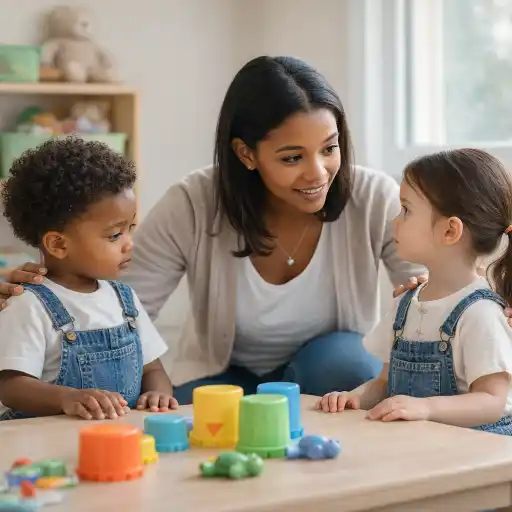
How can teachers support meaningful repair and a safe return?
Repair is not a performance. Requiring a quick “sorry,” hug, or immediate return to shared play may not help children understand the impact or feel ready to reconnect. Instead, offer practical ways to address what happened while respecting both children’s boundaries. A child might return a toy, help rebuild a toppled structure, check whether a peer needs space, or use a kind phrase when ready.
Ask the affected child what would feel helpful, without making them responsible for comforting the other child. Then offer the child who caused harm a small number of realistic repair choices: “Would you like to bring the blocks back, help rebuild, or give your friend some space?” A peer may decline contact, and that choice should be respected. Repair can start with making the space safer or restoring materials; it does not require immediate friendship.
After safety and repair are addressed, make re-entry specific and low-pressure. A child might watch first, take a helper role, join a nearby activity, or return to the original play with a simple plan. For example: “The blocks are ready. You can ask, ‘Can I build here?’ or choose the art table.” Acknowledge the effort you want to encourage: “You helped rebuild and waited while your friend decided what they needed.”
- Offer a few appropriate options; do not demand immediate group participation.
- Check in with both children after play resumes.
- Use repair as a bridge back to community, not a test a child must pass.
Rejoining may take more than one step. Watching nearby or choosing a different center can be a successful beginning, especially when the original game remains emotionally charged.
How can classroom routines make rejoining easier?
When conflict repeatedly happens in the same place or around the same materials, look at the conditions as well as children’s developing skills. Crowded centers, limited high-interest toys, rushed transitions, or unclear roles can make cooperation harder. Observe when and where disputes occur, then consider an environmental adjustment. Prevention is not giving in; it is designing the room so children have a better chance to succeed.
Teach a simple problem-solving routine during calm moments. With pictures, gestures, puppets, or short role-play, practice: stop and get safe, calm the body, say or show what you need, choose a solution, and check whether it worked. Repeat familiar phrases across staff members, such as “Can I play?” “I need space,” and “Can I have a turn when you’re done?” Visuals and communication supports can make the routine accessible to children who use different languages or communication methods.
Directors can help staff respond consistently by agreeing on a few shared phrases and rehearsing examples in team meetings. Families can be partners when teachers describe observations objectively and share the skill being practiced without blame. Brief, confidential notes on recurring patterns can guide a team’s next steps. If behavior is frequent, intense, or unsafe, collaborate with families and appropriate specialists. State requirements vary - check your state licensing agency.
- Make popular play areas spacious and materials easy to access.
- Use timers, turn cards, or role cards when they clarify expectations.
- Practice conflict-solving language with puppets and stories before children need it.
- Review routines and adult responses if the same conflict keeps recurring.
Conclusion: What helps children rejoin play after a conflict?
Children are more likely to rejoin play when teachers first protect safety, support emotional regulation, and then guide a realistic repair and return. Use calm, observable language; allow time; respect each child’s boundaries; and offer specific choices such as watching, helping, joining nearby, or returning to the original activity with a plan.
Most of all, communicate that a child remains part of the classroom community while holding clear limits on unsafe behavior. Consistent practice, accessible communication, and thoughtful room routines make rejoining a learnable process rather than a demand. These steps nurture #belonging, #regulation, #empathy, #repair, and #communication—skills that support relationships well beyond the play area.
For additional professional learning, explore Social Foundations and Responsive Classrooms Buy Now $24.00, which covers social-emotional development, supportive relationships, conflict resolution, and age-appropriate problem-solving. You may also find Teach with Respect ONLINE Buy Now $24.00, Staying Positive: Guidance for Preschoolers Buy Now $24.00, and From Tantrums to Triumphs: Equipping Preschoolers with Self-Regulation Skills Buy Now $25.00 relevant to your professional learning goals.
- Teach with Respect ONLINE
- CDA Family Child Care Credential with Portfolio Review
- CDA Bridge Bundle: Preschool
- CDA Bridge Bundle: Family Child Care
- CDA Bridge Bundle: Family Child Care without Portfolio Review
- CDA Bridge Bundle: Infant/Toddler without Portfolio Review
- CDA Bridge Bundle: Preschool without Portfolio Review
- CDA Bridge Bundle: Infant/Toddler
- Creating Environments that Nurture Growth and Community
- Texas Director Credential
- CDA Certification en Español: Recursos y Consejos para Educadores Bilingües
- Sweet Home Alabama: How Can You Create Classroom Harmony.
- 10 Ejemplos de Cómo la Cultura Influye en el Desarrollo Infantil
- Proporciones de Cuidado Infantil y Tamaños de Grupo por Edad en Virginia (Guía Rápida para Centros y Hogares)
- Cómo Trabajar en el Cuidado Infantil en Carolina del Norte: Requisitos y Pasos
- Celebrando la amistad en el cuidado infantil durante el Día de los Mejores Amigos
- Canciones, juegos y preguntas de círculo para niños
- How can providers coach children through frustration, mistakes, and challenges using developmentally appropriate language?
- Preschool Team-Building Activities for Better Communication and Friendship
- First Week of Pre-K Activities That Help Children Feel Comfortable
- When a Child Refuses to Follow Directions, What Should Teachers Do?
- How Can Farm-Animal Games Build Listening and Vocabulary?
- How Can Teachers Help Two Children Build Together When They Disagree on the “Right” Way?
- How Can Child Care Providers Respond When a Child Publicly Names a Favorite Teacher?
- How Can You Help a Preschooler Recover After a Difficult Drop-Off?
- How Can You Help a Preschooler Rejoin the Group After a Conflict?
- How Can Early Childhood Teachers Encourage Problem-Solving Without Giving the Answer?
- How Can Teachers Help Children Rejoin Play After a Conflict?
