Children learn #emotions, relationships, and self-regulation through hundreds of small interactions each day—not through isolated lessons alone. A thoughtfully selected social-emotional curriculum can help providers create more responsive classrooms, strengthen family partnerships, and make professional practice more intentional; ChildCareEd’s Social Foundations and Responsive Classrooms Buy Now $24.00 course offers practical guidance for applying these ideas and may support ongoing professional learning. For a broader foundation, explore CDA Subject Area 3  Buy Now $80.00, which provides 10 hours of training focused on children’s social and emotional development.
Why does a social-emotional curriculum matter in early childhood?
Social-emotional learning is not an “extra” added after literacy, mathematics, or physical development. It is the relational and regulatory foundation that allows children to participate in all areas of learning. Head Start identifies relationships, emotional functioning, and relationships with other children as central elements of social and emotional development. Children need repeated opportunities to recognize feelings, manage strong emotions, solve problems, cooperate, and seek help. For a broader overview of why social-emotional learning matters in early childhood, read this guide to supporting young learners.
A curriculum gives educators shared language, sequences learning experiences, and reduces the pressure to invent strategies during challenging moments. However, curriculum alone does not create a caring classroom. Blewitt and colleagues’ systematic review found that curriculum-based SEL programs may strengthen responsive teacher-child interactions and classroom management, while evidence about changes in teacher knowledge, self-efficacy, and well-being remains less conclusive. In other words, implementation support matters as much as the lesson materials.
Social-emotional curriculum is especially valuable when it is embedded throughout the day:
- Arrival routines can build trust and belonging.
- Play can provide authentic practice with cooperation and conflict resolution.
- Meals, transitions, and cleanup can reinforce language for feelings and self-regulation.
- Book discussions and role-play can help children consider another person’s perspective.
The goal is not perfect behavior. The goal is to help children gradually develop skills while ensuring that adults respond with empathy, predictability, and appropriate expectations.
How should directors choose a social-emotional curriculum?
Curriculum selection should begin with the needs of the children, families, and educators—not with a popular brand name. The Center for Early Childhood Mental Health Consultation recommends comparing curricula according to factors such as target population, delivery method, evidence, acceptability, and implementation fidelity. Head Start curriculum resources similarly emphasize research basis, scope and sequence, staff support, alignment with learning outcomes, standardized training, and usable materials.
A practical selection process includes these questions:
- Who is the curriculum designed for? Confirm the age range, developmental expectations, language access, and relevance to your program.
- What skills are addressed? Look for balanced attention to relationships, emotional literacy, self-regulation, problem-solving, empathy, and prosocial behavior.
- How will teachers implement it? Examine lesson length, materials, coaching, staff training, and opportunities for practice.
- Does it fit your philosophy? A program should complement developmentally appropriate, play-based, culturally responsive practice.
- How will families be included? Family letters, home activities, multilingual resources, and two-way communication can extend learning beyond the classroom.
- How will progress be monitored? Select methods that support observation and planning without labeling or comparing children unfairly.
Directors should also examine whether the curriculum can be adapted without losing its central components. A rigid program may not fit mixed-age groups, children with disabilities, dual-language learners, or culturally diverse communities. Conversely, excessive adaptation can weaken consistency. State requirements vary - check your state licensing agency before counting a curriculum or related training toward a specific requirement.
What components belong in a high-quality social-emotional curriculum?
A strong curriculum typically combines explicit instruction with daily relationship-based practice. Research reviewed by ERIC identified play-based activities, puppets, stories, role-playing, problem-solving, and family involvement as common features of evidence-based preschool interventions. These approaches are effective because they make abstract skills visible, concrete, and emotionally meaningful for young children.
Core components may include:
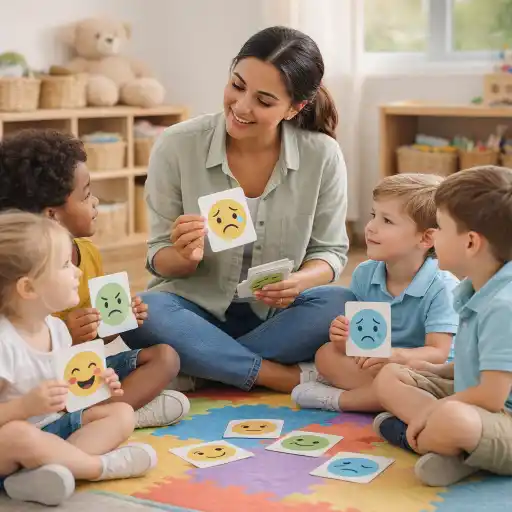
- Emotional vocabulary: Children learn words and visual cues for feelings such as happy, worried, frustrated, disappointed, and excited.
- Self-regulation strategies: Children practice breathing, movement, counting, requesting help, waiting, and using a quiet space with adult support.
- Relationship skills: Lessons address greetings, joining play, listening, turn-taking, empathy, and repairing harm.
- Problem-solving: Children learn to identify a problem, generate possible solutions, consider consequences, and try again.
- Positive guidance: Teachers state clear expectations, model desired behavior, acknowledge effort, and teach replacement skills rather than relying on punishment.
- Family partnership: Families receive accessible ways to reinforce vocabulary and strategies at home.
For infants and toddlers, the curriculum should emphasize consistent caregiving, responsive interactions, co-regulation, and communication through gestures, sounds, and emerging language. Preschoolers can participate in more explicit discussion, role-play, and collaborative problem-solving. Across ages, adults remain the essential model: children learn emotional regulation partly by experiencing how calm, attentive adults respond to stress.
How can teachers embed the curriculum into daily classroom life?
Implementation becomes sustainable when educators treat the curriculum as a framework rather than a set of disconnected activities. Begin with a short, explicit lesson, then intentionally revisit the same skill during routines and play. For example, after teaching children to say, “Can I have a turn?” teachers can model the phrase at the sensory table, prompt it during block play, and acknowledge it during outdoor games.
A useful daily rhythm might include:
- 😊 Connect: Greet each child by name and offer a predictable check-in.
- Teach: Introduce one skill using a story, puppet, picture, song, or demonstration.
- Practice: Provide role-play and play-based opportunities with adult scaffolding.
- Coach: Narrate what children are doing and prompt specific strategies.
- Reflect: Briefly revisit what worked and what children might try next time.
Visual schedules, feeling charts, scripted social stories, and calm-down cards can make expectations accessible, particularly during transitions. CSEFEL resources provide examples of scripted stories, emotion materials, relationship-building tools, and problem-solving supports. These tools should be used proactively—not only after a child is already overwhelmed.
Teachers should also document implementation. A director might observe whether lessons occur as planned, whether adults use shared language, and whether children have opportunities to practice skills across settings. Coaching conversations should be strengths-based: identify an effective interaction, examine one challenging moment, and agree on a manageable next step.
How can programs support individual differences and challenging behavior?
Universal curriculum benefits every child, but some children need additional teaching and individualized support. Behavior has meaning: a child may bite, withdraw, flee, or scream because of communication barriers, sensory overload, fatigue, trauma, developmental differences, or an unmet need. A social-emotional curriculum should help adults investigate the context rather than assume that a child is intentionally defiant.
Use a tiered approach:
- Universal support: Warm relationships, predictable routines, visual cues, explicit instruction, and engaging environments for all children.
- Targeted support: Small-group lessons, additional practice, individualized visual supports, and increased adult coaching for some children.
- Individualized support: Collaborative behavior support plans, functional assessment, mental health consultation, early intervention, or other services when needed.
When a child is dysregulated, prioritize safety and co-regulation. Use a calm voice, reduce language, offer two simple choices, and allow time to recover. Afterward, revisit the event when the child is ready: name the feeling, identify the need, practice a replacement communication, and repair relationships if appropriate. Avoid public shame, forced apologies, exclusionary responses, or expecting a child to use a skill that has not been taught.
Individualization also requires cultural humility. Emotional expression, eye contact, personal space, adult-child communication, and family expectations may vary. Invite family knowledge, use interpreters when appropriate, and ensure that materials reflect children’s languages, identities, abilities, and lived experiences.
How can directors evaluate and sustain a social-emotional curriculum?
Sustainability depends on systems, not enthusiasm alone. Directors can protect implementation by scheduling staff learning, providing coaching, ensuring materials are available, and connecting curriculum goals to program planning. Staff well-being also matters: stressed educators may have less capacity for consistent emotional support, so reflective supervision, adequate breaks, and collegial problem-solving are meaningful components of SEL infrastructure.
Evaluation should examine both child experiences and adult practice. Consider collecting:
- Teacher observations of children’s communication, participation, and problem-solving;
- frequency and quality of adult modeling and emotional coaching;
- family feedback about shared strategies and children’s experiences;
- implementation data, including lesson completion and coaching participation;
- patterns in challenging behavior, transitions, and peer interactions.
Use data to improve instruction, not to rank children or define them by behavior. A team might discover that children understand feeling words during circle but cannot access them during conflicts. The response could be more visual cues, smaller practice groups, adult modeling, or changes to the environment—not simply additional correction.
Review the curriculum at least annually. Ask whether it remains developmentally appropriate, culturally responsive, accessible, and aligned with program goals. The CASEL Program Guide can help teams compare program approaches, implementation supports, training offerings, and evidence indicators. Directors should document decisions, invite educator and family voice, and revise plans based on what children demonstrate.
Conclusion: What makes a social-emotional curriculum effective?
An effective social-emotional curriculum is evidence-informed, developmentally appropriate, culturally responsive, and supported by consistent adult relationships. It teaches concrete skills through stories, play, modeling, practice, and reflection while connecting classroom learning with family partnerships. Most importantly, it does not treat social-emotional development as a response to misbehavior; it builds the conditions in which children can feel safe, belong, communicate, regulate, and learn.
For child care providers and directors, the most practical starting point is to choose one shared skill—such as naming feelings, asking for help, or solving a peer problem—and teach it consistently across the day. Pair that effort with staff coaching, observation, family communication, and individualized supports. Small, repeated moments create a coherent curriculum in action and help children develop the #self-regulation, relationship, and problem-solving abilities they will use throughout life.
Frequently asked questions
Is a purchased curriculum required?
Not necessarily. Programs may use a published curriculum, a locally developed framework, or a combination of resources. The approach should be intentional, evidence-informed, aligned with applicable standards, and appropriate for the children served.
How much time should SEL lessons take?
Brief, repeated lessons are often more practical than long sessions. A short lesson followed by practice during routines and play can be more meaningful than an isolated weekly activity.
What if children are at different developmental levels?
Use the same broad goal with varied supports: gestures and co-regulation for younger children, visual choices for emerging communicators, and role-play or problem-solving scenarios for older preschoolers.
Does teaching SEL eliminate challenging behavior?
No. It can strengthen prevention and provide replacement skills, but children will still experience strong emotions. Persistent or dangerous behavior may require individualized assessment and collaboration with families and qualified specialists.
How can families participate?
Share the week’s feeling words or problem-solving strategy, invite families to describe home practices, provide translated materials, and use two-way communication rather than sending information in only one direction.
- 45 Hour Child Growth and Development
- Social Foundations and Responsive Classrooms
- Children at the Wheel: Emergent Curriculum
- 45 Hour School Age Methods and Materials
- CDA Bridge Bundle: Family Child Care without Portfolio Review
- CDA Bridge Bundle: Infant/Toddler without Portfolio Review
- CDA Bridge Bundle: Preschool without Portfolio Review
- Early Childhood Education
- Texas Director Credential
- Tiny Tots, Big Learning: Crafting Curriculums for the Littlest Learners!
- CDA Certification en Español: Recursos y Consejos para Educadores Bilingües
- A Path to Engaged Learning: Play!
- How the Right Training Turns Child Care Workers into Rockstars
- Cómo simplificar la capacitación para sus empleados de daycare
- How can child care programs best support school-age children’s social and emotional development?
- What Should a School-Age Curriculum Include? A Guide for After-School Programs
- What Is the Difference Between Early Childhood Education and Child Development?
- Happy or Sad? Preschool Activities That Help Children Read Emotional Clues
- How Can Child Care Providers Help New Families Transition into a Childcare Program?
- How Can Childcare Programs Manage Family Complaints Constructively?
- How Can Child Care Providers Teach Problem-Solving Skills in Early Childhood?
- How Can Child Care Providers Create a Positive Classroom Behavior Support Plan Through Curriculum and Play-Based Learning?
- Why Is Social-Emotional Learning at the Heart of 2026 Classrooms?
- How Can Child Care Providers Teach Young Children to Take Turns?
- How Can Child Care Programs Build Effective Emergency Preparedness?
- How Can Child Care Programs Build an Effective Social-Emotional Curriculum?
