Children notice the people who deliver mail, prepare food, repair roads, teach, clean, transport, and care for others—but they need intentional experiences to connect those actions with community well-being. The Curriculum Planning course  Buy Now $24.00 can help you turn children’s questions into developmentally appropriate lessons, aligned learning goals, and meaningful classroom experiences.
For an even broader approach to relationships and social learning, explore Supporting Social Learning: Creating Classrooms that Care Buy Now $35.00. Together, these learning opportunities can strengthen planning, classroom practice, and children’s understanding that everyone can contribute.
Why does learning about community helpers matter in early childhood?
Community helpers are not simply occupations to memorize. They are people whose knowledge, labor, and care help a neighborhood function. When children learn that a baker prepares food, a custodian supports a clean environment, a librarian connects people with information, and a bus driver helps people travel, they begin to understand interdependence.
This learning supports early social studies, language, problem-solving, empathy, and identity development. It also helps children see themselves as capable participants rather than passive observers. A child who returns materials, comforts a friend, waters a plant, or helps set the table is already practicing contribution on a classroom scale.
ChildCareEd’s preschool social science guidance emphasizes belonging, communication, family connections, and civic beginnings. These ideas are especially valuable when providers intentionally represent many kinds of work, including jobs that are often overlooked.
- Build vocabulary for people, places, tools, and actions.
- Strengthen cooperation and perspective-taking.
- Connect classroom responsibilities with real-world contribution.
- Encourage respect without ranking one occupation above another.
How can providers introduce community helpers in developmentally appropriate ways?
Begin with children’s lived experiences. Ask, “Who helps us get what we need?” or “Who helps our classroom work well?” Use photographs, books, real objects, songs, and short conversations rather than long explanations. Young children learn best when ideas are concrete, repeated, and connected to play.
Select a small group of helpers at a time. For toddlers, familiar roles such as caregivers, cooks, delivery workers, health professionals, and custodians may be most meaningful. Preschoolers can expand into librarians, farmers, construction workers, sanitation workers, journalists, artists, and public service workers.
Use a simple framework for each helper:
- Person: Who is the helper?
- Place: Where might the helper work?
- Tools: What materials support the work?
- Contribution: How does the work help people, animals, or the environment?
For example: “A mail carrier delivers letters and packages. The mail carrier uses a bag and vehicle to connect people.” Avoid presenting uniforms or vehicles as the whole meaning of a job. The central concept is service, responsibility, and connection.
Use inclusive language such as “people who care for you” and “people who help in your neighborhood.” Families have different structures and experiences, so avoid assuming that every child has visited a hospital, fire station, or police station.
How can dramatic play make community contributions visible?
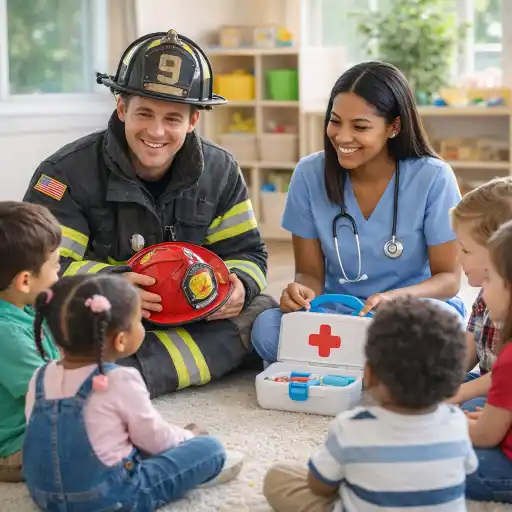 Dramatic play allows children to rehearse social roles, language, cooperation, and problem-solving. A well-planned community helper center does not require expensive costumes. Everyday props, signs, clipboards, envelopes, fabric, boxes, dolls, blocks, and recycled containers can transform a familiar area.
Rotate one or two settings at a time so children have enough time to develop sustained play. Possible settings include:
- 📬 Post office: Children write or draw messages, sort envelopes, and deliver mail to classroom “homes.”
- Clinic or animal hospital: Children care for dolls or stuffed animals, practice comforting language, and organize pretend supplies.
- Bakery or market: Children create menus, count items, exchange play money, and discuss how food reaches families.
- Construction site: Children use blocks, blueprints, measuring tools, and safety signs to design a structure.
- Recycling or sanitation center: Children sort clean materials and discuss how workers care for shared spaces.
Adults should model briefly and then follow children’s ideas. Ask open-ended questions: “What problem are you solving?” “Who needs help?” “What could we try next?” The downloadable Community Helpers Booklet resource can extend role-play into drawing, dictation, and emergent literacy.
How can a community helpers unit connect across the curriculum?
A strong unit is not a collection of unrelated crafts. It is a flexible set of experiences organized around a meaningful question, such as “How do people help our community work?” Curriculum planning guidance recommends beginning with clear objectives, using hands-on experiences, allowing flexibility, and reflecting on children’s responses.
Consider this two-week sequence:
- Week one—notice and name: Read nonfiction and fiction books, study photographs, walk safely around the neighborhood, and create a class list of helpers children recognize.
- Week two—represent and contribute: Build a classroom neighborhood, develop dramatic-play settings, invite family stories, and complete a small thank-you or service project.
Integrate multiple domains:
- Language: Dictate thank-you notes, learn job vocabulary, and retell a helper’s workday.
- Mathematics: Count tools, sort objects, compare quantities, and map routes.
- Science and engineering: Investigate vehicles, ramps, building materials, water systems, or waste reduction.
- Creative arts: Design signs, construct vehicles, create puppets, and dramatize community stories.
- Social-emotional learning: Practice asking for help, cooperating, showing appreciation, and solving problems together.
The sellable resource Community Helpers at Work can serve as a practical activity companion for this sequence. Pair ready-to-use pages with real objects, play, conversation, and child-generated work so the resource supports—not replaces—active learning.
How can providers make community helper learning inclusive and culturally responsive?
Representation communicates who belongs. Review the books, photographs, dolls, posters, and dramatic-play materials in your classroom. Include people of different races, languages, genders, ages, abilities, body types, and family backgrounds. Show helpers in varied settings and avoid implying that one group “owns” a particular occupation.
Include workers whose contributions children may not immediately notice: farmers, food-service workers, maintenance staff, translators, caregivers, utility workers, delivery drivers, artists, office staff, and volunteers. Explain that some work happens inside buildings, some outdoors, and some behind the scenes.
Invite family participation in flexible ways. Families might send a photograph, record a short explanation, contribute a home-language word, or describe an everyday responsibility. Participation should be voluntary, and providers should obtain permission before displaying images or recording children.
Be thoughtful with sensitive roles. Some children may have complicated or frightening experiences with emergency services or public institutions. Focus on safety and support without claiming that every child experiences every helper in the same way. Use language such as, “Which trusted adults can help you in this situation?”
When discussing future careers, avoid limiting children based on gender, disability, language, or family expectations. Emphasize that people can contribute in many ways and that children’s interests may change over time.
How can directors and teachers assess learning and avoid common mistakes?
Assessment should document children’s developing understanding, not test whether they can recite job titles. Observe how children use language, solve problems, collaborate, and represent community roles in play. Collect brief notes, drawings, dictated statements, photographs with permission, and work samples.
Look for evidence that children can:
- Name or describe a helper’s contribution.
- Match a tool, place, or vehicle with a related role.
- Use helping vocabulary during play.
- Recognize that different people contribute in different ways.
- Participate in a classroom responsibility or group project.
Common mistakes include:
- Focusing only on first responders: Expand the unit to include care, food, transportation, maintenance, information, and environmental work.
- Using stereotypes: Offer varied images and explain roles through authentic context.
- Overdirecting dramatic play: Model language, then let children negotiate roles and ideas.
- Relying on worksheets: Balance printable activities with movement, construction, conversation, and real-world observation.
- Forcing family participation: Offer multiple options and protect privacy.
Document reflection after each experience: What interested children? Which vocabulary emerged? Who needed visual, linguistic, sensory, or social support? How can tomorrow’s environment invite deeper inquiry? State requirements vary - check your state licensing agency, especially for visitors, walking trips, photographs, and field experiences.
Conclusion: How can children understand that community helpers contribute?
Children understand community contribution when they can see it, talk about it, act it out, and connect it to their own lives. Begin with familiar people and routines, broaden representation, and use dramatic play and integrated projects to show that communities depend on many kinds of work.
The most effective approach combines intentional planning with child-led exploration. Use Community Helpers at Work as one supporting resource, while prioritizing authentic materials, family knowledge, inclusive books, thoughtful questions, and opportunities for children to help one another.
Start this week by choosing one helper, one contribution, and one classroom action that mirrors the role. A child delivering a note, organizing books, caring for a plant, or helping a peer is not merely pretending to be helpful—they are experiencing what participation in a community can look like.
Frequently asked questions
How many community helpers should we introduce at once?
For younger children, begin with one or two familiar roles. Preschoolers can explore several roles over multiple days, returning to each through books and play.
Do we need visitors or field trips?
No. Photographs, recorded messages, books, neighborhood walks, real objects, and dramatic play can provide meaningful experiences. Follow all safety and permission procedures if visitors or trips are planned.
How can I include children who do not want to role-play?
Offer choices such as observer, photographer, sign designer, map maker, storyteller, materials manager, or helper in a quieter center.
How can I avoid making one child represent an entire culture or occupation?
Use multiple books, photographs, family perspectives, and community examples. Explain that people within any group have varied experiences and roles.
How can directors support consistent implementation?
Provide shared planning time, common vocabulary, inclusive materials, coaching, and opportunities for teachers to review observations together. A clear curriculum framework helps staff connect activities to developmental goals.
- Teach with Respect ONLINE
- Identifying ADHD in Child Care
- 45 Hour Infant and Toddler Methods and Materials
- Pediatric RSV First Aid & CPR/AED
- CDA Bridge Bundle: Family Child Care without Portfolio Review
- CDA Bridge Bundle: Infant/Toddler without Portfolio Review
- CDA Bridge Bundle: Preschool without Portfolio Review
- Texas Director Credential
- Wellness in Action: Teaching Healthy Habits to Children
- Why Celebrate Labor Day?
- CDA Certification en Español: Recursos y Consejos para Educadores Bilingües
- Regulaciones de Licenciamiento de Cuidado Infantil en California para Centros y Hogares de Cuidado Infantil Familiar
- Proporciones de Cuidado Infantil y Tamaños de Grupo por Edad en Maryland (Guía Rápida para Centros y Hogares)
- Proporciones de Cuidado Infantil y Tamaños de Grupo por Edad en Nueva Jersey (Guía Rápida para Centros y Hogares)
- Proporciones de Cuidado Infantil y Tamaños de Grupo por Edad en Virginia (Guía Rápida para Centros y Hogares)
- Cómo Trabajar en el Cuidado Infantil en Carolina del Norte: Requisitos y Pasos
- Cómo Ser Maestra de Preescolar en Virginia
- Capacitación CDA gratuita en Illinois
- Celebrando la amistad en el cuidado infantil durante el Día de los Mejores Amigos
- Cómo simplificar la capacitación para sus empleados de daycare
- Simple Field Trip Ideas Without Leaving the Classroom
- How Can We Teach Young Children About Community Helpers and Work?
- Labor Day Makers: Creative Projects That Get Pre-K Kids Thinking and Building
- Made by Me! Labor Day Crafts for Preschoolers That Celebrate Hard Work
- Social Studies Activities for Toddlers: Start With Home, Helpers, and Their Little World
- How Can Child Care Providers Help Children Understand How Community Helpers Contribute?
- How Can Community Helper Activities Build Career Awareness in Early Childhood?
- How Can a Preschool Community-Helpers Theme Respond to Real Local Needs?
- How Can You Choose a Community Visitor Who Adds More Than a Photo Opportunity?
