Winter math can be more than a worksheet: snowflakes invite children to count, compare, sort, and create patterns with materials they can touch and explore. Try the ideas below to make your preschool math center more engaging and purposeful, and consider Early Mathematics Through Play Buy Now $24.00 for practical strategies spanning number sense, patterns, geometry, and measurement. For an additional play-centered perspective, No Such Thing as Boring Math  Buy Now $24.00 can help you connect children’s exploration with intentional math experiences.
Why does snowflake math matter in preschool?
Snowflake activities make abstract ideas visible. When a child places one counter on each paper snowflake while counting aloud, the child is practicing one-to-one correspondence. When children group snowflakes by size or shape, they are classifying objects and noticing attributes. Repeating these experiences in a playful winter context helps children connect number words, quantities, visual features, and mathematical language.
These invitations can also support attention, fine-motor coordination, communication, and collaboration. Children may use fingers, counters, drawings, or words to show what they know; the educator’s role is to make room for these different ways of thinking. The key is not to make every activity elaborate. A small basket of paper snowflakes, a few number cards, and thoughtful conversation can create a rich learning moment.
- Count objects with one-to-one correspondence and identify the total.
- Compare groups using words such as more, fewer, same, and equal.
- Sort and describe objects by observable attributes.
- Notice, copy, continue, and invent simple patterns.
As described in ChildCareEd’s resource on early math activities and mathematical thinking, math can be woven into play and everyday experiences rather than limited to formal instruction. Snowflakes offer an inviting seasonal starting point.
How can educators set up a snowflake counting invitation?
Prepare paper snowflakes or snowflake cards, numeral cards, and larger counters such as pom-poms or linking cubes. Invite children to choose a snowflake, identify the numeral or quantity shown, and place one counter for each number word. Begin with small sets—perhaps one to three—and expand the range as children show readiness. A ten-frame can provide a helpful visual structure for organizing quantities.
Model counting slowly, touching or moving each counter once. Then ask, “How many are there altogether?” The last number named represents the total, an important idea that children may need repeated opportunities to connect to a set. Avoid rushing to correct; invite the child to recount or show the quantity another way.
- Use reusable counters so children can build, count, and reset the activity.
- Offer number cards in order for children ready to sequence numerals.
- Ask children to show the same quantity with fingers, counters, or a drawing.
- 🧤 Make a “snowflake delivery” game: children carry a card and deliver the matching number of counters to a tray.
For a ready-to-use classroom resource, try ChildCareEd’s Snowflake Match Activity Buy Now $0.00. Keep loose-part size and supervision appropriate for the children in your care, especially with younger children who may mouth materials.
How can snowflakes help children sort and compare?
Offer a mixed collection of paper snowflakes that vary in size, color, or design. First, let children explore freely and suggest their own sorting rules. Then invite them to sort by one attribute at a time: “Can you make a group of large snowflakes?” or “Which ones have the same shape?” This approach encourages children to notice characteristics and explain their reasoning, rather than simply follow an adult’s categories.
After children create groups, bring comparison language into the conversation. Ask which group has more, which has fewer, or whether the groups have the same number. Children can count each group, line up objects to compare them, or add a simple mark to a chart. Sorting can also be revisited with a new rule, helping children recognize that the same collection can be organized in multiple valid ways.
- Sort by one visible feature first, then try a second rule.
- Invite children to explain the sorting rule in their own words or gestures.
- Compare group sizes by matching objects one-to-one or counting.
- Record a class observation with drawings, tally marks, or picture labels.
Where real snow is available and conditions are safe, children might observe flakes on a dark piece of paper. Indoors, printed cards and classroom materials work just as well. A snowflake sorting activity can introduce observation and classification without requiring outdoor snow.
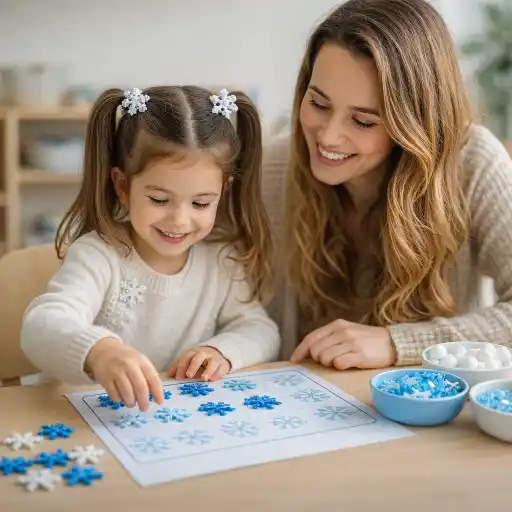
What winter patterns can preschoolers build?
Start with a simple repeating pattern using two colors or shapes: blue-white-blue-white, or large-small-large-small. Use paper snowflakes, cubes, buttons too large to pose a choking risk, or movement cues such as clap-stomp-clap-stomp. Ask children what they notice, what comes next, and how they know. These questions encourage children to identify the repeating unit rather than guess the next item.
Once children can copy a pattern, invite them to continue it or create one for a peer to solve. Some children may benefit from a model that remains visible, while others may be ready to build a pattern from memory or use three elements, such as blue-white-silver. Patterns can be represented with objects, sounds, body movements, or marks on paper, giving children several ways to participate.
- Copy a short AB pattern before asking children to extend it.
- Use pattern blocks to design a snowflake and describe the repeated arrangement.
- Invite children to make a pattern path for a toy animal to follow.
- Extend the challenge by asking, “What would happen if we changed the rule?”
Building snowflakes with shapes can also bring spatial language into play: beside, above, below, and across. ChildCareEd’s Snowflake Symmetry Art Activities Buy Now $1.85 offers a related way for children to notice and represent matching parts. Keep the emphasis on exploration, not identical finished designs.
How can providers adapt activities and observe learning?
Children in one preschool group may be at different points in their mathematical development. Adapt an activity by changing the number of objects, the size of materials, the visual support, or the kind of response expected. A child might point to a group, place counters, use a home-language number word, or explain a sorting rule aloud. These are all useful ways to participate and show thinking.
Observe strategies rather than judging learning by a finished product. Does the child touch each counter once? Can the child tell how many there are after counting? Can the child describe why two snowflakes belong together? A short note or photo can guide what you offer next. For example: “Counted four counters accurately; next, invite the child to match the set to a numeral.”
- Beginning counters: use a few large objects and count together.
- Developing counters: match quantities to numerals and compare groups.
- Children ready for more: build patterns, sort by two attributes, or solve simple “one more” questions.
- For motor access, offer larger pieces, tongs with supervision, or pointing and verbal choices.
Avoid overloading one activity with too many goals or treating speed as evidence of understanding. Keep materials accessible and conversations warm. State requirements vary - check your state licensing agency when connecting activities or training with local expectations.
Conclusion: How can snowflake math make winter learning meaningful?
Snowflake math turns winter-themed materials into practical opportunities to count, sort, compare, and create patterns. Begin with a clear, manageable goal; offer hands-on materials; model a strategy; and invite children to explain or demonstrate their thinking. Repeating these ideas across centers and routines helps children encounter math in varied, meaningful ways.
Most of all, let children’s curiosity lead. A snowflake may become a counter, a sorting clue, or the next piece in a pattern—and each possibility can support mathematical reasoning. For deeper professional learning on playful, developmentally appropriate math, explore Early Mathematics Through Play Buy Now $24.00 and No Such Thing as Boring Math Buy Now $24.00. Small, joyful moments of exploration can build sturdy foundations for future learning.
- Early Mathematics Through Play
- CDA Home Visitor Subject Area 3 Part 3 Birth to 5
- CDA Home Visitor Subject Area 2 Part 3 Birth to 5
- CDA: Stand With Respect and Professionalism
- Birth to Five CDA Credential with Portfolio Review
- Working Together: Teachers & Preschoolers
- Math Foundations in Early Childhood
- Connections That Count: Building Relationships in Child Care
- Texas Director Credential
- 45-Hour Infant and Toddler Curriculum
- Increasing Fine Motor Skills in the Early Childhood Education Classroom
- CDA Certification en Español: Recursos y Consejos para Educadores Bilingües
- 💛🧩 ¿Cómo puedo hacer que mi enseñanza sea inclusiva para los niños con autismo?
- Proporciones de Cuidado Infantil y Tamaños de Grupo por Edad en Maryland (Guía Rápida para Centros y Hogares)
- Proporciones de Cuidado Infantil y Tamaños de Grupo por Edad en Virginia (Guía Rápida para Centros y Hogares)
- Actividades de Otoño Fáciles para Preescolares esta Temporada
- How can I teach colors, shapes & numbers through play in Michigan classrooms?
- Celebrando la amistad en el cuidado infantil durante el Día de los Mejores Amigos
- Canciones, juegos y preguntas de círculo para niños
- Cómo simplificar la capacitación para sus empleados de daycare
- How can I use simple math activities for preschoolers every day?
- How can North Dakota child care providers build number sense in everyday routines?
- How can seasonal activities (spring, summer, fall, winter) combine fun with clear educational goals?
- How can everyday play build number sense in young children?
- STEM for Preschoolers: Fun Activities That Encourage Curiosity
- What’s Happening Outside? Fall Science Adventures for Preschoolers
- Count It, Sort It, Find It! Fall Math Games for Preschoolers
- How Can Child Care Providers Build Halloween Math Around Children’s Play—Without Candy?
- How Can Child Care Providers Keep Toddlers and Preschoolers Active Indoors During Winter?
- How Can Snowflake Math Make Winter Counting, Sorting, and Patterns Fun for Preschoolers?
