Introduction
This short guide helps child care providers and directors learn simple, practical facts about #autism so you can better support children in your care. It is written for busy #classrooms and uses clear steps you can try right away. Remember: state requirements vary - check your state licensing agency.
Why it #matters:
1) Early recognition and support can change a child’s path. 2) Making small classroom changes boosts learning and belonging for everyone. For extra classroom ideas, see How Can You Make Your Classroom More Inclusive for Children with Autism? on ChildCareEd.
What is autism and what should #educators understand?
Autism is a #developmental difference that affects how a child communicates, #plays, and senses the world. Children with autism may:
- Have different ways of using words, gestures, or eye contact.
- Prefer routines and get upset by sudden changes.
- React strongly to sounds, lights, or touch, or seek more movement or pressure.
Key ideas for educators:
- See strengths first: many children with autism have strong interests, good memory, or deep focus.
- Adjust teaching: visual supports, clear language, and predictable schedules help learning.
- Use evidence-based approaches: for classroom and therapy ideas see the CDC treatment overview at CDC: Treatment and Intervention and ChildCareEd resources like Early Intervention Strategies and Services.
Hashtags: #autism #inclusion #communication #sensory #earlyintervention
How can I spot early signs and when should I ask for screening?
Many children show signs of autism by age 2. Watch for delays in talking, repeating words, not pointing to show interest, or not playing #pretend. Also look for strong reactions to sounds or lights.
Steps to take:
- 🟢 Observe and record what you see in simple notes or videos.
- 🔵 Share observations with the child’s family in a caring way.
- 🟡 Suggest screening when concerns appear. The CDC explains screening steps and recommended ages at CDC: Screening for ASD.
Remember: developmental monitoring and screening are different but both matter. The CDC’s Learn the Signs materials help families and providers work together; see CDC Learn the Signs. Act Early.
What #classroom-strategies help children with autism succeed?
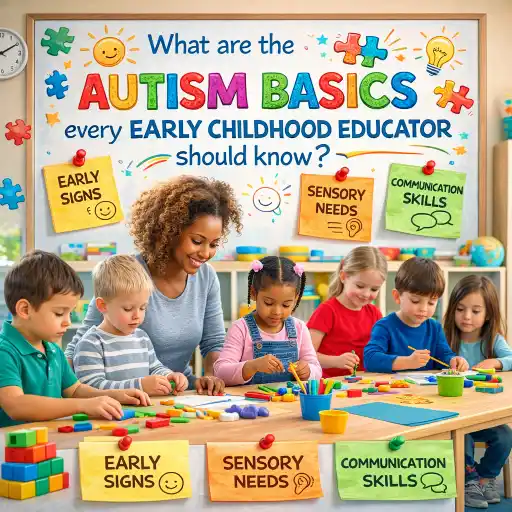
Small changes make a big difference. Try these practical strategies in your program:
- 🎯 Predictability: Use visual schedules and give clear warnings before transitions.
- 🧩 Communication supports: Offer picture cards, simple choices, or assistive devices. For ideas, see ChildCareEd’s resources on communication and play like Play with Purpose
 Buy Now
 $55.00$40.00. - 🛋️ Sensory supports: Provide a quiet corner, headphones, or fidgets for calming. Link sensory needs to routines so all children can use them.
- 🤝 Peer strategies: Teach peers to play and support, using structured small-group activities and role play.
- 📊 Track progress: Use simple data (like how many times a child follows a direction) to see what works.
Common mistakes and how to avoid them:
- ❌ Mistake: Waiting too long to act. ✅ Fix: Share concerns early with the family and suggest screening.
- ❌ Mistake: One-size-fits-all supports. ✅ Fix: Individualize strategies; what helps one child may not help another.
- ❌ Mistake: Blaming the child. ✅ Fix: Look for triggers in the environment and teach replacement skills.
For behavior support planning, see ChildCareEd’s Special Needs in Daycare: Behavior Support Buy Now $0.00 and the CSEFEL brief on Positive Behavior Support at CSEFEL.
How do I work with families and community resources?
Families are partners. Follow these steps to build trust and connect to services:
- 🗣️ Start with listening: Ask what works at #home and what the family worries about.
- 📑 Share clear notes: Give #examples of what you see and possible next steps (screening, referral).
- 📞 Refer and follow up: Help families find local #early-intervention or evaluation #centers. For program ideas and community links, ChildCareEd lists outcomes and resources at List community resources.
- 🔗 Use local partners: Many regions have #assessment clinics and regional centers. The CDC partner toolkit and local resources can guide referrals—see CDC Autism Partner Toolkit.
Keep meetings short, #respectful, and focused on the child’s strengths. Offer to help fill forms or call the referral phone number together. State systems differ—state requirements vary - check your state licensing agency.
Conclusion
Every #early-childhood educator can make a big difference by noticing differences early, using simple #classroom-supports, and working with families. Start with small steps: observe, share, try one new strategy, and track results. For training, consider ChildCareEd courses like Effective Approaches for Autism and Inclusion Buy Now $55.00 or Play with Purpose Buy Now $55.00$40.00 to build confidence and skills.
FAQ
- Q: When should I tell a family about concerns? A: As soon as you have consistent, documented observations. Be kind and factual.
- Q: Does every child with autism need therapy? A: Many children benefit from early supports; discuss options with families and professionals.
- Q: Can inclusive classrooms really work? A: Yes. With planning, peer support, and small adaptations, children with autism thrive alongside peers.
- Q: Where can I learn more? A: Use ChildCareEd courses and CDC materials like Learn the Signs. Act Early.
- 45 Hour Child Growth and Development
- 45 Hour Preschool Methods and Materials
- CDA Family Child Care Credential with Portfolio Review
- 45 Hour School Age Methods and Materials
- CDA Bridge Bundle: Family Child Care without Portfolio Review
- CDA Bridge Bundle: Infant/Toddler without Portfolio Review
- CDA Bridge Bundle: Preschool without Portfolio Review
- Texas Director Credential
- CDA Certification en Español: Recursos y Consejos para Educadores Bilingües
- Bright Futures in Colorado: What Every Early Childhood Educator Should Know
- 😫🧸 ¿Qué hacer cuando un bebé no quiere dormir la siesta en el aula?
- Recursos en Español sobre el Sueño Seguro del Bebé
- How Can Texas Early Childhood Educators Build Strong Communication with Children with Special Needs?
- How Can Child Care Providers Support Children With Special Needs?
- Will DC’s Early Childhood Educator Pay Equity Fund Survive?
- How can North Dakota child care programs best support children with special needs?
- What Counts as Professional Development for Early Childhood Educators?
- When Is Repetitive Speech Typical—and When Should Teachers Pay Closer Attention?
- Free ECE Courses in Canada: Test the Field Before You Commit to a Diploma
- Preschool Teacher Requirements in Florida: Do You Need a CDA, FCCPC, or College Degree?
- Special Needs Training for Early Childhood Educators: Which Course Should You Take?
- How Can Bingo Games Support Turn-Taking and Social Skills?
- How Can Child Care Providers Include Children with Communication Differences?
- Why Do Children Repeat the Same Play—and Why Should Educators Let Them?
- How Can Providers Create an Inclusive Classroom for Every Child?
- What Does a Neurodiversity-Affirming Classroom Look Like?
- What Early Signs of Autism May Child Care Providers Notice?
- How Can Preschool Educators Encourage Learning Through Play?
